AI, Defence, Agri, Trade Top India, Israel Deals

Joint defence roadmap unveiled
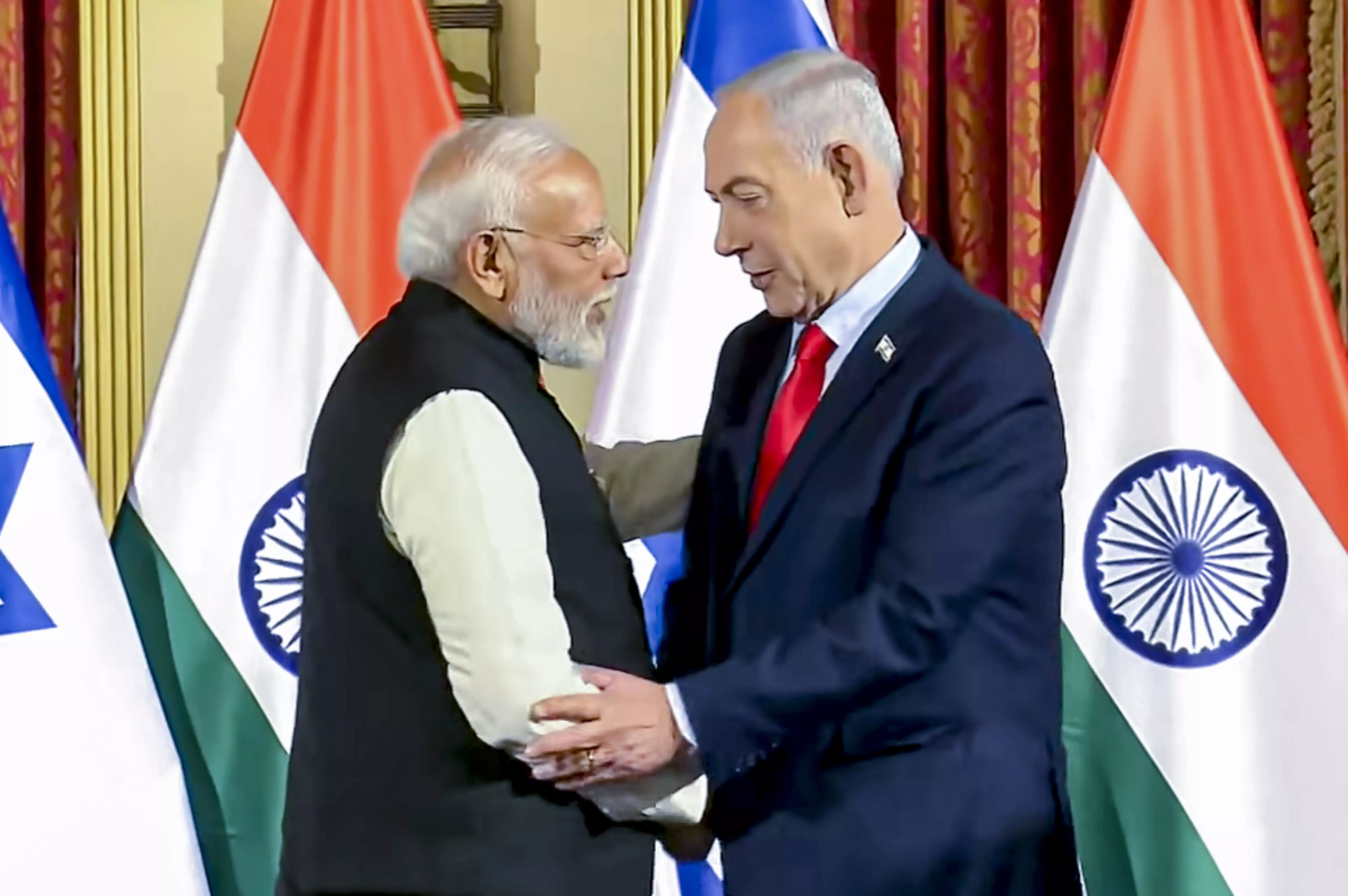
New Delhi:Prime Minister Narendra Modi held delegation-level talks with his Israeli counterpart Benjamin Netanyahu in Jerusalem on Thursday, during which the two sides took what they described as a “historic decision” to elevate their time-tested partnership to a “Special Strategic Partnership for Peace, Innovation and Prosperity.”
Both sides announced 27 outcomes, including 17 agreements and 10 official announcements, and agreed to deepen cooperation across sectors such as defence and security, trade and investment, energy exploration, digital and cross-border payments, critical minerals, innovation, agriculture, fisheries, mobility, people-to-people exchanges, artificial intelligence, quantum technologies, biotechnology, advanced pharmaceuticals, and culture.
At a special media briefing, foreign secretary Vikram Misri said tensions between the US and Iran in West Asia were discussed, with India offering any support required for a peaceful resolution. He also said New Delhi expressed readiness to participate in the reconstruction of Gaza, citing India’s “specific capabilities and capacities.”
In his remarks after the talks, Modi announced the establishment of a Critical and Emerging Technologies Partnership, to be led by the National Security Advisers of both countries, to accelerate cooperation in areas such as AI, quantum technologies, and critical minerals. An agreement was signed on cooperation in mineral exploration using advanced geophysical and AI technologies.
The two sides also agreed to expand the 2023 Manpower Mobility Agreement. The framework, which currently provides employment opportunities for Indian workers in Israel’s construction and caregiving sectors, will now extend to commerce and services, with a quota of up to 50,000 Indian workers over the next five years. Three implementation protocols were signed covering labour mobility in the restaurant, manufacturing, and commerce and services sectors.
“Indian workers have earned trust through their hard work, commitment and skills,” Modi said, adding that people-to-people ties remain a key pillar of bilateral relations.
On regional connectivity, Modi said both sides would advance cooperation under the India-Middle East-Europe Economic Corridor (IMEC) and the India-Israel-UAE-USA (I2U2) framework.
On defence, Modi referred to the bilateral defence MoU signed last year to facilitate joint development, joint production and technology transfer of defence platforms. A Joint Statement said both leaders outlined a roadmap for future defence cooperation, including collaboration in civil nuclear energy and space. India is also exploring Israeli expertise to strengthen its air defence architecture.
On trade, Modi noted that a Bilateral Investment Agreement signed last year would promote mutual investments and announced that the two countries would soon finalise a mutually beneficial Free Trade Agreement. He also said an agreement had been concluded to enable the use of India’s UPI digital payment system in Israel. The two sides decided to institute a financial dialogue and establish a Joint Cyber Centre of Excellence in India to promote cybersecurity best practices and AI-driven education initiatives.
Acknowledging the success of the India-Israel Joint Research Calls (IIJRC), both leaders agreed to increase annual funding contributions from US$1 million to US$1.5 million each to promote joint research between universities.
Agriculture was a key focus area, particularly the use of Israeli technology to benefit Indian farmers. Modi announced that the number of Centres of Excellence established in India with Israeli cooperation would be expanded from 43 to 100. He also said both nations are working to develop “Villages of Excellence” to extend Israeli agricultural technology to rural India, and that an India-Israel Innovation Centre for Agriculture would be established in India.
Both leaders strongly condemned terrorism. Modi said, “Terrorism has no place in the world. In any form or manifestation, it cannot be accepted.” The Joint Statement condemned the October 7, 2023 terror attack on Israel, the April 22, 2025 attack on Indian tourists in Pahalgam, and the November 10, 2025 terror incident near Red Fort in New Delhi.
On Gaza, Modi said peace and stability in West Asia are directly linked to India’s security interests and reiterated India’s support for dialogue and peaceful resolution. The Joint Statement welcomed US President Donald Trump’s “Comprehensive Plan to End the Gaza Conflict” and underlined the need for a just and durable peace.
Netanyahu proposed holding a Government-to-Government (G2G) meeting in India soon to further strengthen bilateral ties. Earlier in the day, Modi visited Yad Vashem, the World Holocaust Remembrance Centre, where he paid tribute to Holocaust victims. He also met Israeli President Isaac Herzog before concluding his visit on Thursday evening.
