Infrastructure Damaged, Transport Halted, Valley Plunged Into Darkness
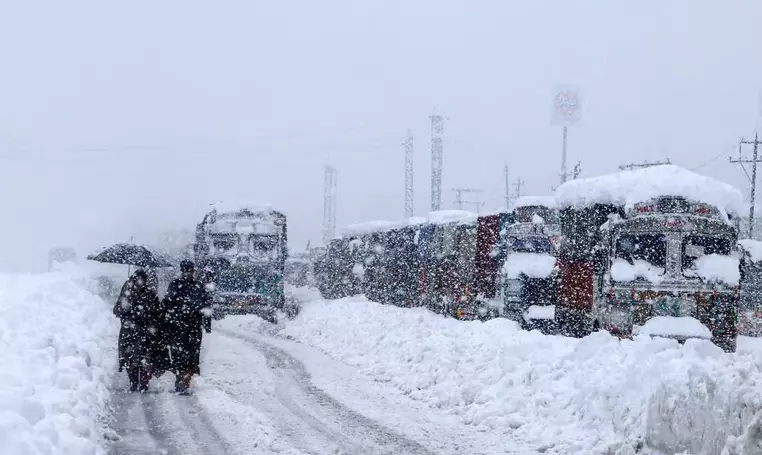
Srinagar: The Kashmir Valley and several other parts of Jammu and Kashmir have been battered by a powerful combination of intense windstorms and heavy snowfall, resulting in one of the most disruptive winter weather events the region has witnessed in recent memory.
Over the course of just two days, the Valley was plunged into chaos as the weather system—driven by successive Western Disturbances—intensified rapidly, bringing life to a near standstill across urban centers, rural belts, and mountainous terrain alike.
As the storm strengthened late on Thursday and continued through Friday, the scenic Kashmir found itself gripped by one of its harshest winter spells in years. Heavy to very heavy snowfall blanketed vast stretches of the Valley, from Srinagar and Budgam to Baramulla, Kupwara, Shopian, Anantnag, Pulwama, Bandipora, and Kulgam.
Capital Srinagar recorded its first major snowfall of the season, with 3–4 inches accumulating across the city, while higher reaches such as Gulmarg, Shopian, and parts of Kupwara were buried under 2–5 feet of snow. In several pockets of southern Shopian and north Kashmir, isolated areas reported accumulations reaching 5–6 feet, much of it falling within a span of just 15 hours. The sudden shift from a prolonged dry spell to intense precipitation dramatically altered the landscape, turning tourist destinations like Gulmarg, Pahalgam and Sonamarg into postcard-perfect winter scenes even as access routes became dangerously obstructed.
Compounding the heavy snowfall were fierce, high-intensity windstorms that swept through multiple districts. These gusts uprooted trees, blew off rooftops, collapsed boundary walls, and caused widespread structural damage in areas such as Srinagar and its peripheries, Tangmarg, Khag, and several villages across central and north Kashmir. Vehicles were damaged and electricity poles snapped under the force of the winds, triggering a cascading collapse of the power grid. At one point, all 33 kV feeders across the Valley were down, causing the active power load to plummet from the usual 1,700 MW to below 100 MW. More than 80 percent of the region was plunged into darkness.
The office of Chief Minister Omar Abdullah wrote on ‘X’, “As per KPDCL, the active power load in the valley is less than 100 MW as against the usual 1700 MW, essentially due to outage of almost all 33KV feeders including those feeding emergency services. Teams are on job for rectification but extensive tree fall on the lines and the windy conditions are major hurdles to be overcome. Damage assessment is underway but would take some time owing to prevailing weather conditions.”
Restoration teams from the Power Development Department were deployed on a war footing, but their efforts were hampered by fallen trees, slippery terrain, and continuing gusty winds that repeatedly damaged freshly repaired lines.
Transport and connectivity suffered severe setbacks. Srinagar International Airport was forced to cancel all flights due to persistent snowfall and near-zero visibility, stranding hundreds of passengers. The Jammu–Srinagar National Highway (NH-44), the Valley’s primary all-weather link to the rest of India, was shut in both directions after heavy snow accumulation and landslide risks along critical stretches such as Banihal, Ramban, Nashri, and the Banihal–Qazigund sector near the Navyug Tunnel.
The Srinagar–Leh highway (NH-1D) was closed at Zojila Pass, while other key routes—including NH-244 (Kishtwar–Sinthan–Anantnag) and the Mughal Road via Peer Ki Gali—were rendered impassable. Despite the widespread disruption, the Katra–Srinagar Vande Bharat Express continued to operate, with railway staff working round the clock to clear snow from tracks and maintain essential connectivity, officials said.
In Jammu’s higher reaches, including Poonch, Udhampur, and the area around the Mata Vaishno Devi shrine, moderate to heavy snowfall blocked several roads and triggered rescue operations that saved more than 100 stranded individuals. The Jammu plains experienced moderate rainfall, adding to the region’s weather-related challenges.
The India Meteorological Department issued a series of alerts, including a heavy snowfall warning for January 22–23 and an orange alert for gusty winds, thunderstorms, and possible hailstorms across parts of the Pir Panjal range, Chenab Valley, and south Kashmir. Forecasts indicated wind speeds of 40–50 km/h and fresh snow accumulation of 2–10 cm in many areas, along with heightened avalanche risk in higher reaches. Temperatures across the Valley and Ladakh were expected to plunge to between −2°C and −8°C, deepening the cold wave. While the current intense phase of the disturbance began to ease, another active Western Disturbance was projected to affect the region between January 26 and 28, potentially bringing additional precipitation.
Authorities have urged residents to remain indoors during periods of high wind, avoid unnecessary travel—especially toward higher elevations—and adhere strictly to traffic and weather advisories. With power restoration, road clearance, and essential services still facing significant challenges, officials emphasised patience and caution. Chief Minister Abdullah acknowledged the widespread destruction but noted that gradual improvements were underway, with priority being given to restoring electricity, reopening major roads, and ensuring the safety of residents.
Despite the hardships, the heavy snowfall has offered some long-term benefits, including replenishing water resources and supporting agricultural needs for the coming seasons. For now, however, the Valley continues to grapple with the immediate aftermath of a storm that has tested the resilience of its people and infrastructure.

