Why Early Trends Can Be Misleading on Counting Day

4 May 2026 11:44 AM IST4 May 2026 11:44 AM IST
Early trends in India Assembly Election 2026 counting day are often misleading as partial results, postal ballots, and round-wise updates can change final outcomes significantly.
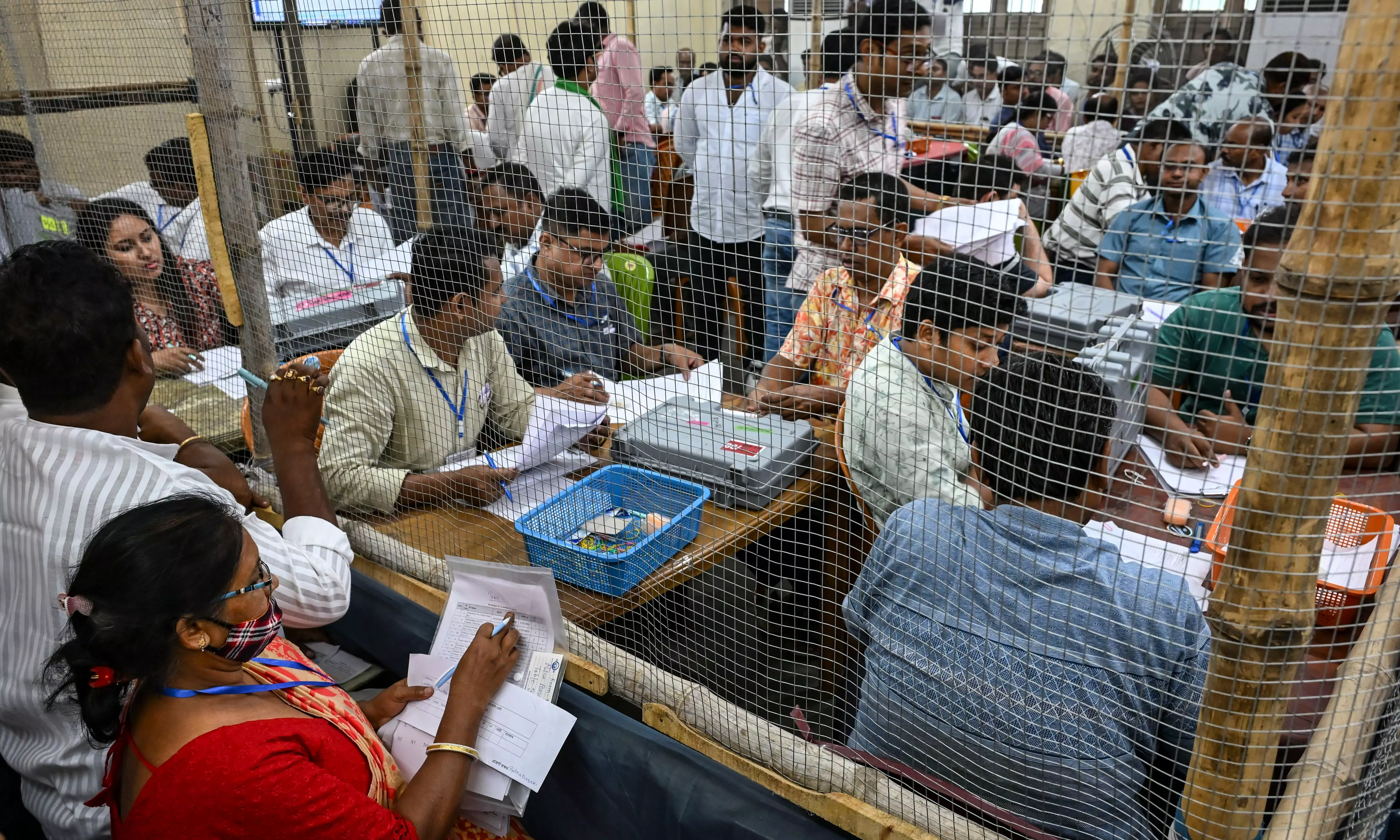
Officials count postal ballots at a counting centre during the West Bengal Assembly election results day, in Ranaghat, Nadia district, West Bengal, Monday, May 4, 2026. (PTI Photo)
As counting of votes is underway in the Assembly elections across five Indian States/Union Territory, including West Bengal, Tamil Nadu, Kerala, Assam and Puducherry, early trends emerging from counting centres are being closely tracked by political parties, media networks and the public.
However, Election Commission procedures and past electoral counting patterns clearly show that early trends during counting day are not final indicators of results and can often change significantly as counting progresses.
Counting Process Begins With Partial Data
According to the Election Commission of India (ECI) counting framework, vote counting begins at 8 AM and is conducted in multiple structured rounds.
The process typically follows this order:
- Postal ballots are counted first
- EVM votes are counted in successive rounds across counting tables
- VVPAT slips are verified in selected booths as part of mandatory cross-checks
- Because of this structure, early trends reflect only partial data from limited booths and postal ballots, not the complete electorate.
Early Leads Can Shift in Later Rounds
Election counting in India is conducted constituency-wise, and results are updated after each round. Each round may include votes from different polling stations.
This creates a situation where:
- Early rounds may show a temporary lead for one party or candidate
- Later rounds, covering different geographic or demographic sections, may reverse that lead
- Urban, rural, and high-turnout booths often get counted at different stages
- As a result, initial leads are not stable indicators of final outcomes.
Postal Ballots Can Distort Initial Trends
Postal ballots are counted first as per procedure. These include:
- Service voters (armed forces, government officials on duty)
- Absentee voters under specific categories
- Since postal voting patterns can differ from EVM voting patterns, early leads based on postal ballots may not reflect broader voter preference across the constituency.
Partial Counting Across Constituencies
With counting taking place simultaneously across hundreds of constituencies in five regions, early trends are often compiled from incomplete data sets.
This means:
- Some constituencies may report multiple rounds early
- Others may be delayed due to verification or logistical sequencing
- Aggregate “state-level trends” can shift rapidly as more tables report results
Media Trend Reporting Is Not Final Result Reporting
News channels and digital platforms often display “live trends” during counting day. These trends are:
- Based on ongoing updates from counting centres
- Subject to frequent revision
- Not certified results from the Election Commission
- The ECI declares final results only after completion of all counting rounds and verification procedures.
Final Results Only After Full Verification
The Election Commission of India confirms results only after:
- All EVM votes are counted across all rounds
- Postal ballot counting is fully reconciled
- VVPAT verification is completed where required
- Until this stage is completed, any lead shown in early trends remains provisional and subject to change.
Conclusion
Early trends on counting day in the ongoing Assembly elections across five states and Union Territory serve as real-time indicators of counting progress, not final outcomes.
Due to partial booth coverage, postal ballot sequencing, and round-wise reporting differences, these trends can fluctuate significantly before final results are officially declared by the Election Commission.
In electoral counting, only the final certified result reflects the true mandate of voters.
( Source : Deccan Chronicle )

Next Story