Why are IndiGo Flights Getting Delayed and Cancelled?

5 Dec 2025 7:30 PM IST5 Dec 2025 7:30 PM IST
The airline operates over 2,200 flights within the country and to international destinations every day — about twice that of its nearest competitor.
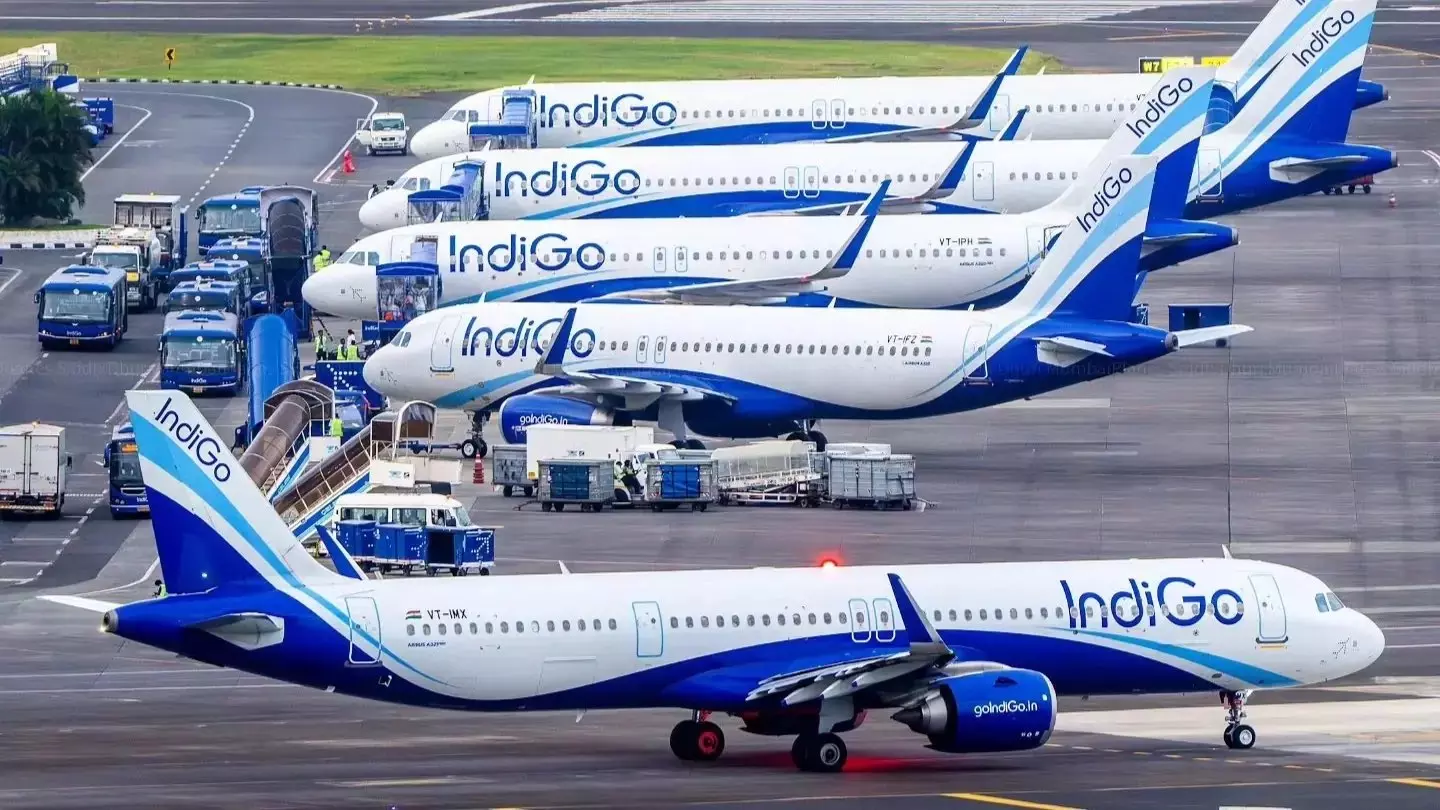
Representational Image/X
An unprecedented wave of flight disruptions has hit India's leading airline, IndiGo, nationwide. Hundreds of flights have been delayed or cancelled, leaving at least a few thousand passengers stranded at airports from New Delhi to Bengaluru to Hyderabad. What's behind the chaos — and can travellers expect respite soon?
What Went Wrong?
The new regulations affecting the resting hours of crew, prescribed by the national regulator DGCA, are at the core of the turbulence. Flight Duty Time Limitations, or FDTL, is the updated set of rules requiring flight crews to take longer rest periods. Night landings have been capped, and the number of night shifts drastically reduced, while maximum duty hours have also been limited.
While the regulations aimed at reducing pilot fatigue to improve safety, the timing could not have been worse for IndiGo. It had traditionally built its schedules around high-frequency overnight operations, minimal downtime between flights, and a lean crew roster of which conflicted directly with the new norms. Hence, many flights were either scrubbed or delayed: in the past 48 hours alone, more than 300 flights were cancelled nationwide.
Why IndiGo Was Hit Hardest?
The disruption has been particularly overwhelming for IndiGo because of its scale of operations. The airline operates over 2,200 flights within the country and to international destinations every day — about twice that of its nearest competitor.
For an airline of this scale, even a 10–20% crew shortage or scheduling disruption means hundreds of flights. The company’s model — built on maximising aircraft utilisation and minimising downtime — made it especially vulnerable to stricter crew rest requirements.
Industry players and pilot associations have highlighted the fact that IndiGo had sufficient time—almost two years after the FDTL norms were announced—to make necessary adjustments in its staffing. However, instead of ramping up manpower, the airline continued with what some said was a “lean manpower strategy,” even resorting to issuing a hiring freeze and imposing non-poaching agreements.
Image:X
Consequences and Fallout.
The immediate consequence has been chaos at airports: long queues, frustrated and stranded passengers, and serious breakdowns in IndiGo's famed on-time performance. Industry data show the airline's punctuality fell sharply: an above 80% OTP in October slipped to around 35% on December 2, the lowest among Indian carriers.
Against this backdrop of disruption, two pilot organisations-the FIP and the Airline Pilots' Association of India-have come out with scathing criticisms. They have gone on to claim that such a crisis could and should have been avoided and that IndiGo's staffing practices and "cost-first" culture caused the crisis. Some even view it as an attempt to use the disruption as a bargaining chip to secure relaxations of FDTL norms.
What Needs to Change?
Many feel that for long-term stability, airlines must adopt crew planning practices that anticipate regulatory shifts - not just chase ever-higher aircraft utilisation. As FIP (Federation of Indian Pilots) has pointed out, regulators should only grant flight slots when airlines prove they have adequate pilot strength under the new rest norms.
Now, IndiGo needs to regain the faith of its passengers and flight crew. Building a strong team of pilots with revised rosters and better workforce management will help restore both reliability and morale. Tourists across India grimly think that in aviation, safety rules and the scale of operations have to be balanced carefully, not traded off for cost savings.
The article has been authored by Siftpreet Kaur, an Intern at Deccan Chronicle
( Source : Deccan Chronicle )

Next Story