US Museum Unveils Unique Exhibition Featuring 100 Prints of Hindu Gods

7 March 2026 11:17 AM IST7 March 2026 11:17 AM IST
Curated by John Guy, the exhibition features works from famous studios in Calcutta, Poona, and Bombay, highlighting the shift from traditional religious icons to affordable prints that changed household worship in India.
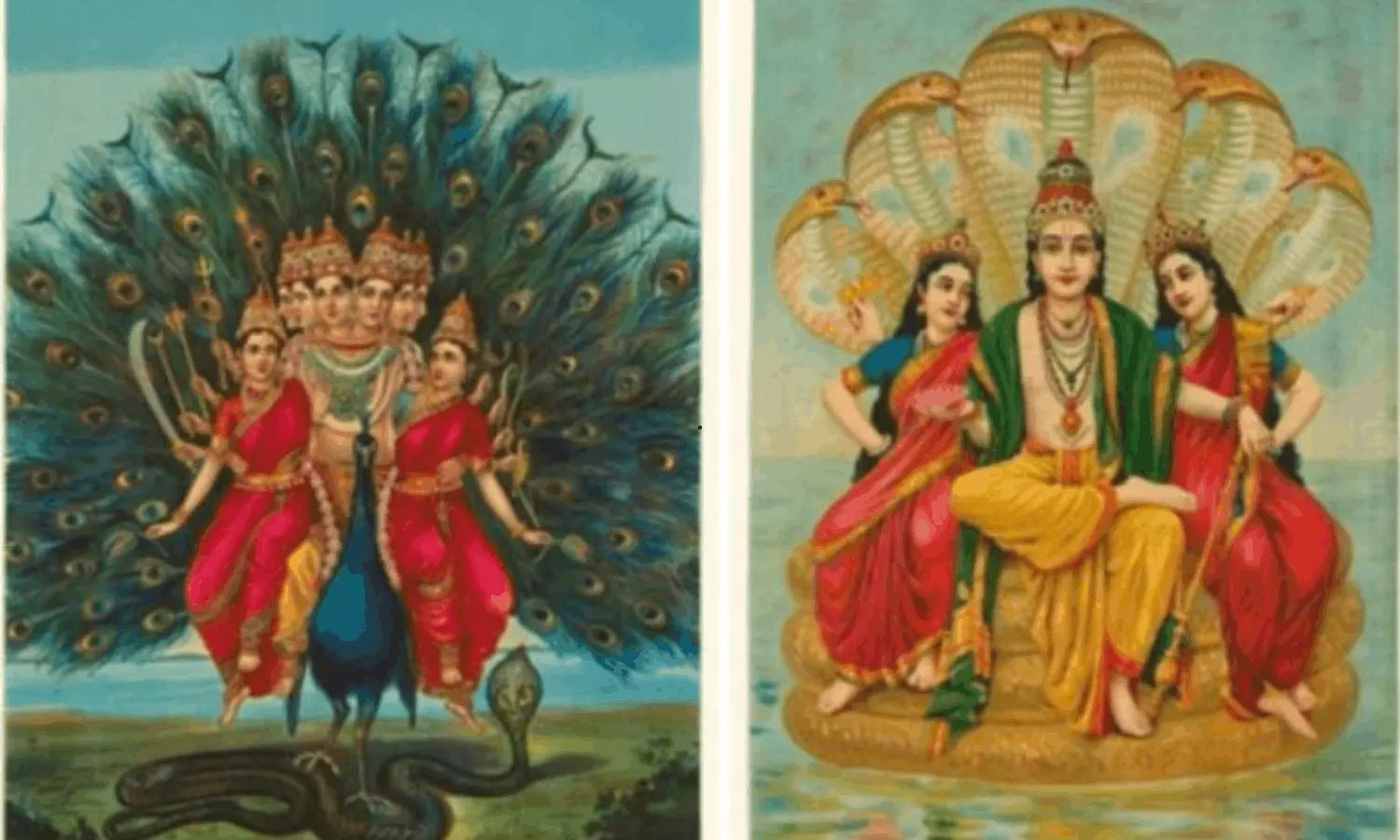
Print of the Hindu Gods (Image/The Met)
New York: Over 100 images of Hindu Gods, curated from collections dating 1860 to 1930, are being displayed at a special exhibition at the prestigious Metropolitan Museum of Art (The Met) here.
The Metropolitan Museum of Art is presenting the exhibition 'Household Gods: Hindu Devotional Prints, 1860–1930' on view in four rotations beginning January this year through June 27, 2027, the museum said in a statement.
The exhibition presents over 100 works drawn from The Met collection, focusing on acquisitions from the past decade, presented in dialogue with select works of earlier painting traditions.
'Household Gods: Hindu Devotional Prints, 1860–1930' presents the "first encyclopedic exhibition of these chromolithographic prints from the pioneering studio presses of Calcutta (Kolkata), Poona (Pune), and Bombay (Mumbai).
These mass-produced prints became a powerful means of expressing Indian religious identity at a time when the country was experiencing the first stirrings of the Independence movement," the museum said.
Featuring approximately 120 works, shown in four rotations, from The Met's collection of chromolithographic prints, along with paintings and portable triptych shrines, Household Gods provides a "unique window on the vibrant tradition of Indian devotional imagery on the cusp of modernity".
The exhibition is made possible by the Florence and Herbert Irving Fund for Asian Art Exhibitions and is curated by Florence and Herbert Irving Curator of South and Southeast Asian Art at The Met John Guy.
"Celebrating the gods through imagery is central to all religions, and nowhere more so than in Hinduism, where the communion between deity and devotee takes on a heightened immediacy and reality through the concept of 'darshan', "seeing God"," the statement said.
"The necessity of displaying an image of the divine in the home, located in the household shrine, was traditionally fulfilled by icons made of clay or metal," it said.
However, the invention of photography in the mid-19th century and its rapid introduction in India "fatally disrupted" traditional painting and the production of painted religious images that were used by Indian elites, the statement added.
"Soon after, however, with the arrival of new lithographic printing technologies from Europe in the 1880s, another revolution occurred in the world of religious painting: the mass production of inexpensive chromo-lithographic prints (oleographs) of the Hindu gods for widespread consumption.
"For the first time in India, even the humblest home could afford a colourful icon of their chosen god to display in the household shrine," it said.
The Met said that the exhibition introduces the "little-known" last chapter of traditional Indian painting and its "role in the popular worship of the Hindu gods".
It spans from the early hand-coloured woodblock prints produced in the Battala district of Calcutta in the first half of the 19th century-such as The Met's relief print celebrating the goddess Durga-to the "astonishing images of Kali as worshipped at the Kalighat temple in south Calcutta, as seen in The Met's Sri Sri Kali.
"Among the most revolutionary prints produced on the new lithographic presses was the set of 10 Mahavidyas, tantric aspects of the goddess, produced by the Calcutta Art Studio Press around 1885–95.
"The goddesses were paired, two per sheet, and inscribed in both Bengali and English. The powerfully evocative portrait-like work depicting Shiva as Lord of the Universe in Benares, Kashi Vishvanatha, underscores the quality of artists employed in much of the production," it said.
Further, it said that among the highlights of the later works was the "chromatically rich imagery" produced by the Ravi Varma Press, epitomized by the "radiant six-head Subramanian, Shri Shanmukha Subramania," the statement said.
Coinciding with the exhibition, the Met will host a lecture on the 'Arts of South and Southeast Asia: Gods at the Gate of Modernity-Religious Arts in Colonial Calcutta' on March 20 by Research Professor of Religion, Bard College, New York Richard Davis. India's Consul General in New York Binaya Pradhan will give opening remarks at the lecture.
"In Calcutta, the cosmopolitan colonial capital of 19th-century India, artists and artisans adapted new technologies of mechanical reproduction to render the Hindu gods more accessible and affordable.
"During this time, they pioneered the chromolithographic religious print, a form of popular devotional imagery that became ubiquitous in twentieth-century India. This lecture explores how this new genre emerged and proliferated into the pervasive visual language of modern India," the Met said.
( Source : PTI )

Next Story