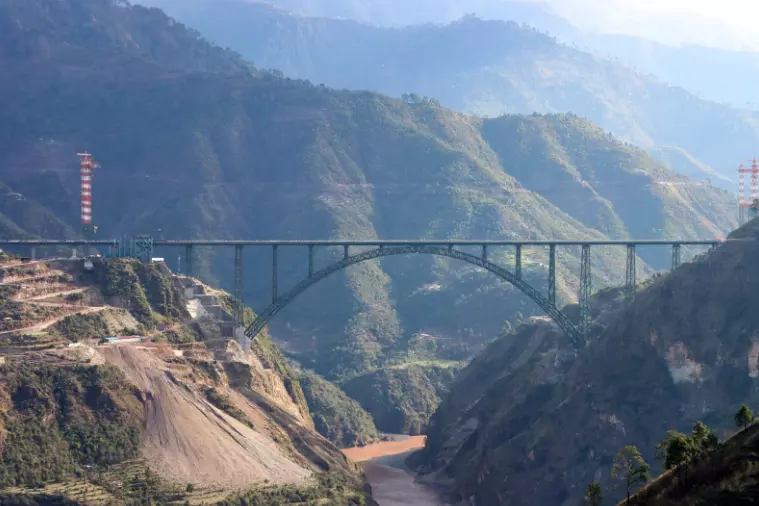
Inaugurated on June 6, 2025, the bridge is not just a record-breaker in height; it’s also a triumph of intelligent engineering in one of the most geologically challenging terrains on Earth.
Standing 359 meters above the Chenab River in the Himalayas, the bridge is built on mountains made of dolomite — a soft rock prone to cracking and landslides. To overcome this, engineers reshaped the mountain slopes using controlled blasting (pre-splitting) and stabilized them with steel anchors, cement grouting, and shotcrete (sprayed concrete).
One of the greatest engineering challenges was the 915-meter gap between the mountains, too wide for regular cranes. The solution? Engineers erected two towers, each over 100 meters high, and stretched strong cables between them. Using these, cable cars ferried heavy steel components, which were assembled mid-air. Over 600,000 nuts and bolts were used to construct the massive steel arch, and precision hydraulic jacks ensured both halves of the bridge met flawlessly.
Located in a seismic zone, the bridge was built to withstand earthquakes up to magnitude 8. It features spherical bearings — large ball-and-socket joints — that allow controlled movement, and expansion joints that let the bridge safely expand or contract with temperatures ranging from –20°C to +50°C.
The bridge also uses a ballastless track system, where rails are placed on concrete slabs rather than gravel. These sit on shock-absorbing pads, enabling trains to travel safely and smoothly even at high altitudes.
Designed to endure for over 120 years, the Chenab Rail Bridge can withstand wind speeds up to 266 km/h and blasts equivalent to 40 tons of TNT. With this, trains can now run year-round between Kashmir and the rest of India, regardless of snow or severe weather.
More than just infrastructure, the Chenab Bridge is a symbol of India’s engineering excellence and national integration, bridging not just mountains, but people and progress.
The article is authored by Kanishka Yadav, an intern from IIT Hyderabad