Strategic Communication Key To Promoting Sustainable Mass Transit: PIB ADG Akhil Mishra

UMI Conference roundtable stresses public trust, inclusive outreach and behavioural change: Reports
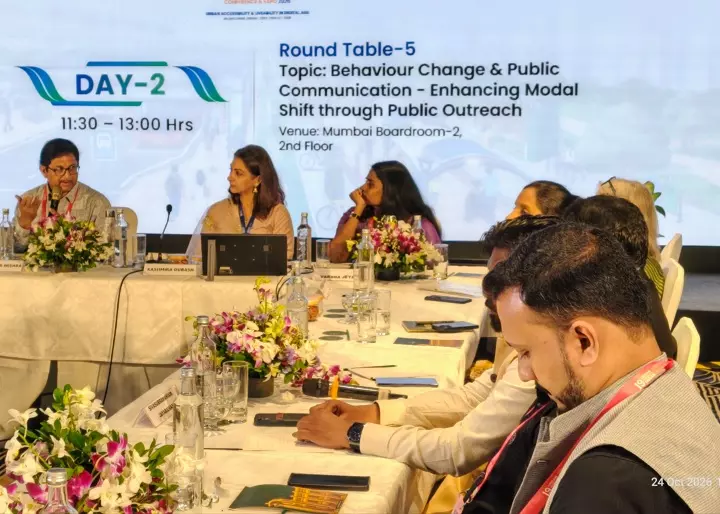
BHUBANESWAR: Strategic public communication and sustained behavioural interventions are essential to reducing dependence on private vehicles and accelerating the shift towards sustainable mass transit, Akhil Kumar Mishra, Additional Director General (ADG) of the Press Information Bureau (PIB) and Central Bureau of Communication (CBC), Bhubaneswar, said on Saturday.
Chairing a roundtable on “Behaviour Change and Public Communication – Enhancing Modal Shift through Public Outreach” on the side-lines of the 19th Urban Mobility India (UMI) Conference and Exhibition 2026, Mr. Mishra said infrastructure development alone could not transform urban mobility without public trust and effective outreach.
The panel emphasised that public communication must become an integral part of urban transport planning rather than remain a routine administrative exercise. With cities facing rising pollution, climate challenges and traffic congestion, experts stressed the need to make public transport an attractive and convenient option through reliable real-time information on timetables, ticketing, interchanges and last-mile connectivity.
Mr. Mishra said the effectiveness of public engagement depended on the “intention and intensity of communication”. Genuine efforts by policymakers and implementing agencies to connect with citizens were essential to building institutional trust, he observed.
Drawing a parallel with the ancient Indus Valley Civilization, he cited its standardised systems, visual symbols, planned settlements and shared public spaces as examples of coherent civic organisation. He urged modern urban planners to incorporate similar principles of clarity and accessibility into public communication and transport systems.
Highlighting the human dimension of mobility, Mr. Mishra said public transport connected people with livelihoods, education and communities, making it more than merely a means of travel.
He also called for eliminating “information shadows” in cities, warning that residents of slums, informal settlements and peripheral areas often lacked timely information despite expanding digital infrastructure. He urged urban authorities to adopt inclusive, hyper-local communication strategies to ensure that no community was left behind.
The session was moderated by Kashmira Dubash, Deputy Director at the Institute for Transportation & Development Policy (ITDP).
The panel included Dr. V.P. Jeyaseelan, Sivasubramaniam Jayaraman, Cornelia Stolzenberg of GIZ’s EASE project, Anuj Dayal of the Delhi Metro Rail Corporation, Harpreet Bagga of Purpose, Abhijit Lokre, Kumar Manish, Asish Kumar Patra and Varsha Jeyapandi.
