INDIA Bloc Tested as Stalin and Mamata Lose Ground

4 May 2026 12:32 PM IST4 May 2026 12:32 PM IST
n West Bengal, the Trinamool Congress has long been the backbone of opposition politics. Led by Mamata Banerjee, it was seen as one of the strongest regional forces capable of countering the BJP’s expansion. But the current trends suggest that the party is facing a far tougher fight than expected.
DC Image
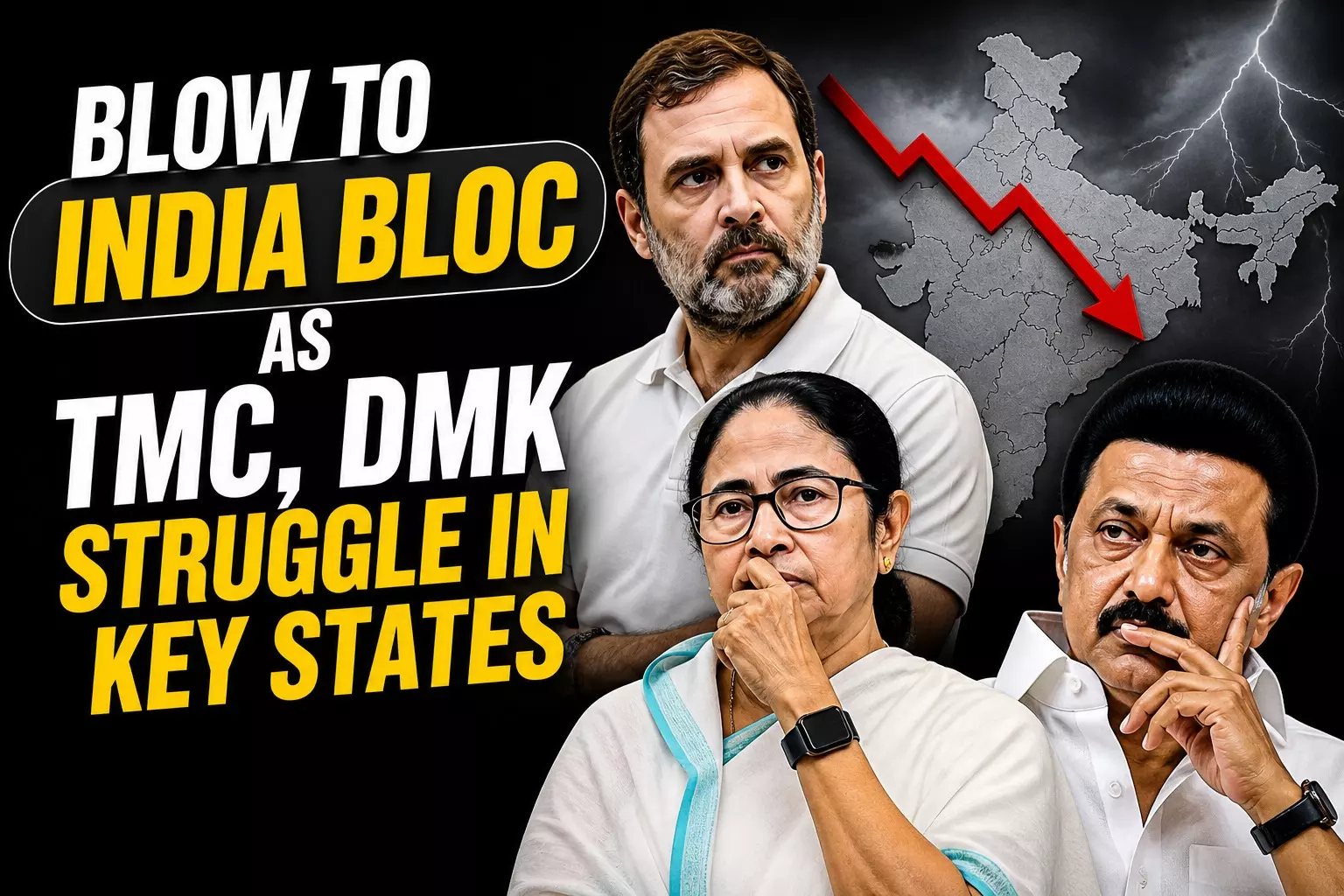
The idea of the Indian National Developmental Inclusive Alliance was built on one simple belief. That a united opposition could take on a powerful national ruling party by combining regional strength across states. But early trends from key battlegrounds are now raising serious questions about how strong that unity really is, especially with the weakening position of the All India Trinamool Congress and the Dravida Munnetra Kazhagam.
In West Bengal, the Trinamool Congress has long been the backbone of opposition politics. Led by Mamata Banerjee, it was seen as one of the strongest regional forces capable of countering the BJP’s expansion. But the current trends suggest that the party is facing a far tougher fight than expected. This does not just affect the state. It sends a signal across the national political space that even strong regional players are not immune to shifting voter moods.
A similar concern is emerging in Tamil Nadu. The DMK, under M. K. Stalin, has been a key pillar of the opposition alliance. Its strength in Tamil Nadu gave the bloc both numbers and credibility. Now, with the contest appearing tighter and new players entering the field, there is growing uncertainty about how solid that support base remains.
The impact of these developments goes beyond individual states. The INDIA bloc depends heavily on regional parties to deliver seats from their respective strongholds. If two of its most important partners begin to lose ground at the same time, the overall structure of the alliance starts to look fragile. It raises doubts about coordination, strategy and the ability to present a united front.
For the BJP, this situation opens up opportunity. A divided or weakened opposition makes it easier to expand influence into states where regional parties once dominated. The narrative also shifts. Instead of a strong coalition challenging the centre, the focus moves to whether the opposition can even hold its ground.
That said, it is still early in the counting process and political trends can change quickly. Regional parties have shown resilience in the past and have often bounced back from difficult moments. But the current signals are hard to ignore.
What is unfolding now feels like a stress test for the INDIA bloc. Its strength lies in unity, but unity depends on the performance of its key players. If parties like the Trinamool Congress and the DMK struggle to maintain their dominance, the alliance will have to rethink its approach.
For now, the message from the ground is clear. The opposition’s biggest challenge may not just be taking on the BJP. It may be holding itself together when its strongest pillars begin to shake.
( Source : Deccan Chronicle )


Next Story