Srinagar Jama Masjid Witnesses First Jumat-Ul-Vida Congregation in 7 Years

Had been placed under house arrest early in the morning, with police personnel deployed in large numbers outside his Nigeen residence: The Mirwaiz
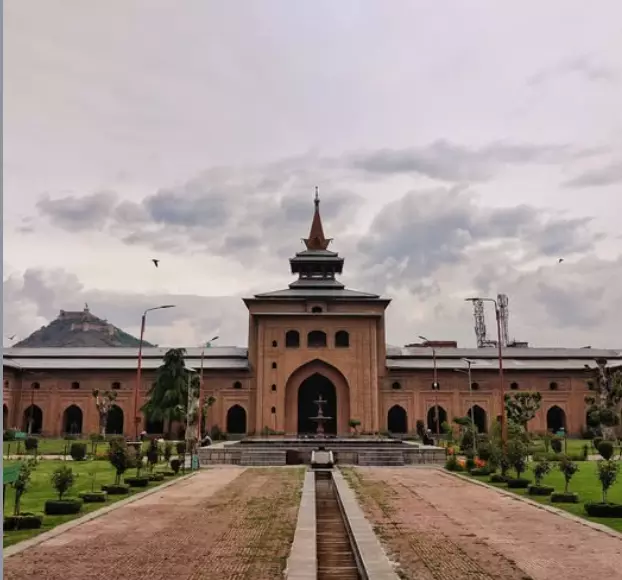
SRINAGAR: Thousands of worshippers gathered at Srinagar’s historic Jama Masjid on Friday to offer congregational prayers on Jumat-ul-Vida, the last Friday of the Muslim fasting month of Ramadan. The gathering marked the first time in seven years that the grand mosque hosted prayers on this significant occasion, restoring a tradition deeply rooted in the Valley’s religious life.
Yet the day unfolded under a cloud of controversy. Mirwaiz Muhammad Umar Farooq, Kashmir’s chief cleric and the region’s most prominent religious leader, was prevented from attending the prayers and delivering his customary sermon.
The Mirwaiz said he had been placed under house arrest early in the morning, with police personnel deployed in large numbers outside his Nigeen residence. Barricades and concertina wires were laid across adjoining lanes, effectively sealing the area and restricting all movement. He shared photographs of the scene on ‘X’ to support his claim.”
Condemning the restrictions, the Mirwaiz said the measures were aimed solely at stopping him from addressing the congregation at the Jama Masjid. He asserted that such actions could neither “erase identity nor weaken faith,” framing the curbs as part of a broader attempt to undermine Muslim institutions in the region.
In his social media outreach, he also said that for the third consecutive Friday of Ramadan he had been subjected to an “arbitrary house arrest,” enforced not through formal orders but through the physical presence of police vehicles and security personnel blocking access to his home. “While it conveys panic of the rulers,” he added, “the centrality of Jama Masjid for the Muslims of the region has unfortunately always been a thorn in their side… But such measures cannot erase identity nor weaken faith. These attempts will fail.”
The restrictions followed a similar episode earlier in the week. On Monday evening, authorities closed all entrances to the Jama Masjid and informed its management that the annual Shab-e-Qadr or Laylat al-Qadr congregation would not be permitted. The decision barred thousands of worshippers from gathering at the Valley’s central mosque on one of the holiest nights in the Islamic calendar—a night believed to hold the spiritual merit of a thousand months of devotion. The Mirwaiz was again confined to his residence.
Last Friday, while mosques, shrines, and hospices across Jammu & Kashmir and Ladakh witnessed large Ramadan gatherings—including over 1.2 lakh devotees at Srinagar’s revered Hazratbal shrine—the gates of the Jama Masjid remained locked. Worshippers were prevented from offering the special Friday prayers there, and the Mirwaiz, scheduled to deliver the sermon and his customary post-prayer address, was placed under house arrest.
Government officials have not offered a specific explanation for the repeated closures of the historic mosque, describing the decisions only as “preventive measures.” In the past, similar restrictions have been justified as precautionary steps to avert potential law-and-order disturbances, with authorities often citing “bitter past experiences.” One such incident frequently invoked is the killing of Deputy Superintendent of Police Muhammad Ayub Pandith, who was caught by a mob, stripped, and beaten to death outside the mosque on the night of June 22, 2017, during Shab-e-Qadr.
Despite the renewed congregation at Jama Masjid this Jumat-ul-Vida, the continued restrictions on the Mirwaiz and the closure of the mosque on key religious occasions have once again stirred debate in the Valley. Responding to the authorities closing Jama Masjid on Monday night, former chief minister and People’s Democratic Party president Mehbooba Mufti wrote on ‘X’, “For the seventh year in a row that too on the blessed night of Shab e Qadr not only have gates to Jama Masjid been locked but Mirwaiz Sahab too has been placed under house arrest. Year after year Kashmir’s normalcy is touted yet Kashmiris here are deprived of the very fundamental yet basic right to worship. How callous & cruel to forbid us from doing so on a day we all look forward to eagerly.”
Meanwhile, Lieutenant Governor Manoj Sinha and Chief Minister Omar Abdullah have extended warm greetings to the people on the occasion of Eid-ul-Fitr, which will be celebrated across the country on Saturday, marking the conclusion of the holy month of Ramadan.
In his message, the Lt. Governor said, “On the auspicious occasion of Eid-ul-Fitr, I extend my heartiest greetings and good wishes to all.” He said that the festival, which marks the blessed culmination of the holy month of Ramzan, carries profound spiritual and social significance. It embodies the noble spirit of sacrifice, compassion, and the joy of sharing. He further stated, “On this sacred day, let us renew our commitment to serving humanity and uplifting the lives of the poor and the needy. May Eid usher in peace, prosperity, and happiness for all.”
Highlighting the spiritual essence of Eid, the Chief Minister described it as a divine celebration following a month of fasting, prayer, and self-discipline. He emphasised that the festival is a moment to express gratitude to the Almighty and to uphold the values of compassion, generosity, and unity nurtured during Ramadan.
“Eid is a joyous occasion that brings people together to celebrate the blessings of Ramadan. It strengthens community bonds and reaffirms the values of mutual respect and brotherhood. It is a time to spread happiness, extend kindness, and lend a helping hand to those in need,” he said.
He added that the festival reflects the rich ethos of communal harmony, shared heritage, and cultural inclusivity that define J&K, reinforcing the spirit of unity and peace.
Praying for lasting peace, sustained progress, and prosperity for the people of J&K, the Chief Minister extended his best wishes to all celebrating Eid-ul-Fitr across the globe. He also extended heartfelt greetings on the auspicious occasion of Nauroz. He noted that the festival, which marks the arrival of spring and the beginning of the Persian New Year, symbolises renewal, hope, and harmony.
He said Nauroz, celebrated with great enthusiasm in various parts of the region, reflects a rich cultural heritage and the spirit of togetherness. The Chief Minister prayed for enduring peace, development, and prosperity in J&K and hoped that the festival would bring joy and positivity to every household.
