SCO Condemns Pahalgam Attack; Says No Dual Standards on Terror

New Delhi had on Sunday appreciated China’s support to India at the summit in addressing concerns on terrorism.
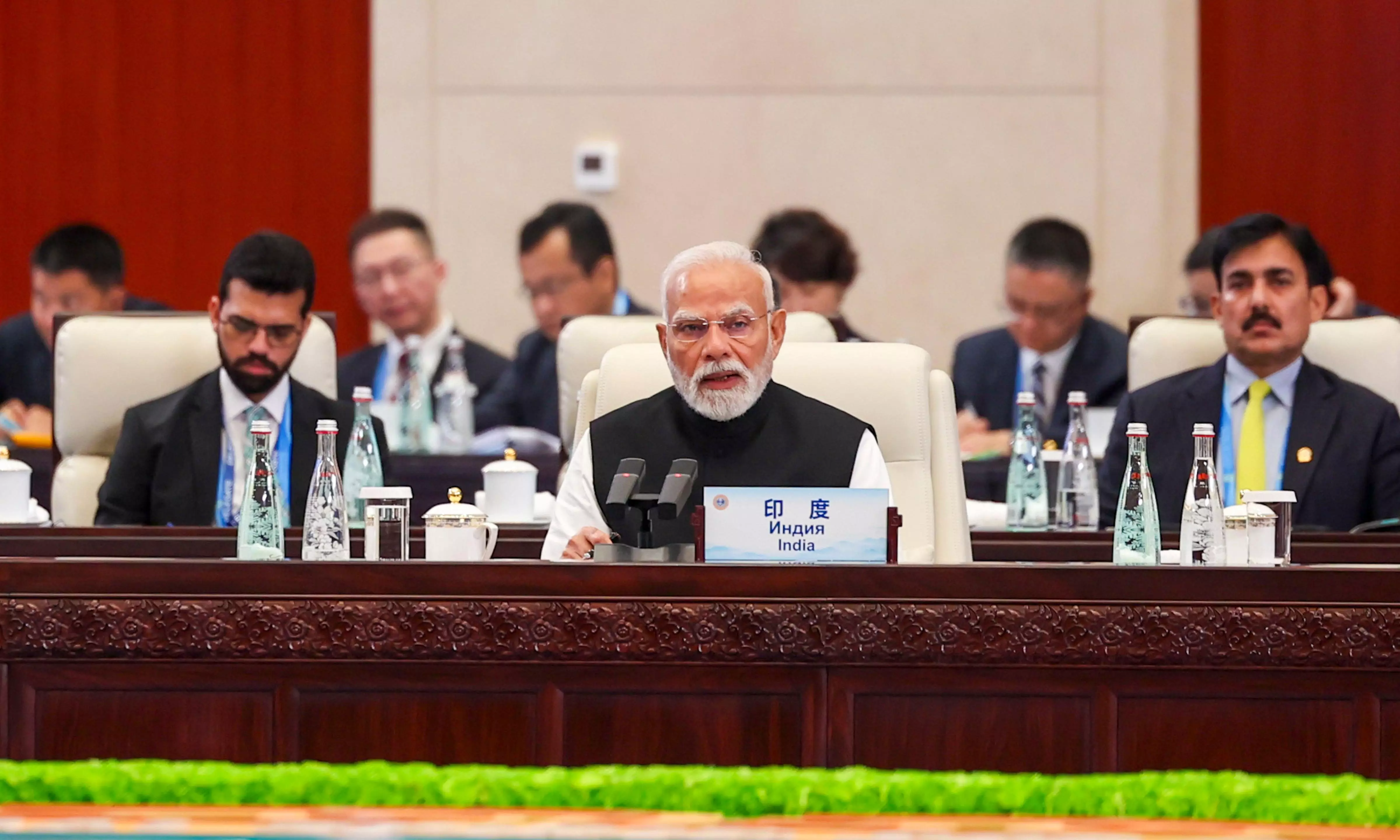
New Delhi: The 25th Shanghai Cooperation Organisation (SCO) summit in China’s port city of Tianjin came out with a “Tianjin Declaration” on Monday that strongly condemned cross-border terrorism, along with both the Pahalgam terror attack in India that took place in April this year and the Jaffer Express train hijack and Khuzdar school-bus bombing terror attacks that took place in Pakistan’s Balochistan province in March and May this year.
This came shortly after Prime Minister Narendra Modi attacked “double standards” on terrorism as “unacceptable” and referred to the April terror attack in Kashmir as the “most heinous face of terrorism in Pahalgam”. He noted that “for the past four decades, India has been bearing the grave scars of ruthless terrorism” in which “countless mothers have lost their children, and innumerable children have been left orphaned”.
Speaking in the presence of leaders of member-nations, including Pakistan PM Shehbaz Sharif, Modi questioned whether “the open support for terrorism by certain countries would ever be acceptable to us”, in a thinly-veiled reference to Islamabad’s role in the massacre and other terror attacks.
All 10 SCO member-nations — China, Russia, India, Pakistan, Iran and Central Asian nations of Tajikistan, Uzbekistan, Kazakhstan and Kyrgyzstan, and Belarus — signed the joint declaration. With Pakistan being an SCO member, it was no surprise that the declaration did not hold it accountable for sponsoring terrorism. The condemnation of attacks that took place both in Kashmir (India) and Balochistan (Pakistan) is also seen as a balancing act by the grouping. But the declaration itself and the reference to cross-border terrorism reflects an increased concern and understanding for India’s position compared to the SCO defence ministers’ meeting in Beijing in June, when defence minister Rajnath Singh had refused to accept any joint communiqué unless India’s position and concerns on terrorism were reflected in it.
New Delhi had on Sunday appreciated China’s support to India at the summit in addressing concerns on terrorism.
The SCO, in its declaration, condemned both Israel and the United States for the attacks on Iran in June this year. While India also endorsed the Tianjin Declaration, it may be recalled that in June, New Delhi had disassociated itself from a similar condemnation by the SCO of Israel, but there appeared to be no such move this time. New Delhi’s condemnation of the US is being seen as a strong message to the Trump administration.
In a thinly-veiled criticism of American sanctions and tariffs, the SCO also opposed “unilateral coercive measures, including those of an economic nature, that contravene the UN Charter and other norms of international law, the rules and principles of the World Trade Organisation, damaging the interests of international security”.
Modi said at the summit: “From the Covid crisis to global economic uncertainties, we (India) have endeavoured to convert challenges into opportunities. We are consistently pursuing wide-ranging reforms, which are creating new opportunities for both national development and international cooperation. I warmly invite you all to be a part of India’s development journey.”
On the aftermath of the Pahalgam attack, Modi said: “I express my deep gratitude to all the friendly nations that stood by us during this moment of grief. This attack was not only an assault on the conscience of India, but also an open challenge to every nation, and every individual who believes in humanity.” He added: “Together, we must oppose terrorism in every form and manifestation. This is our responsibility to humanity. Terrorism is not only a threat to the security of individual nations, but a shared challenge to all of humanity. No country, no society, no citizen can consider themselves completely safe from it.”
Calling for UN reform and a greater role for the Global South, Modi said “it is time to change the screen” from the current “black-and-white” one, adding: “The SCO can play a guiding role in promoting multilateralism and an inclusive world order”.
Despite improving ties with Beijing, the PM also took a veiled dig at China’s Belt and Road Initiative, which India has refused to join, the flagship project of which is the China-Pakistan Economic Corridor (CPEC) that passes through Pakistan-occupied Kashmir. He said “every effort towards connectivity must uphold the principles of sovereignty and territorial integrity enshrined in the core principles of the SCO charter”, adding that “connectivity, that bypasses sovereignty, ultimately loses both trust and meaning”. He also proposed creation of a Civilisational Dialogue Forum under the SCO to strengthen people-to-people ties.
Expressing solidarity with Iran, an SCO member, the joint declaration said: “Member states strongly condemned the military strikes by Israel and the United States of America against the Islamic Republic of Iran in June 2025. Such aggressive actions against civilian targets, including nuclear energy infrastructure, which resulted in the death of civilians, are a gross violation of the principles and norms of international law and the UN Charter, and an infringement on the sovereignty of the Islamic Republic of Iran.”
The PM said India’s vision and policy towards the SCO are built on three key pillars, S — Security, C — Connectivity and O — Opportunity, and sought greater action.
On the first pillar, Modi said: “I would like to emphasise that security, peace, and stability form the foundation of any nation’s development. However, terrorism, separatism, and extremism remain major challenges along this path. This year, while leading the Joint Information Operation, India undertook an initiative to counter Al-Qaeda and its affiliated terrorist organisations. We have also proposed enhanced coordination, and joint measures against radicalisation. We have raised our voice firmly against terror financing.
On the second pillar, the PM said: “C, that is, connectivity. India has always believed that strong connectivity does not merely facilitate trade but also opens the doors to trust and development. It is with this vision that we are working on initiatives such as the Chabahar Port and the International North-South Transport Corridor. Through these, we can enhance our linkages with Afghanistan and Central Asia. He added: “The third pillar is O, that is Opportunity. Opportunity for Cooperation and Reform.”
