Rumour Mill Grinding Hard in J&K Ahead Of Article 370 Revocation Anniversary

4 Aug 2025 5:19 PM IST4 Aug 2025 5:19 PM IST
These rumors, fueled by recent events and the Himalayan region’s complex history, range from plausible to highly speculative.
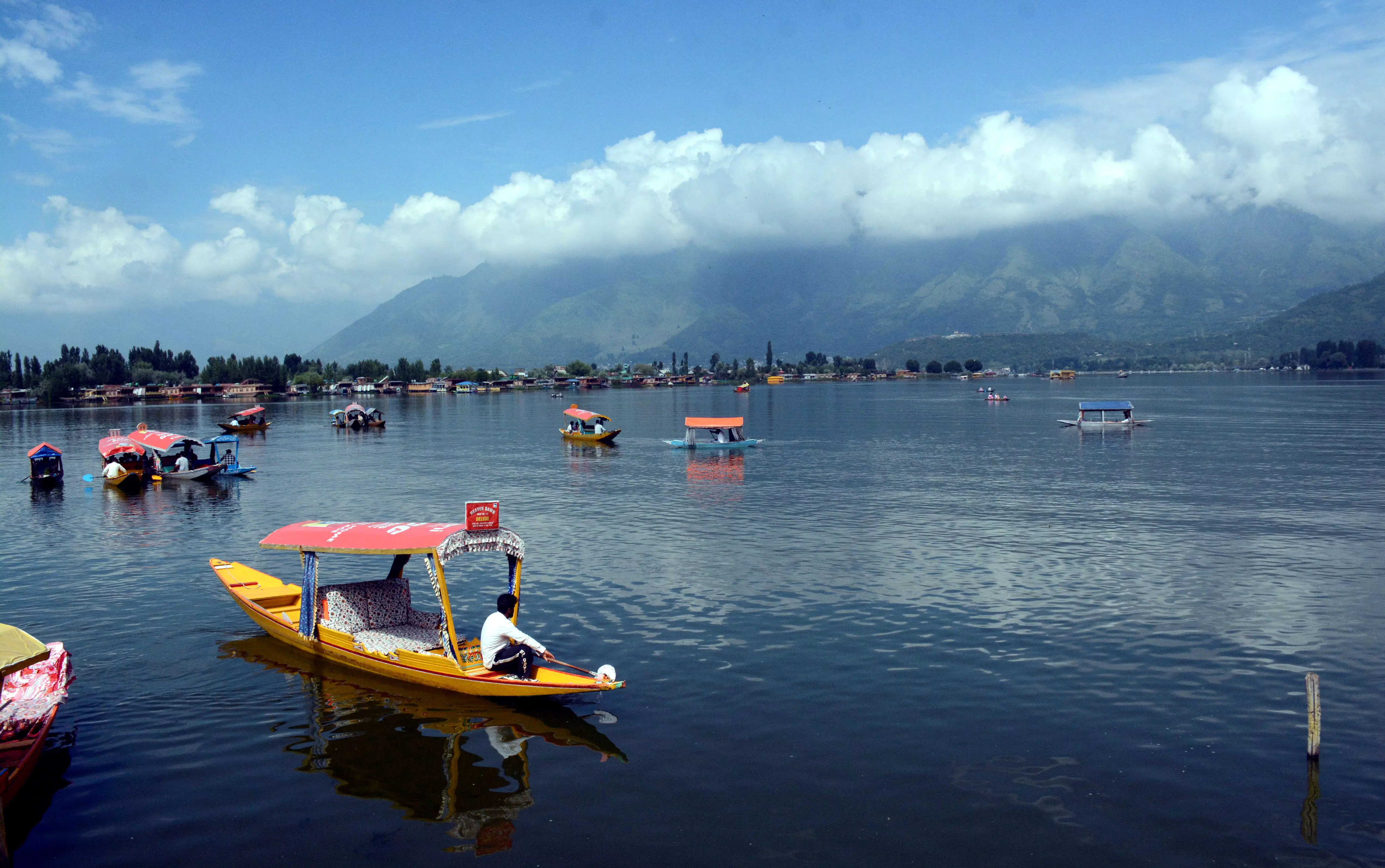
Tourists take 'shikara' rides at Dal Lake on a cloudy day, in Srinagar, Jammu and Kashmir, Wednesday, July 30, 2025. (PTI Photo)
Srinagar: Ahead of the anniversary of revocation of Article 370, Jammu and Kashmir is rife with rumours and speculation across social media, political circles, and public discourse, reflecting both hope and anxiety about the region’s political future. These rumors, fueled by recent events and the Himalayan region’s complex history, range from plausible to highly speculative.
The most widespread rumour suggests J&K may regain statehood around August 5, aligning with the 2019 reorganization’s anniversary. The demand for statehood restoration has been consistent among J&K’s political parties, including the National Conference (NC), Congress and People’s Democratic Party (PDP).
In October 2024, the J&K Cabinet passed a resolution for statehood, approved by Lieutenant Governor Manoj Sinha. Chief Minister Omar Abdullah, after Delhi meetings, expressed optimism about assurances from the Centre, though no timeline was confirmed.
Union Home Minister Shah has repeatedly said that statehood will be restored “at an appropriate time,” a promise echoed by Prime Minister Narendra Modi more than once. However, no concrete timeline has been disclosed, and the government cites security and stability as prerequisites.
The Congress party, an NC ally, has, at a time when Parliament is in session, intensified its campaign for statehood, with protests and outreach programs like ‘Hamari Riyasat, Hamara Haq’ and a planned ‘Black Day’ on August 5, to mark the 2019 revocation.
While this rumour is grounded in political momentum and government assurances, the Centre’s cautious approach, possibly due to upcoming Maharashtra and Jharkhand elections in November 2025, suggests any announcement may be symbolic rather than immediate. The lack of a clear timeline keeps this speculative without official confirmation.
Another rumour links statehood restoration to the dissolution of the current J&K assembly, established after the 2024 elections. Under Article 3 of the Constitution, which enabled the 2019 reorganization, the assembly could legally continue post-statehood. However, political analysts suggest fresh elections might be needed to ensure democratic legitimacy under a restored state’s framework. This decision would depend on parliamentary action, balancing legal continuity with political credibility. While plausible, this remains speculative without concrete government signals.
A more controversial rumour, circulating on social media and in regional discussions, claims the Centre might grant statehood to Jammu while keeping the Kashmir Valley as a permanent Union Territory. This speculation is driven by the abrupt end of the Amarnath Yatra, high-level meetings involving Prime Minister Modi, Home Minister Shah, and President Droupadi Murmu, and a political atmosphere reminiscent of 2019, when Article 370 was revoked, stripping J&K of its special status and splitting it into two UTs—J&K and Ladakh.
This could theoretically favour the Bharatiya Janata Party (BJP), which has stronger support in Jammu, potentially enabling it to appoint a Chief Minister there while maintaining Central control over the Valley due to its history of unrest. The BJP’s 2024 electoral loss to the NC-Congress coalition and criticism for unfulfilled statehood promises add context to this speculation.
However, analysts highlight significant hurdles. They say further splitting J&K would require constitutional amendments beyond the 2019 Reorganisation Act. Such a move could also inflame tensions in the predominantly Muslim Kashmir Valley, where statehood and autonomy are strongly demanded, potentially risking unrest. This rumour, while politically charged, lacks substantial evidence and faces legal and social challenges.
The most far-fetched rumour suggests a “decisive” military operation to “liberate” Pakistan-occupied Jammu and Kashmir (PoJK), possibly termed “Operation Sindoor 2.0,” around August 5 or 15. Social media posts cite increased CAPF deployments and missile tests as evidence. However, these claims lack credible backing. Analysts dismiss this as highly improbable due to geopolitical risks, including escalation with Pakistan, a nuclear-armed state, and potential Chinese involvement. The Centre’s focus remains on internal stabilization, with a 59 percent reduction in terror incidents from 2019 to 2020, though recent events like the April 22 Pahalgam attack underscore ongoing caution rather than aggressive military plans.
The political analysts say that while the statehood restoration rumour carries weight due to political developments, others—particularly the PoJK military action—are largely speculative. One of them said that the Centre’s emphasis on security and normalcy suggests any major decisions will be carefully timed, likely post key elections, leaving J&K in a state of cautious anticipation.
( Source : Deccan Chronicle )

Next Story