Pro Iran Demonstrations Held Across Several Shia Majority Pockets Of Kashmir, Kargil

Mehbooba Mufti Urges Unity in Iran, Warns Against “External Ploys”: Reports
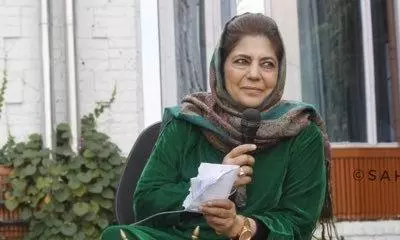
SRINAGAR: Huge crowds of mainly Shia Muslims gathered after Friday prayers in various places across the Kashmir Valley and Kargil to voice support for Iran and its Supreme Leader Ayatollah Ali Khamenei.
Meanwhile, former chief minister and People’s Democratic Party (PDP) president, Mehbooba Mufti, urged the people of Iran on Friday to stay united against what she described as “ploys” by the United States and Israel.
The rallies remained peaceful, yet they carried a strong political message as the participants expressed solidarity with Iran while denouncing what they described as interference by the United States, Israel, and their allies. Similar sentiments were reported from Kargil as well, where residents marched through the city in sub‑zero temperatures over the past several days, underscoring a broader regional reaction to the unfolding situation in Iran.
In Srinagar, gatherings were seen in areas such as Nehru Park, Hassanabad and Gund Hassi Bhat, while in Budgam demonstrators assembled at Main Chowk. Pulwama’s Gangoo area also witnessed a sizeable turnout. Protesters marched with portraits of Ayatollah Khamenei and Khamenei and chanted slogans praising Iran’s leadership. Many accused the US and Israel of perpetrating injustices against Muslim communities worldwide, framing their demonstrations as an act of solidarity with Iran amid what they viewed as mounting external pressure. Several participants also criticised what they called interference in Iran’s domestic affairs, arguing that such actions contributed to instability across the region.
Mufti on Friday issued a strong appeal to the people of Iran, urging them to remain united in the face of what she described as “ploys” by the US and Israel. Speaking to reporters here, she also called on Iran’s leadership to address the concerns of protesters within the country, emphasising that public grievances are a natural part of any society and deserve attention. Inside Iran, activists had reported large‑scale casualties—claiming that more than 2,600 people had been killed during a crackdown on anti‑government protests. At the same time, warnings from the US about potential military action added to the sense of uncertainty.
Mufti argued that the US has a long history of intervening in other nations under the pretext of promoting democracy, while actually pursuing strategic and resource‑driven interests. She claimed that several Muslim‑majority countries had suffered destabilisation as a result of such interventions. At the same time, she criticised what she viewed as selective global concern, pointing to the humanitarian crisis in Gaza and alleging that the US had not acted to stop the suffering there.
Referring to the pro‑Iran demonstrations held across parts of J&K after Friday prayers, the former chief minister said she was encouraged to see people expressing solidarity with the Islamic Republic. She urged Iranians to recognise what she described as the geopolitical motives of the US and Israel, asserting that these countries were primarily interested in the region’s natural resources. According to her, falling prey to external manipulation could leave Iran facing instability similar to that experienced by Syria.
While stressing the importance of unity among the Iranian people, Mufti also underlined that governments everywhere must listen to their citizens. She noted that Iran has historically shared cultural and religious ties with Kashmir, and lamented that expressions of solidarity—once common across India—had become less visible in recent years. She attributed this shift to what she described as a climate of fear since the change in political leadership at the national level.
Addressing concerns about students from J&K currently studying in Iran, Mufti said she had reached out to External Affairs Minister S. Jaishankar, requesting special flights to ensure their safe return amid the ongoing uncertainty.
On Thursday, the Chief Minister Omar Abdullah spoke with External Affairs Minister S. Jaishankar to underline the urgency of safeguarding students from J&K currently in Iran, along with other Indian travellers caught in the unfolding crisis. In a post on X, he noted that Jaishankar had shared an assessment of the situation on the ground as well as the measures the Ministry of External Affairs was preparing. He added that he was grateful for the assurance that every necessary step would be taken to protect the lives and interests of students and other residents of J&K who remain in Iran.
In a separate statement, the Chief Minister’s Office announced that the Government had appointed the Additional Resident Commissioner in New Delhi as the nodal officer to coordinate with the MEA and the Indian Embassy in Tehran. The officer will handle documentation, advisories, and welfare‑related support for J&K residents, particularly students, until the situation stabilises.
Current estimates suggest that between 2,000 and 3,000 Indian students are studying in Iran, most of them enrolled in medical programmes at institutions such as Tehran University of Medical Sciences and Shahid Beheshti University. During the present unrest, assessments have consistently placed the number of Indian MBBS students alone at around 2,000.
A large share of these students—often described as a majority—hail from J&K and Ladakh. Iran has become a preferred destination for Kashmiri medical aspirants due to relatively affordable tuition, cultural and religious familiarity, and the ease with which many students adapt to Persian because of its linguistic closeness to Urdu and Kashmiri. Estimates for students from J&K range from about 1,500, according to the Jammu and Kashmir Students Association, to nearly 2,000 in some reports. In certain universities, observers note that up to 70 percent of Indian students come from the Kashmir Valley and Kargil, a predominantly Shia region.
Over the past few years, Iran has even surpassed countries like Bangladesh as a top choice for medical education among Kashmiri families, with annual admissions from J&K reportedly crossing 300. Lower overall costs—typically ₹20–35 lakh for an entire MBBS programme—combined with cultural comfort and established student networks have reinforced this trend. However, these figures fluctuate with each academic cycle and are often affected by geopolitical tensions, periodic evacuations, and episodes of domestic unrest within Iran.