Presidential Reference Hearing: Judicial Activism Shouldn't Become Judicial Terrorism, Says CJI

The chief justice's remark came when Solicitor General Tushar Mehta, appearing for the Centre, told a bench that elected people who have a lot of experience should never be undermined
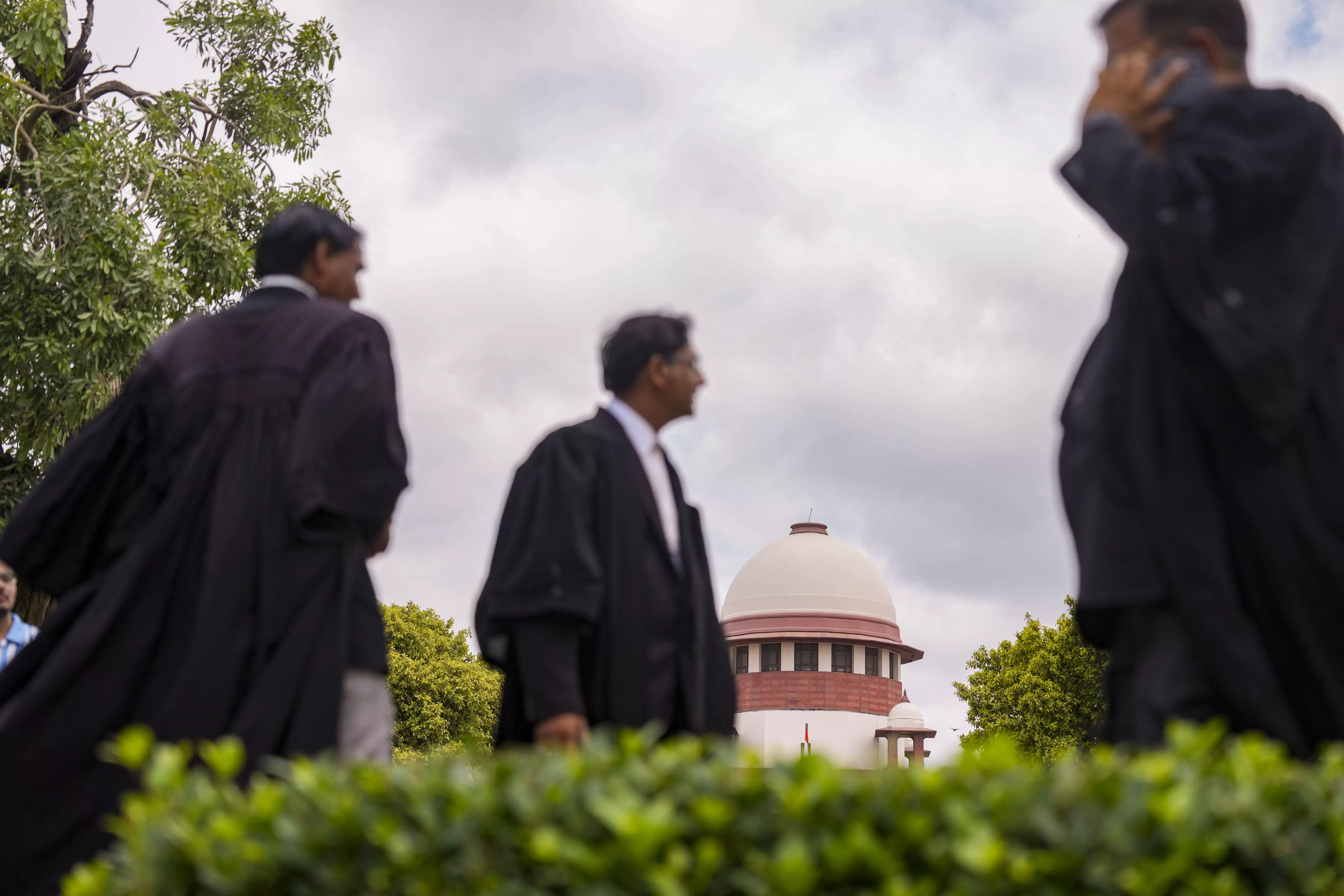
New Delhi: The Supreme Court on Thursday asked the Centre if the hands of Constitutional courts could be tied if Constitutional functionaries refused to discharge functions or there was inaction on the part of the Governor on Bills passed by State Assemblies.
The apex court made the remarks after the Centre's assertion that if some Governors sat over Bills passed by the Assembly, political solutions had to be explored by States instead of judicial remedies.
A five-judge Constitution bench headed by Chief Justice B.R. Gavai was hearing for the third consecutive day a Presidential reference on the question whether the court can impose timelines for Governors and President to deal with Bills cleared by State Assemblies.
The bench, also comprising Justice Surya Kant, Justice Vikram Nath, Justice P.S. Narasimha and Justice A.S. Chandurkar, was hearing a presidential reference on the question of whether or not the court could impose timelines for Governors and the President to deal with Bills passed by State Assemblies. If there was any wrong, the bench said, there ought to be a remedy.
Hearing in the matter will resume on Tuesday.
CJI Gavai on Thursday asked Solicitor General Mehta, "If constitutional functionaries do not discharge their functions without any reason, can the hands of a constitutional court be tied?" The SG said for all problems, courts couldn't be the solution and in a democracy, primacy had to be given to dialogue.
Justice Kant said, "If there is any inaction on the part of the Governor, which can vary from state to state, and if an aggrieved state approaches the court, can the judicial review of such inaction be completely barred. Tell us what can be the solution?"
Arguing for some "flexibility", Mehta submitted: "Suppose the Governor is sitting over Bills, there are political solutions which can be adopted. It is not everywhere that the Chief Minister rushes to the court. There are instances where parleys take place, the Chief Minister meets the Governor, he meets the Prime Minister and President and solutions are found."
The law officer said there were several occasions like telephonic conversations to resolve the impasse. "For decades, this practice has been adopted to resolve disputes, if any. Delegations go and meet the Governor, President and sometimes a middle path is found."
Mehta underscored invoking statesmanship and political maturity to end the impasse between the state government and Governor, who is Centre's representative. "I am saying, every problem in this country may not have solutions here in the court. There are problems in the country where you find solutions within the system," he added.
Mehta further argued nowhere in the Constitution was a timeline fixed for Governor or President to act on the Bills and where a timeline was provided, it was expressly provided.
CJI Gavai then told Mehta, "If there is any wrong, there has to be a remedy. This court is the custodian of the Constitution and it will have to interpret the Constitution by giving it literal meaning."
Justice Kant agreed with the CJI and said, "If the power of interpretation vests in the Supreme Court, then interpretation of law has to be tried by the court."
The SG said justiciability was a different thing while adding something to the Constitution was different. "There has to be some flexibility when dealing with the constitutional functionaries. This court has time and again called the law officer or representative and asked to do certain work without making it in the judgement," Mehta said.
He continued, "This court can very well ask the Parliament to enact a law fixing a timeline for the Governor in dealing with the Bills passed by the Assembly but it cannot be done through the judgement of this court."
Justice Narasimha noted, "If an extreme view is taken to argue that you can't do it, you say we don't have the power to do it at all, how do you make the Constitution work?"
Mehta then referred to the April 8 verdict in Tamil Nadu Governor case, leading to the present Presidential reference, and said the verdicts said the President and the Governor will record reasons and if they don't follow the timeline, states can approach the apex court or the High Court.
"This means one institution is directing the President to do it within some time frame. I respect the directions and there may be justification but it can't confer jurisdiction," Mehta said.
In May, President Droupadi Murmu exercised rarely-used powers under Article 143(1) to know from the top court whether judicial orders could impose timelines for the exercise of discretion by the President while dealing with bills passed by state assemblies.
On April 8, the apex court while dealing with the powers of Governor with respect to Bills passed by the Tamil Nadu Assembly, for the first time, prescribed the President to decide on the Bills reserved for her consideration by the Governor within three months from the date on which such a reference was received.
