Mehbooba Mufti Calls For United Political Outreach On J&K’s Future

Mufti insists on the urgent need of sustained political engagement, consensus‑building, and a unified voice for the UT to address public and political anxieties.
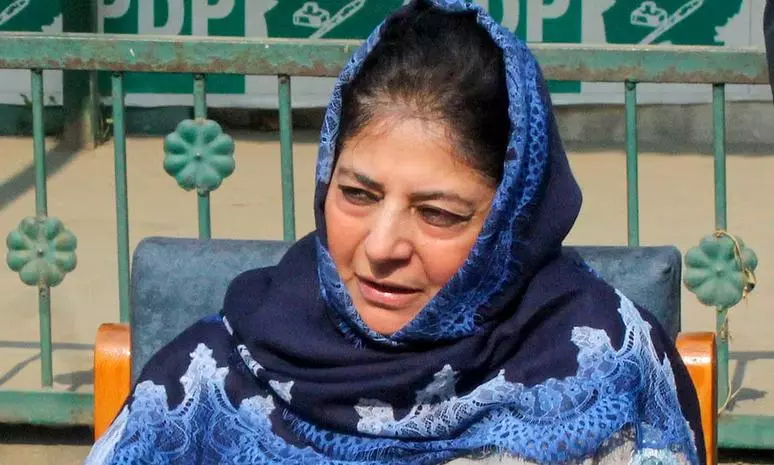
Srinagar : Peoples Democratic Party (PDP) president Mehbooba Mufti has written a detailed letter to Chief Minister Omar Abdullah urging him to convene an all‑party meeting and launch a coordinated political outreach to the Union Government on issues concerning Jammu and Kashmir.
She argues that the Union Territory is in urgent need of sustained political engagement, consensus‑building, and a unified voice capable of addressing the deepening public and political anxieties across the region. Drawing a parallel with Ladakh’s recent progress in negotiations with the Centre—led by the Leh Apex Body and the Kargil Democratic Alliance—Mufti stresses that dialogue remains the only credible path to meaningful outcomes.
In her communication, the former chief minister notes that she had earlier sought an appointment with the Chief Minister but, given his preoccupations, chose to write instead, warning that “time is running out”. She describes J&K as being “at a crossroads”, marked by growing despair and disillusionment among the people. According to her, the developments in Ladakh demonstrate that determined, collective, and persistent engagement with New Delhi can yield tangible results. She argues that J&K now requires a broad‑based political consensus that transcends party lines, insisting that constructive engagement with the Government of India is essential to restore the dignity and security of its citizens.
Mufti urges Abdullah to take the lead in bringing together regional political parties for a formal meeting, followed by a joint outreach to Prime Minister Narendra Modi and Union Home Minister Amit Shah. She emphasises that political differences must be set aside in the larger public interest and warns against reducing the process to credit‑claiming or point‑scoring. Internal disagreements among regional parties, she notes, have weakened collective interests—particularly in the post‑2019 political landscape. If Ladakh could secure progress through unity and sustained struggle, she argues, there is no reason J&K cannot pursue a similar path. She adds that Abdullah’s participation would be crucial for the credibility and success of such an initiative, and mentions that she has enclosed a list of parties already approached, inviting him to include additional stakeholders.
The Union Government’s willingness to extend constitutional safeguards to Ladakh—on the lines of Article 371—has dramatically reshaped political discourse in the Himalayan region and triggered sharp criticism of J&K’s mainstream leadership. The move, widely seen as a major concession to Ladakh’s long‑standing demands for protection of land, jobs, culture, and local governance, has sparked a pointed question across political circles and social media: why did Ladakh succeed where J&K’s leadership did not? Ladakh’s leaders, activists, and civil society groups are being praised for their unity, discipline, and persistence over the past four years—marked by hunger strikes, mass mobilisations, and repeated delegations to New Delhi. In contrast, J&K’s political class is being accused of complacency, electoral preoccupation, and failing to mount a comparable struggle after the abrogation of Article 370 in 2019.
National Conference (NC) MP Aga Syed Ruhullah Mehdi recently articulated this sentiment sharply, calling the Centre’s decision a “slap on the face” of J&K’s political leadership. He argued that if a “small region like Ladakh” could fight and secure its rights, Kashmir’s leaders had no justification for not doing the same. PDP leader Waheed Ur Rehman Para echoed this critique, noting that Ladakh had achieved in seven years what J&K could not in seven decades.
Another PDP leader Iltija Mufti, amplifying her mother’s letter to the Chief Minister on social media, remarked that “Ladakh’s unity holds lessons for J&K’s leadership to draw from. Unfortunately, the state’s parties have been defined by disagreements and discord.” Her comment added momentum to the growing debate over why Ladakh’s political mobilisation has yielded results while J&K’s mainstream parties remain mired in internal divisions.
Journalist Zafar Chaudary reinforced this sentiment, observing that “a handful of notable Ladakhis, not more than six in number,” had succeeded in negotiating a promising deal with the Centre despite lacking political dynasties or entrenched party structures. His remarks struck a chord across social media, where comparisons between Ladakh’s cohesive, grassroots‑driven movement and J&K’s fragmented political landscape have become increasingly widespread. Together, these voices have intensified public scrutiny of regional leadership and revived calls for unity at a time when political stakes in J&K are rapidly evolving.
After years of protests, negotiations, and public mobilisation, Ladakh’s leadership now appears close to securing a comprehensive framework for constitutional safeguards and democratic governance. The breakthrough follows Union Home Minister Amit Shah’s recent visit to Leh, where Ladakhi representatives insisted that only direct engagement with top decision‑makers could resolve their long‑pending concerns. Their long‑standing four‑point agenda includes restoration of statehood, inclusion under the Sixth Schedule, separate Lok Sabha seats for Leh and Kargil, and a dedicated Public Service Commission. While not all demands have been fully met, the Centre’s in‑principle agreement to provide Article 371‑style protections marks a significant shift. These safeguards would protect Ladakh’s land ownership patterns, cultural identity, and traditional practices, similar to protections in Nagaland, Mizoram, and Sikkim.
The Centre has also indicated openness to establishing a powerful elected government headed by a Chief Minister, with legislative, executive, and financial authority vested in a Union Territory‑level assembly. This would fundamentally transform Ladakh’s current bureaucratic governance model, placing key decision‑making powers in the hands of elected representatives. For many observers, the contrast between Ladakh’s assertive mobilisation and J&K’s comparatively muted approach has become impossible to ignore. Critics argue that J&K’s mainstream parties remained preoccupied with electoral calculations and internal rivalries rather than mounting a coordinated push for structural safeguards.
Regardless of the final contours of Ladakh’s agreement, the episode has already reshaped political narratives across the region—casting Ladakh’s leadership as determined and effective, while leaving J&K’s mainstream parties grappling with uncomfortable questions about their own choices and missed opportunities. Yet even Ladakh’s process has not been without friction. Climate activist Sonam Wangchuk has alleged that crucial points—particularly those relating to the primacy of elected representatives over the bureaucracy—were omitted from the draft minutes of a recent meeting between Ladakhi leaders and the Centre. He warned that such omissions could undermine the fragile trust built during the talks and urged the government to ensure that the official record accurately reflects the agreements reached.
