First Nehru, Now Rahul Gandhi Disregarded Vande Mataram: Modi In Parliament

Modi asserted that Vande Mataram, that Mahatma Gandhi had seen as the National Anthem in 1905, and which was a source of immense strength for every Indian, both within the country and abroad, later suffered grave injustice in the last century
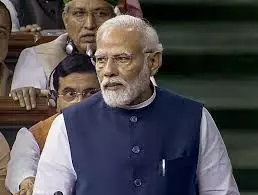
New Delhi: Initiating the special debate on Vande Mataram in the Lok Sabha on Monday, Prime Minister Narendra Modi launched a blistering political attack on the Congress and accused the party of “insulting” and “compromising” on the National Song. He recalled that when Vande Mataram completed 100 years, the nation was “shackled” by the Emergency and the Constitution was “throttled”.
The Prime Minister also accused the Congress of breaking the National Song “into pieces” under the guise of social harmony, and said it was still following the politics of appeasement.
Modi asserted that Vande Mataram, that Mahatma Gandhi had seen as the National Anthem in 1905, and which was a source of immense strength for every Indian, both within the country and abroad, later suffered grave injustice in the last century.
He questioned why such betrayal occurred with Vande Mataram, why such injustice was done, and which forces were so powerful that they overshadowed even the sentiments of the Mahatma, dragging this sacred inspiration into controversy.
The Prime Minister stressed that as India celebrated 150 years of Vande Mataram, “it is our duty to inform new generations of the circumstances that led to this betrayal” and highlighted that the Muslim League’s politics of opposition to the Vande Mataram was intensifying, and Mohammed Ali Jinnah raised a slogan against Vande Mataram from Lucknow on October 15, 1937.
Modi stated that instead of firmly countering the baseless statements of the Muslim League and condemning them, Jawaharlal Nehru, then Congress president, did not reaffirm his and the Indian National Congress’ commitment to Vande Mataram and began questioning Vande Mataram itself.
The Prime Minister recalled that just five days after Jinnah’s opposition, on October 20, 1937, Nehru wrote a letter to Netaji Subhas Chandra Bose, agreeing with Jinnah’s sentiment and stating that the “Anand Math” background of Vande Mataram could irritate Muslims.
Modi quoted Nehru’s words: “I have read the background of the Vande Mataram song. I feel that this background may provoke Muslims.”
He noted that following this, a statement came from the Indian National Congress that from October 26, 1937, the Congress Working Committee would meet in Kolkata to review the use of Vande Mataram.
Highlighting that it was Bankim Chandra Chatterjee’s Bengal, Bankim Babu’s Kolkata, that was chosen for this review, he said the entire nation was stunned and shocked, and patriots across the country opposed the proposal by organising morning processions and singing Vande Mataram.
“But, on October 26, Congress compromised on Vande Mataram. They broke it into pieces under the mask of social harmony, but history is witness. This was Congress’ attempt at the politics of appeasement. Under pressure of politics of appeasement, Congress agreed to divide Vande Mataram. This was the reason Congress also bowed to the demand for Partition,” he alleged.
Addressing the Lok Sabha, the PM remarked that under the pressure of appeasement politics, the Congress bowed to the division of Vande Mataram, and subsequently bowed to the Partition of India.
He asserted that the INC had outsourced its decisions, and regrettably, its policies remain unchanged. Modi also hit out at the Opposition and its allies for resorting to appeasement politics and continued attempts to create controversies around Vande Mataram.
The PM stated that on the occasion of 150 years of Vande Mataram, the House (Lok Sabha) was making an effort to experience its collective energy. Recalling that when Vande Mataram completed 50 years, the nation was compelled to live under colonial rule, Modi said, and that when it reached 100 years, the country was shackled by the chains of the Emergency.
He noted during the centenary celebrations of Vande Mataram, the Constitution of India was throttled, and that those who lived and died for patriotism were imprisoned behind bars.
The Prime Minister said that the true character of any nation was revealed not in good times but during periods of challenge and crisis, when it is tested and proven on the touchstone of resilience, strength, and capability. He remarked that after Independence in 1947, while the country’s challenges and priorities changed, the spirit and life force of the nation was still the same, continuing to inspire.
He underscored that whenever India faced crises, the nation advanced with the spirit of Vande Mataram. He noted that even today, on occasions like August 15 and January 26, the sentiment is visible everywhere as the tricolour flies proudly in every home.
He recalled that during the food crisis, it was the spirit of Vande Mataram that inspired farmers to fill the nation’s granaries, and when attempts were made to crush India’s freedom, when the Constitution was stabbed and Emergency imposed, it was the strength of Vande Mataram that enabled the nation to rise and overcome.
The PM underscored that whenever wars were thrust upon the country, whenever struggles arose, it was the spirit of Vande Mataram that made soldiers stand firm at the borders, ensuring the flag of Mother India continued to wave in victory. He said this was the strength of the nation, a powerful flow of energy that connects the country with emotions, a stream of consciousness, and a reflection of the unbroken cultural current that propels progress.
“Vande Mataram is not merely a period of remembrance but a time to draw new energy and inspiration, and to dedicate ourselves to it,” he said.
The Prime Minister said Vande Mataram was not just a song or a hymn, but a source of inspiration that awakens us to our duties towards the nation, and must be continuously upheld. As the country pursues the dream of an “Aatmanirbhar Bharat”, Vande Mataram remained an inspiration.
Modi called on all to move forward with this sentiment, to build a self-reliant India, and achieve the vision of a developed India by 2047. The PM said if 50 years before Independence someone could dream of a free India, then 25 years before 2047 we too can dream of a prosperous and developed India, and dedicate ourselves to realising it.
