Celebrations Across J&K, Kargil After US–Iran Ceasefire Announcement

The news of ceasefire triggered an immediate and emotional response across the Kashmir Valley, pockets of Jammu, and the Kargil district.
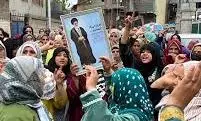
Srinagar : As the United States and Iran agreed to a Pakistan‑brokered two‑week ceasefire—an announcement made shortly before President Donald Trump’s declared deadline for military escalation—waves of celebration swept through several regions of Jammu and Kashmir and parts of Ladakh. With delegations from Washington and Tehran expected to meet openly in Islamabad for the first time on Friday, the news triggered an immediate and emotional response across the Kashmir Valley, pockets of Jammu, and the Kargil district, where thousands of people poured into the streets chanting what they described as “victory for Iran.”
Across Budgam, Srinagar, Kulgam, Baramulla, and Bandipore in the Valley, as well as parts of Poonch in Jammu and several neighbourhoods of Kargil, men, women, and youth marched in large processions carrying Iran’s national flag and portraits of prominent Iranian leaders. Images of Ayatollah Syed Ali Khamenei, past revolutionary figures, and celebrated military personalities were held aloft as crowds moved through marketplaces, village roads, and town squares. The atmosphere in many places resembled a spontaneous public rally, with slogans in support of Iran echoing through the streets. In some localities, the celebrations intensified with the bursting of firecrackers, adding a festive yet politically charged energy to the sky.
Social media platforms across the region quickly filled with posts expressing relief, admiration, and solidarity. Many users described the ceasefire as a diplomatic triumph for Iran and praised Pakistan’s role in mediating between the two adversaries, crediting Islamabad with preventing what they feared could have escalated into a catastrophic regional conflict. Others, however, voiced skepticism about the durability of the truce, citing concerns about the broader geopolitical tensions involving Israel and the United States. These mixed reactions reflected both the emotional investment of many residents in West Asian affairs and the uncertainty that continues to surround the region’s political landscape.
Amid the celebrations, the J&K Shia Association issued a public advisory urging restraint. In a post on ‘X’, the organisation reminded people that the period coincided with the 40th day of mourning for “Shaheed” Ayatollah Imam Khamenei, a solemn religious observance. The association appealed to the public to avoid firecrackers and maintain decorum in honour of the occasion, emphasising that expressions of joy should not overshadow the sanctity of the mourning period.
Political leaders in J&K also reacted to the ceasefire, though with differing perspectives. Chief Minister Omar Abdullah criticised the broader conflict, describing it as an “unjust war” that had yielded little tangible outcome. In a post on ‘X’, he questioned the purpose of the 39‑day confrontation, noting that the ceasefire merely reopened a strait that had been freely accessible before hostilities began. His remarks, tagged with #UnjustWar, reflected a broader sentiment of frustration over the human and political costs of the conflict.
Kashmir’s chief Muslim cleric, Mirwaiz Muhammad Umar Farooq, welcomed the ceasefire as a positive step toward de‑escalation. In his statement, he emphasised that dialogue and restraint must take precedence over confrontation, praising the resilience of the Iranian people and acknowledging the diplomatic efforts—particularly those by Islamabad—that contributed to the breakthrough. He expressed hope that the temporary truce would pave the way for longer‑term stability and sustained engagement between the parties involved.
Across J&K and Ladakh, the reactions to the ceasefire revealed a complex blend of relief, celebration, political awareness, and cautious optimism. While the streets in many areas erupted with emotion, the underlying sentiment remained one of hope—that the fragile pause in hostilities might evolve into a more lasting peace, sparing the region and the wider world from the consequences of further escalation.
Significantly, both the Kashmir Valley and Kargil witnessed widespread demonstrations in the wake of the U.S.–Israel air strikes on Iran, protests that intensified after the killing of Iran’s Supreme Leader, Ayatollah Khamenei. In the days that followed, large numbers of people—predominantly from the Shia community—mobilised in solidarity with the Iranian population. Many donated substantial amounts of money, gold and silver ornaments, livestock, and even personal vehicles such as cars and motorbikes, describing their contributions as aid for the victims of what they alleged to be U.S.–Israel “aggression.”
