PM's Recurrent Odisha Visits Give a Push to BJP Ahead of Panchayat and Urban Elections
For the BJP, the 2027 local polls will be the first major test of whether it can translate top-down political capital into durable grassroots strength. The Biju Janata Dal (BJD), despite losing power in the 2024 Assembly polls, still dominates at the village level.
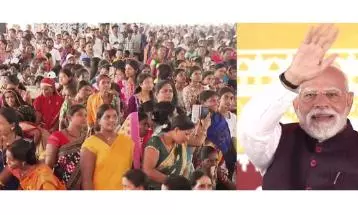
Bhubaneswar: Prime Minister Narendra Modi’s frequent visits to Odisha are reshaping the state’s political dynamics, giving the Bharatiya Janata Party (BJP) fresh momentum ahead of the 2027 panchayat and urban elections.
Since its surprise victory in 2024—when it secured power in Odisha without a strong grassroots network—the BJP has focused on consolidating gains through central leadership outreach, welfare delivery, and developmental projects. Modi, well-supported by Union ministers Amit Shah, Rajnath Singh, and Assam Chief Minister Himanta Biswa Sarma, played a pivotal role in driving the party’s rise. His seven visits to the state in 18 months, according to political analysts, reflect the Centre’s commitment, with announcements spanning semiconductor units, railway expansion, and highway development.
For the BJP, the local polls will be the first major test of whether it can translate top-down political capital into durable grassroots strength. The Biju Janata Dal (BJD), despite losing power in the 2024 Assembly polls, still dominates at the village level. It controls all the 30 Zilla Parishads and over 90 percent of block offices and urban bodies in the state. Interestingly, the BJD polled slightly more votes than the BJP in 2024—10,102,454 (40.22 per cent) against the BJP’s 10,064,827 (40.07 per cent)—reflecting how closely matched the two rivals are.
The BJP is banking on schemes like the Subhadra Yojana, aimed at women voters, to dent the BJD’s core support base. Analysts believe if even half of its beneficiaries shift allegiance, it could tilt the scales decisively in 2029. State BJP president Manmohan Samal has intensified rural campaigns, hoping to energise cadres and project the party as a viable alternative.
Meanwhile, the BJD is facing its stiffest challenge in decades. After 24 years in power, the party is grappling with internal dissent, senior leaders defecting, and persistent concerns over Naveen Patnaik’s health. The absence of a succession plan has further deepened uncertainty, even as the party retains a loyal vote bank.
The Congress, under its state president Bhakta Charan Das, is also attempting a revival by promoting young leaders. Yet, its weak organisation and limited reach keep it a distant third force. Without a clear niche, it risks irrelevance in what is increasingly a bipolar contest between the BJP and BJD.
With the Durga Puja season set to mark a fresh round of BJP activity, the party is expected to intensify rural and urban outreach. The outcome of the 2027 panchayat and municipal elections will be crucial—not just for immediate gains but as a dress rehearsal for the 2029 Assembly polls. Whether the BJP can turn Modi’s popularity into lasting grassroots influence, or the BJD can regroup to defend its dominance, will define Odisha’s political future.
