PM Modi Inaugurates Landmark Pachpadra Greenfield Refinery

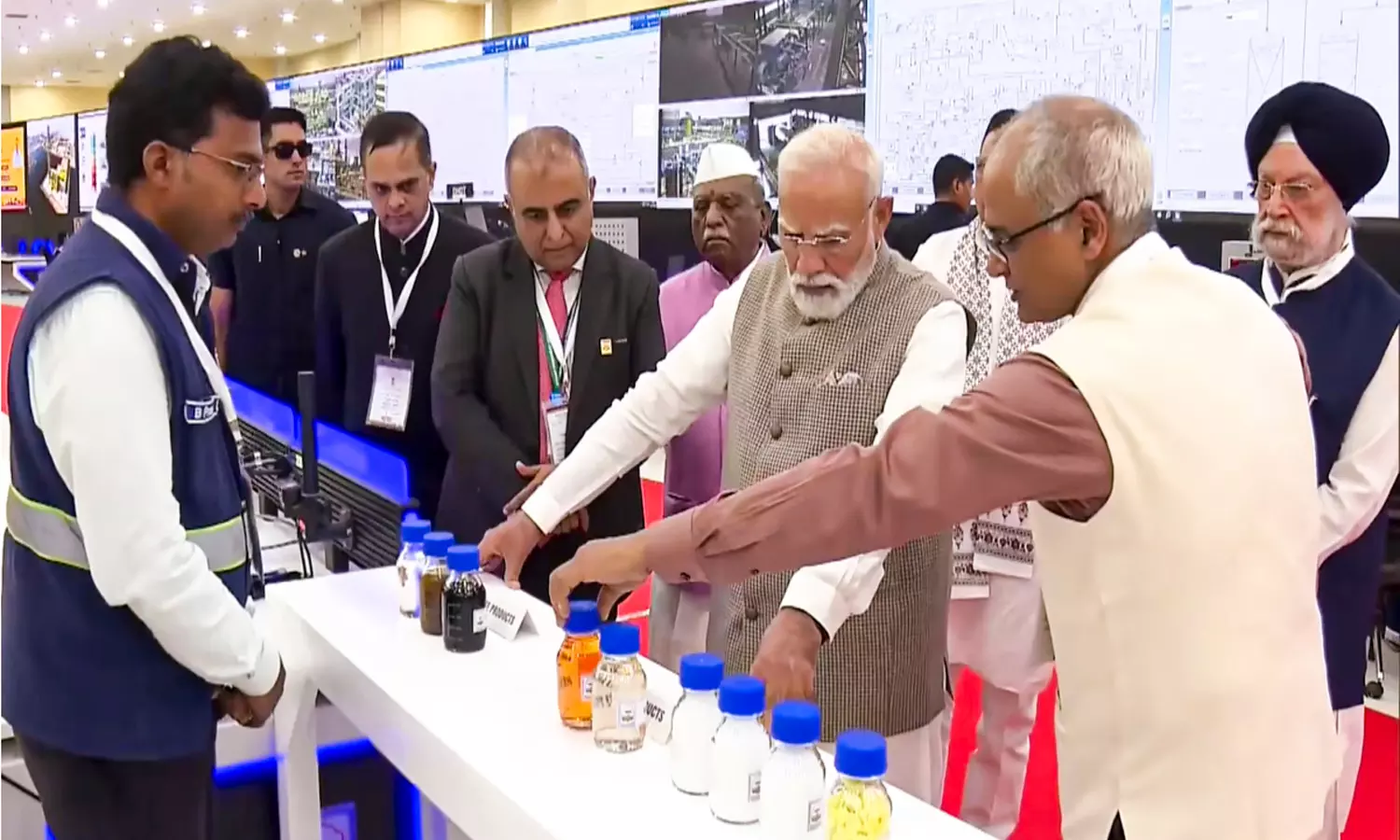
Prime Minister Narendra Modi on Saturday dedicated the country's first greenfield integrated refinery-cum-petrochemical complex to the nation at Pachpadra in Rajasthan's Balotra district.
NEW DELHI, JAIPUR, GANDHINAGAR: Prime Minister Narendra Modi on Saturday said India had successfully navigated one of the biggest global energy crises through proactive policies, diversified fuel sourcing and strong diplomatic ties, while ensuring that the burden on citizens remained minimal.
Addressing a gathering after inaugurating a refinery at Pachpadra in Rajasthan's Balotra district, Modi said rumours were spread and people were incited, but those with malicious intentions did not succeed.
"Those who wished to see India fail had even begun making predictions. Today, they must be wallowing in the depths of despair," he said.
Later in the evening, after inaugurating the CG Semi Outsourced Semiconductor Assembly and Test (OSAT) facility at Sanand in Gujarat, the Prime Minister said India was building the entire electronics value chain, from products and components to semiconductors, which would pave the way for Viksit Bharat.
The Prime Minister dedicated, inaugurated and laid the foundation stone for development projects worth around ₹1.06 lakh crore in Balotra.
Referring to the conflict in West Asia, Modi said the resulting instability had triggered one of the biggest energy crises of the 21st century, leaving even developed nations grappling with fuel shortages.
"Because of the war in West Asia, there is an outcry across the world, and major countries are struggling with fuel shortages," he said.
Contrasting the global situation with India's resilience, the Prime Minister credited timely decisions, balanced resource management and proactive diplomacy for insulating the country's economy.
"India took the right decisions at every level, assessed the crisis in time and effectively used its diplomatic strength to overcome the situation," Modi said.
He also criticised those who spread rumours and panic during the crisis while praising the government's policy interventions and diplomatic efforts.
"When some forces were busy spreading rumours, the policy and diplomatic steps taken to handle the situation were unprecedented," he said.
Highlighting measures to protect consumers, Modi said the government expanded piped natural gas (PNG) connections to reduce dependence on LPG cylinders and connected over 11 lakh households to the network in a short period.
"The government ensured that the entire demand for cooking gas did not depend solely on LPG," he said.
Despite predictions that domestic LPG cylinder prices could rise to ₹2,000, the government kept prices below ₹950 and provided Ujjwala cylinders for less than ₹650, he said.
He added that commercial LPG prices had also been reduced two days earlier.
"This shows how sensitively our government is working to ensure that consumers are not burdened," Modi said.
Referring to the global rise in crude oil prices from $70 to $120 a barrel, the Prime Minister said many countries had introduced fuel rationing because of supply disruptions.
"In many countries, diesel and petrol were supplied on a quota basis because import routes had been disrupted," he said.
He said the government absorbed losses of over ₹75,000 crore between April and June and reduced excise duty by ₹10 per litre to ensure uninterrupted fuel supplies.
"In India, there was not a single day of fuel scarcity, and we ensured that the burden on the people remained minimal," he said.
In Gujarat, Modi said India's youth would power the AI, robotics and next-generation technology revolution with Made-in-India semiconductor chips.
"The expansion of the semiconductor industry in India did not happen overnight. It is the next step in the electronics revolution that has taken place over the past decade," he said after receiving the first semiconductor chips produced at the facility, which will be exported to Japan.
"First products, then components, and now semiconductors. India is building the entire electronics value chain. This is the roadmap to Viksit Bharat. This is the next phase of Make in India," he said.
The Prime Minister said the government's goal was to build a complete semiconductor ecosystem, from chip design to fabrication and packaging.
"The Semicon India programme is gathering rapid momentum, step by step, brick by brick, chip by chip," he said, adding that India's youth would drive the AI, robotics and next-generation technology revolution.
Highlighting the emergence of a domestic semiconductor ecosystem, Modi said companies such as Micron, Kaynes and CG Semi had begun production in the region within months of each other. He said the ecosystem would attract chemical manufacturers, testing laboratories, design centres and startups, creating more jobs and boosting the regional economy.
"This is the true power of a cluster, where one industry gives birth to ten others, transforming the economy of the entire region," he said.
The Prime Minister also noted that India had transformed from a major importer of mobile phones into the world's second-largest producer and exporter of mobile devices.
"We deliberately began with mobile phone manufacturing to achieve these milestones," he said.
Semiconductor Push
• Facility: CG Semi OSAT, Sanand
• First chips: To be exported to Japan
• Goal: Design → fabrication → packaging
• Theme: “Step by step, brick by brick, chip by chip”
• Roadmap: Products → components → semiconductors
• Aim: AI, robotics, next-gen tech with Made-in-India chips
