Pawar presents Rs 7.20 lakh crore state budget, proposes 7 ‘growth hubs’ in MMR

The Maharashtra government further aims to generate five million new jobs over the next five years, supported by memorandums of understanding (MoUs) worth Rs 15.72 trillion signed with 56 companies at the World Economic Forum in Davos
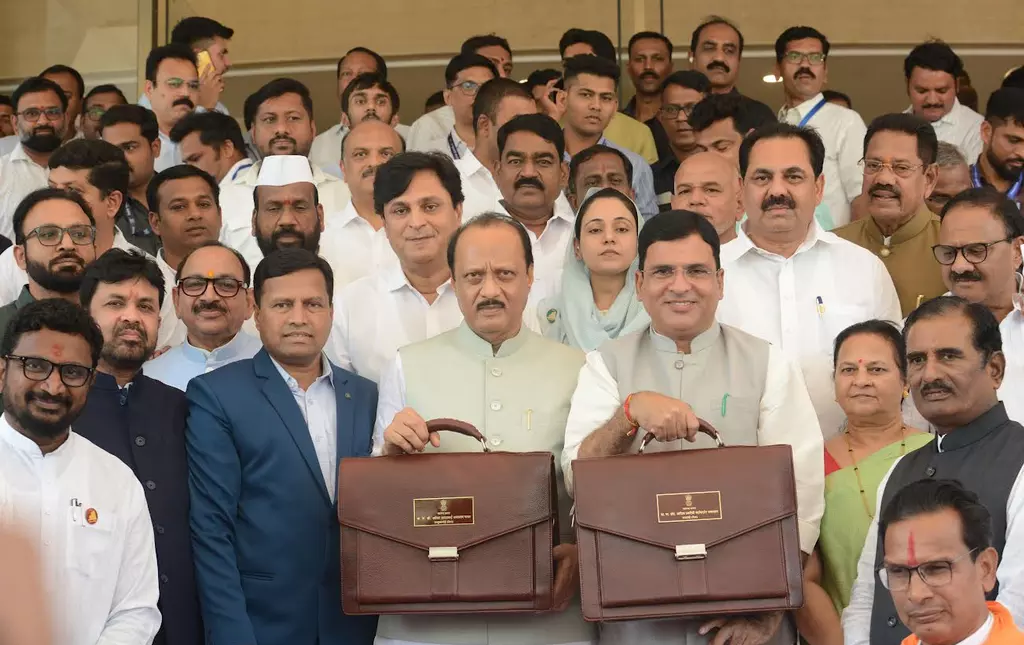
Mumbai: Unlike the election year of 2003-2024, the Maharashtra budget this year did not have any populist announcements. Instead, state finance minister Ajit Pawar, who on Monday presented the ‘Mahayuti’ government’s first budget after the election, announced plans to develop the Mumbai Metropolitan Region (MMR) as an international-class ‘Growth Hub’. To achieve this, seven trade hubs will be set up in the metropolitan region. He also increased taxes on non-transport four wheeler CNG and LPG vehicles.
Mr. Pawar presented a Rs 7.20 lakh crore budget with revenue deficit of Rs 45,892 crore and fiscal deficit of Rs 1,36,234 crore. As per the budget document, the debt stock of the state is Rs 8,39,275 crore in the financial year 2024-25, while it would be increased to Rs 9,32,242 crore in the financial year 2025-26.
However, chief minister Devendra Fadnavis said, “It is true that our debt has increased. At the same time, our ability to take new loans has also increased. A state’s debts should not be more than 25 per cent of its GDP. We are at 18 percent. Maharashtra and Guajarat are the only two states in the country to have debt less than 20 per cent of its GDP. We have not violated the norms of FRBM (Fiscal Responsibility and Budget Management).”
The budget document also said that the government is going to receive Rs 5,60,963 crore including Rs 2,02,278.33 crore from GST, while the revenue expenditure is 6,06,855 crore including Rs 2,02,136.19 crore on general services and Rs 2,49,336.59 crore on financial services. Thus, the revenue deficit will be Rs 45,892 crore for 2025-26 financial year.
In the budget speech, Mr. Pawar said, “MMR will be developed as an international level economic development center, i.e., a Growth Hub. International level business centers will be established at seven locations, such as Bandra-Kurla Complex, Kurla-Worli, Wadala, Goregaon, Navi Mumbai, Kharghar, and Virar-Boisar. The objective is to increase the size of the economy of MMR from the current 140 billion dollar to 300 billion dollar by 2030, and to 1.5 dollar trillion by 2047.”
While praising Mr. Pawar’s budget, the chief minister said, “Mumbai has become a fin-tech capital and start-up capital. Considering the situation, NPCI (National Payments Corporation of India) has come to the state. National Stock Exchange of India Limited has also sought the land. Foreign Banks are coming to Mumbai. This is the time to strengthen and expand our business centre.”
Announcing the tax on motor vehicles of CNG and LPG, the finance minister said, “Motor vehicle tax is currently levied at the rate of 7 per cent to 9 per cent on individual-owned non-transport four-wheeler CNG and LPG vehicles depending on the vehicle type and price. It is proposed to increase this tax rate by 1 per cent. The proposed increase in the motor vehicle tax rate is expected to generate an additional revenue of around Rs. 150 crores for the state in 2025-26.”
The finance minister also proposed to levy motor vehicle tax at the rate of 6 per cent on electric vehicles priced above Rs. 30 lakhs. As per the budget document, the financial year 2024-25, the government collected Rs 14,875 crore through motor vehicle tax. This fiscal year (2025-26), the state is expected to collect Rs 15,606 crore.
Mr. Pawar also announced that the government is planning to develop 1,500 km of new roads and upgrade 7,000 km of existing roads to cemented roads. The Maharashtra government further aims to generate five million new jobs over the next five years, supported by memorandums of understanding (MoUs) worth Rs 15.72 trillion signed with 56 companies at the World Economic Forum in Davos. The budget also included plans for a new health and senior citizens policy.
In his budget speech, Pawar emphasised that the state remains at the forefront of foreign direct investment (FDI) inflows, reinforcing its position as a top destination for global investors.
