He emphasised that such claims were being circulated without substance and did not reflect the internal cohesion of his party.
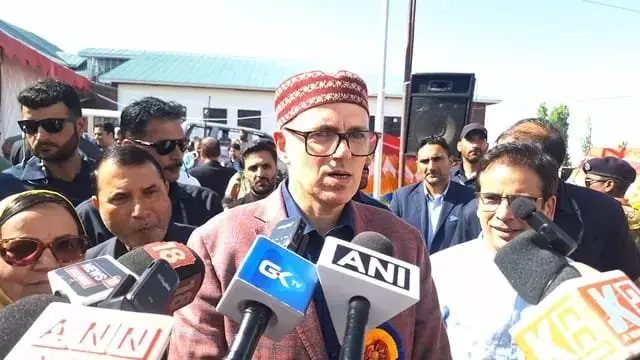
Srinagar: Jammu and Kashmir Chief Minister Omar Abdullah on Wednesday firmly dismissed speculation about possible defections from the National Conference (NC), asserting that no party MLA would shift allegiance to support the Bharatiya Janata Party (BJP).
Speaking to reporters in Tangmarg, near the popular ski destination of Gulmarg, Abdullah—who also serves as the NC’s vice president—described the rumours as baseless and lacking any factual foundation. He emphasised that such claims were being circulated without substance and did not reflect the internal cohesion of his party.
Responding to questions about allegations involving the People’s Democratic Party (PDP), Abdullah referred to earlier developments during the Rajya Sabha elections. He noted that information obtained through the Right to Information Act had already established that the PDP had extended support to the BJP during those polls. According to him, this was not a matter of conjecture but a documented fact that had emerged through official disclosures.
The Chief Minister also reiterated that his government operates independently and does not take instructions from any external organisation or political force. He stressed that the administration “speaks and acts for itself,” underscoring the autonomy of decision-making within the Union Territory government. On the reopening of tourist destinations, Abdullah explained that the issue had been discussed in the Legislative Assembly and that several locations had already been opened to visitors. The remaining sites shut after the Pahalgam terror attack, he said, would be reopened in a phased and carefully managed manner to ensure safety and preparedness.
Addressing questions about a possible cabinet expansion, Abdullah maintained that a decision would be taken at an appropriate time. He refrained from making any specific commitments, indicating that the matter required deliberation and would be handled in due course.
Earlier in the day, while speaking at an academic function, he hinted at a significant political message he intended to deliver after Eid-ul-Azha falling in the last week of May. He explained that he was deliberately holding back because the academic setting was not suitable for political commentary. “Trust me, I want to burst like a cloudburst,” he remarked, adding that he would speak more openly at a public gathering after the festival.
Turning to governance and youth-related issues, Abdullah highlighted the central role of students in shaping the future of J&K. He said the government was working to strengthen education, employment, and economic opportunities for young people across the region. One of the challenges he pointed out was the limited presence of private universities in the state, which had compelled many families to send their children outside J&K for higher education—often at considerable financial cost. To address this gap, he said the government had passed a Private University Bill and was in the process of framing rules for its implementation. He expressed hope that private universities would soon be established in various parts of the region, noting that areas like Tangmarg offered favourable conditions for such institutions.
On employment, Abdullah acknowledged that government jobs alone could not resolve the issue of unemployment. However, he said the administration had set a target of providing between 20,000 and 25,000 government jobs during the year to offer immediate relief. He also highlighted self-employment initiatives such as Mission Yuva, which aims to improve access to loans for young entrepreneurs, including those working in tourism, small businesses, and emerging sectors. Skill development programmes, he added, were being expanded to align training with market needs and to equip young people with practical, employable skills.
Abdullah emphasised that the broader goal of his government was to build a self-reliant J&K with strong local economic foundations. By strengthening education, employment, and infrastructure, he said, the region could reduce long-term dependence on the Centre and create sustainable opportunities within its own boundaries. “We want a day when we can stand on our own,” he said, expressing confidence that sustained efforts would help achieve that vision.
Meanwhile, PDP president Mehbooba Mufti criticised the NC leadership, accusing it of “dragging” religious scripture into political discourse to divert attention from what she described as the government’s shortcomings. “For God’s sake, do not drag the Quran into politics. They are doing this to hide their failures over the past two years of being in government. People are disheartened with them,” she told reporters. Her remarks came in response to comments by NC chief spokesman and MLA Tanvir Sadiq, who had challenged the PDP president and her MLAs to swear by the Qur’an that they had not voted for the BJP in the previous year’s Rajya Sabha elections. An RTI reply had revealed that the PDP had not appointed a chief agent for those polls, prompting the NC to allege that the party’s three MLAs had supported the BJP.
Mufti rejected the allegations, asserting that the NC was attempting to deflect attention from its own performance in government.

