Omar Abdullah Defends Power Tariff Hike Amid Rising Political Tempers in J&K

6.83% rise from September sparks opposition fury over unfulfilled free-power promise
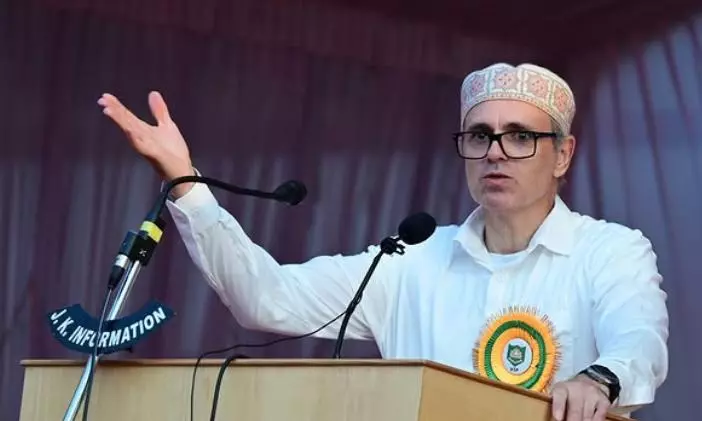
Srinagar: Jammu and Kashmir Chief Minister Omar Abdullah on Monday mounted a firm defence of the recent electricity tariff hike, describing the increase as a “compulsion” driven by structural pressures in the power sector.
He emphasised that his government had never promised a freeze on electricity rates, asserting instead that its commitment was limited to providing 200 units of free electricity to the poorest households through a solar-based scheme—a pledge he insisted remains intact and unrelated to the tariff revision.
The tariff hike, approved by the Joint Electricity Regulatory Commission (JERC) for J&K and Ladakh, introduces an average 6.83 per cent increase for the financial year 2026–27. The revised rates will apply strictly to electricity consumed from September 1 onward, marking the first upward revision in four years. JERC’s decision followed detailed scrutiny of proposals submitted by the Jammu Power Distribution Corporation Limited (JPDCL) and Kashmir Power Distribution Corporation Limited (KPDCL), both of which had sought a 5 per cent increase to meet revenue requirements.
Earlier in the day, Srinagar witnessed loud street protests led by activists of the People’s Democratic Party (PDP) and the J&K Apni Party. Demonstrators accused the government of reneging on its promise of free electricity and demanded an immediate rollback.
Chief Minister Abdullah dismissed the criticism, reminding opponents that previous governments had raised tariffs by 14 per cent and 15 per cent, far higher than the current increase. He argued that inflation, rising commodity prices, and mounting sectoral losses had made a modest hike unavoidable. “We increased the rates by as little as we could… This was our compulsion,” he said, adding that improvements in the power sector would reduce the need for such measures in the future.
The Chief Minister also addressed unrelated political concerns, clarifying that there was no crisis within the government and that a cabinet reshuffle would occur only when necessary. He reiterated that he had merely ruled out a reshuffle before August 15, not beyond. On reports of threats issued to Kashmiri Pandit employees, Abdullah urged security agencies to conduct a thorough investigation, stressing that such threats must be taken seriously given past incidents targeting minority employees.
The tariff order itself reveals the financial strain on J&K’s power distribution companies. JERC assessed the combined Annual Revenue Requirement (ARR) of JPDCL and KPDCL at Rs 10,275.72 crore, while projected revenue under existing tariffs stood at Rs 7,352.87 crore, leaving a gap of Rs 2,922.85 crore. Bridging this gap through tariffs alone would have required a staggering 40 per cent increase, which the Commission deemed untenable. To cushion consumers, JERC factored in Rs 2,420.78 crore in government subsidy under Section 65 of the Electricity Act, 2003. The remaining shortfall will be met through government grant-in-aid, allowing the tariff hike to remain relatively moderate.
Despite these explanations, political reactions have intensified. Opposition parties accuse the National Conference government of betraying its flagship election promise of free electricity. BJP vice president Priya Sethi criticised the move as a “new shock” for consumers ahead of winter, questioning the whereabouts of the promised relief. Leader of Opposition Sunil Sharma called the hike a “betrayal of the people”, arguing that the government had shifted from pre-election promises to post-election burdens. NC MP Aga Syed Rahullah acknowledged that the pledge of free electricity remains unfulfilled even after two years in office, while PDP MLA Waheed Ur Rehman Para described the shift from promises to higher bills as a clear reversal. Apni Party chief Syed Altaf Bukhari labelled the move “selfish” and “draconian,” vowing to oppose measures that increase the burden on ordinary citizens.
Trade bodies, including the Kashmir Trade Alliance (KTA), have warned that the hike will further strain the region’s fragile economy. Ordinary consumers echoed similar concerns, saying the increase contradicts the relief they were promised and adds to the rising cost of living.
