Odisha Must Build Climate-Resilient, People-Centric Development: CS Ahuja
The conclave features 15 thematic sessions across five pillars—ecosystem protection, just transitions, resilient governance, vulnerability reduction and social leadership
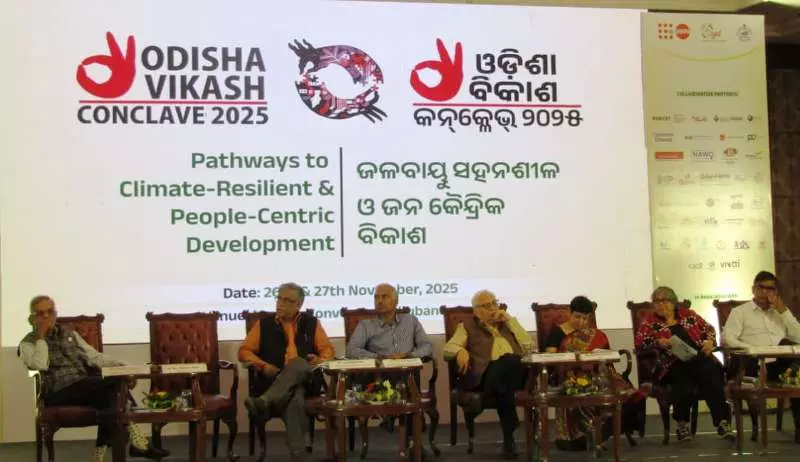
Bhubaneswar: Odisha’s development pathway—amid rising climate risks, shifting livelihoods and growing social vulnerabilities—must be grounded in strong partnerships between the government, civil society, academia, markets and communities, said Chief Secretary Manoj Ahuja on Wednesday.
Speaking at the inaugural session of the 6th Odisha Vikash Conclave (OVC) 2025, organised by the Centre for Youth and Social Development (CYSD), Ahuja stressed the importance of decentralised, community-driven approaches. Empowering SHGs and local organisations, he said, is key to improving service delivery, creating local livelihoods and reducing distress migration.
OVC 2025 places “Balanced Development and Climate Resilience” at the core of Odisha’s long-term vision, said Dr. Jagadananda, convenor of the Odisha Development Initiative and Co-founder of CYSD. He highlighted the interconnectedness of forests, coasts, wetlands, livelihoods, governance and technology, urging the State to prioritise last-mile communities as partners in shaping solutions.
Dr. Md. Nadeem Noor, State Head of UNFPA Odisha, noted that the State’s fertility rate has declined to 1.6 and that Odisha is projected to enter a “net mortality zone” by 2041. With rising life expectancy, declining births and increasing disability prevalence, he called for anticipatory governance and a robust public health strategy.
Srestha Banerjee, Director of Just Transition & Climate Change at iFOREST, said the recent COP30 has elevated Just Transition as a global priority. Odisha, she emphasised, must adopt a people-centric approach that safeguards livelihoods in coal-bearing and resource-dependent regions. Planning, she said, must extend down to the district, block and panchayat levels.
The conclave features 15 thematic sessions across five pillars—ecosystem protection, just transitions, resilient governance, vulnerability reduction and social leadership. It will produce key outcomes, including an Odisha Climate & Development Policy Brief and a compendium of locally led, climate-resilient solutions for scale-up.
Speakers included Dr. Rajesh Tandon, Co-Chair, UNESCO Chair in Community-Based Research; Rajib S. Sahoo, Chairperson, ICC Odisha; Avimuktesh Bhardwaj, Back to Village; and Swapna Sarangi, FES.
CYSD is hosting the OVC in partnership with the Government of Odisha and organisations such as iFOREST, FES, Back to Village, Gram Vikas, Aide et Action India and UNFPA.
