Odisha Farmer’s Integrated Model Yields Prosperity, Jobs In Tribal Rayagada

The model combines crop diversification, horticulture, fisheries and organic practices — significantly enhancing productivity, income stability and rural employment: Report
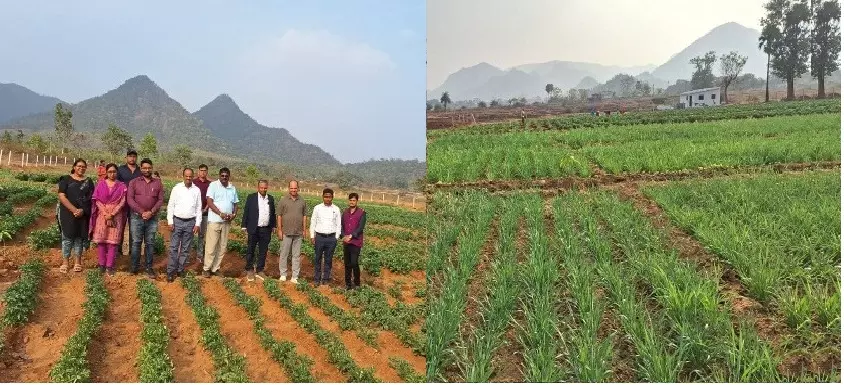
RAYAGADA: At a time when many small farmers cite rising input costs and uncertain markets, a progressive cultivator from Odisha’s tribal Rayagada district is demonstrating how integrated farming can turn adversity into opportunity.
Ramachandra Behera, an entrepreneur-farmer from Bijamandali village, about 12 km from Muniguda, has transformed what was once a single-crop paddy field into a thriving eight-acre integrated farm branded as “RCB Farm.” The model combines crop diversification, horticulture, fisheries and organic practices — significantly enhancing productivity, income stability and rural employment.
Until a few years ago, Behera’s land produced only kharif paddy. Today, the landscape is a mosaic of cereals, pulses, oilseeds, vegetables and fruit orchards interwoven with fish ponds.
The farm grows wheat and sugarcane alongside oilseeds such as mustard and sunflower. Pulses including green gram, black gram, horse gram and lentil are cultivated in rotation to improve soil fertility. Seasonal vegetables — potato, radish, chilli, coriander, leafy greens, cucumber, ginger, pumpkin, bottle gourd, watermelon, okra and both indigenous and sweet corn varieties — ensure year-round cash flow.
Bordering the fish ponds are orchards of banana, mango, coconut, jackfruit, cashew and litchi, creating a multi-tier cropping system that maximises land use and ecological balance.
The eight-acre farm is managed largely through organic methods, emphasising soil health, water conservation and crop diversity. Officials who recently visited the site said the integrated approach reduces risk, lowers dependence on chemical inputs and ensures multiple income streams.
A nine-member team from the district’s agriculture and farmers’ empowerment department, horticulture department, watershed and soil conservation wing, and ATMA (Agricultural Technology Management Agency) inspected the farm and described it as a replicable model for small and marginal farmers.
Beyond profits, Behera’s farm has emerged as a local employment hub. Between eight and ten workers are engaged daily, earning steady livelihoods close to home.
Behera says his larger vision is to prevent distress migration by providing sustainable work to landless and below-poverty-line families in the village. Plans are underway to expand into dairy farming, duck and poultry rearing, floriculture and beekeeping — further strengthening the integrated ecosystem.
Government schemes aimed at soil conservation, water management and farmer empowerment have laid the groundwork, but Behera believes individual initiative is the key differentiator.
“Schemes help, but a farmer’s interest and determination decide success,” he says.
