Hyderabad House: Symbol of Nizam's Royal Past Turned Diplomatic Landmark In Delhi

5 Dec 2025 12:36 PM IST5 Dec 2025 12:36 PM IST
PM Narendra Modi and Russian President Vladimir Putin will participate in the 23rd India-Russia summit at the Hyderabad House in New Delhi today (December 5).
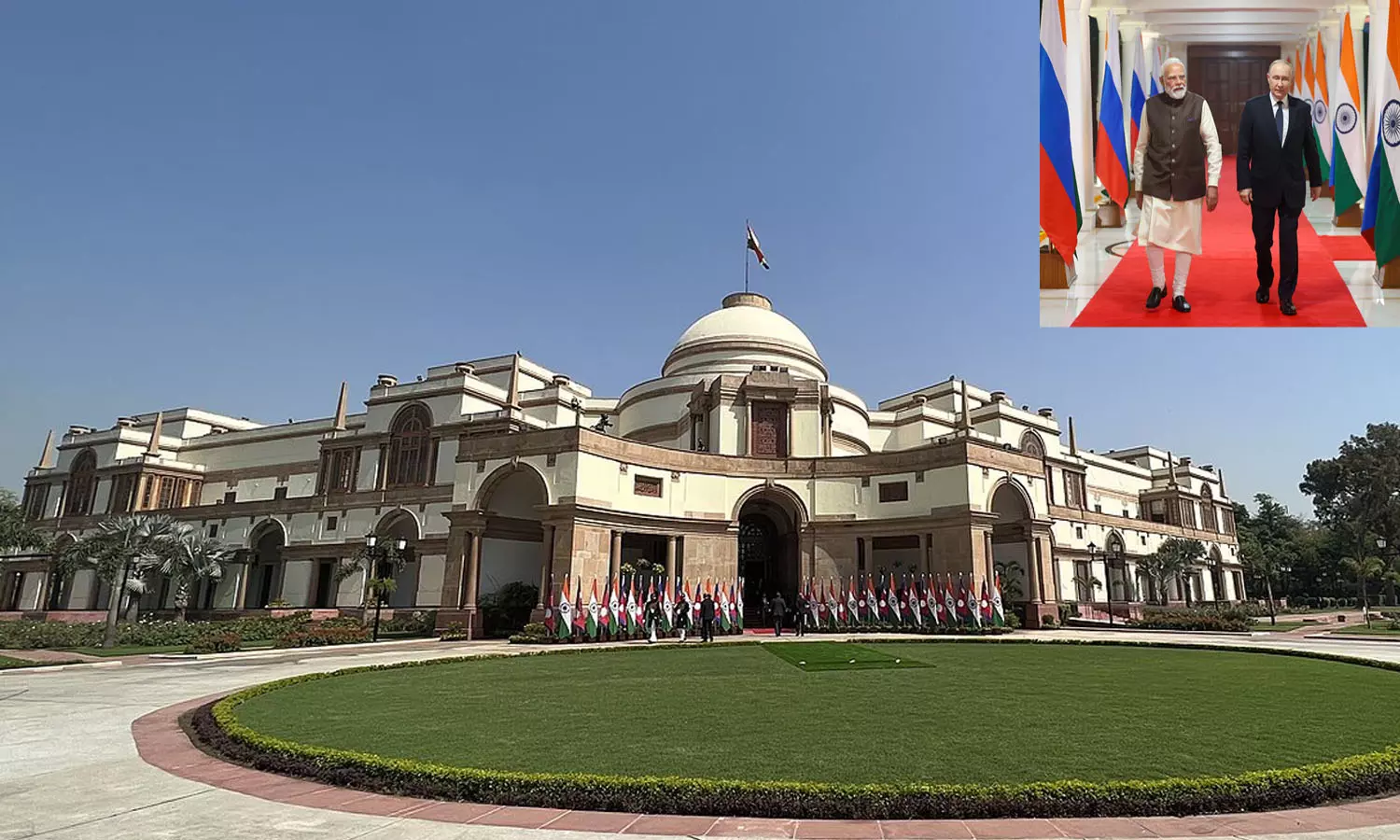
Hyderabad House ( Source Wikimedia Commons) Inset: PM Narendra Modi & Russian President Vladimir Putin ( Source PIB)
Delhi: With Prime Minister Narendra Modi all set to host Russian President Vladimir Putin for the second time at the iconic Hyderabad House in New Delhi on Friday (December 5) for the 23rd India-Russia summit, the focus now is on the venue of the meeting. The Hyderabad House, a royal palace which was once owned by the richest man in the world and the last Nizam of Hyderabad, Mir Osman Ali Khan, is now a landmark building used by the Central government to host foreign dignitaries.
Currently, under the control of the Ministry of External Affairs (MEA), it serves as the Prime Minister’s state guest house, primarily used for high-profile banquets, press conferences, and diplomatic meetings.
Mir Osman Ali Khan, the 7th Nizam of Hyderabad ( DC Photo Library)
Origins and Construction
Hyderabad House, one of New Delhi’s most iconic landmarks, was commissioned by Mir Osman Ali Khan, the seventh Nizam of Hyderabad, in 1919. The Nizam purchased 8.2 acres of land in the heart of Delhi to build his royal residence after the British shifted India’s capital from Calcutta to Delhi in 1911. To accommodate rulers of princely states attending the newly formed Chamber of Princes, the British allocated plots of land to five states of Hyderabad, Baroda, Patiala, Jaipur, and Bikaner at the end of King’s Way (now Kartavya Path), close to the Viceroy’s House (now Rashtrapati Bhavan).
The Nizam entrusted renowned architect Edwin Lutyens with the design. Between 1921 and 1931, Lutyens created Hyderabad House in the shape of a butterfly, blending European styles with Mughal motifs. The palace featured 36 rooms, including four for the zanana, courtyards, archways, stairways, fireplaces, and fountains.
Hyderabad House | Source Wikimedia Commons
Architectural Grandeur
No expense was spared in its construction. Teak was imported from Burma, furnishings matched those of London hotels, and electrical fittings came from New York. The palace cost approximately ₹50 lakh at the time, equivalent to ₹170–180 crore today. Its interiors included rhombic marble floor designs, a circular foyer, and a grand hallway. The dining hall could seat over 500 guests and was adorned with silver.
The Nizam also invested in art, purchasing 30 paintings from Lahore’s famed painter Abdul Rahman Chuqtai for ₹12,000, along with additional commissioned works. Carpets were procured from regions such as Anatolia, Iraq, Persia, Turkestan, and Afghanistan, adding to the palace’s opulence.
Reception by the Nizam
Despite its grandeur, the Nizam and his family were unimpressed by the Westernised style. During his visit in 1936, Mir Osman Ali Khan reportedly dismissed Hyderabad House as resembling a “horses’ stable” rather than a royal palace. Consequently, the residence was rarely used by the Nizam.
Transition to Government Control
After India’s independence in 1947, Hyderabad initially resisted integration into the Indian Union. Following Operation Polo in 1948, the state was annexed, and Hyderabad House fell into disuse. In 1954, the Government of India leased the property, and by the mid-1970s, the Ministry of External Affairs (MEA) assumed full jurisdiction. The India Tourism Development Corporation (ITDC) managed catering and events, while the building was designated for state visits and banquets.
Hyderabad House ( Source ITDC website)
In the early 1990s, a land exchange agreement between the Centre and the erstwhile Andhra Pradesh government granted the state land near Andhra Bhavan in New Delhi in return for Hyderabad House.
File Pic: New Zealand PM Christopher Luxon with PM Narendra Modi at Hyderabad House ( Image Source: PIB)
Today, Hyderabad House serves as the Prime Minister’s state guest house under the MEA. It is the venue for high-profile banquets, press conferences, and diplomatic meetings. Over the years, it has hosted global leaders including former US President Bill Clinton, Britain’s ex-PM Theresa May, Russia’s Vladimir Putin, and New Zealand’s Prime Minister Christopher Luxon. Hyderabad House currently remains a symbol of India’s royal past and its modern diplomatic stature.

Next Story