NIT Rourkela Patents Advanced System To Detect Intruders In Restricted Zones

Developed at a cost of Rs. 1.90 lakh, the system uses thermal imaging technology for low-light and night-time operation
Bhubaneswar: National Institute of Technology at Odisha’s Rourkela (NIT Rourkela) innovators have secured a patent for an intelligent surveillance technology titled “Unauthorized Person Detection using Thermal Imaging and Gait Recognition for Intra-Building Security.”
The system has been developed by Professor Samit Ari, department of electronics & communication engineering, along with research scholar Mohammad Iman Junaid, and M. Tech graduates Narayan Prasad Sharma and Irshad Ali from NIT Rourkela. It introduces a next-generation solution to address the challenge of monitoring unauthorized access in large and complex building environments.
Conventional CCTV camera-based surveillance systems require extensive manual monitoring and analysis, making them ineffective and prone to human errors. In large setups, tracking individuals across multiple cameras is difficult, particularly under varying lighting conditions and occlusions.
To address these limitations, the NIT Rourkela research team developed a fully automated, non-intrusive system that can detect, identify, and track individuals using thermal imaging technology. Developed with the support of the Science and Engineering Research Board (SERB), India, under grant number CRG/2019/001414, the innovation is designed to monitor suspicious activities. The integrated thermal imaging technology helps distinguish humans from the background due to lower infrared noise and enables accurate detection even in inadequate lighting conditions.
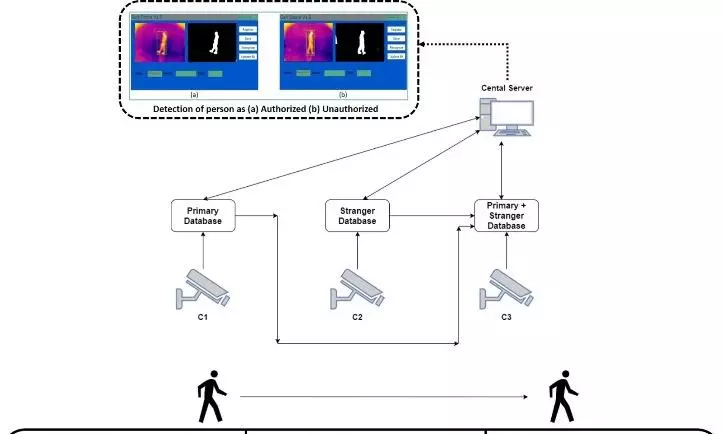
To achieve this, the research team has used human gait as a biometric identifier, which recognises individuals based on their unique walking pattern, thus reducing the need for manual monitoring. When a person enters a restricted area, the system compares their walking pattern with those of authorized individuals. If no match is found, it flags the individual as suspicious and alerts security.
The research team has developed a working prototype with three thermal cameras connected to a central server via USB interfaces. The system detects unauthorized individuals at entry, tracks their movement across multiple checkpoints, maintains a temporary database for unknown individuals, and determines entry and exit patterns based on movement direction. If an individual exits the restricted area, their temporary record is cleared, while historical data remains stored for future reference and forensic use.
Speaking about the key features of the developed technology, Prof. Samit Ari said, “Developed at an estimated cost of Rs. 1.90 lakh, the system uses thermal imaging for low-light and night-time operation, along with gait-based identification for non-intrusive biometric recognition. Automated multi-camera tracking enables seamless monitoring across locations, supported by centralised data processing for logging and database management.”
As the next step, the research team is looking for potential industry collaborations to bring the technology to real-world deployment, particularly in security-sensitive sectors.
