India Has Boarded Reform Exp: Modi Meets India Inc

Seeks to build world-class capabilities, global integration
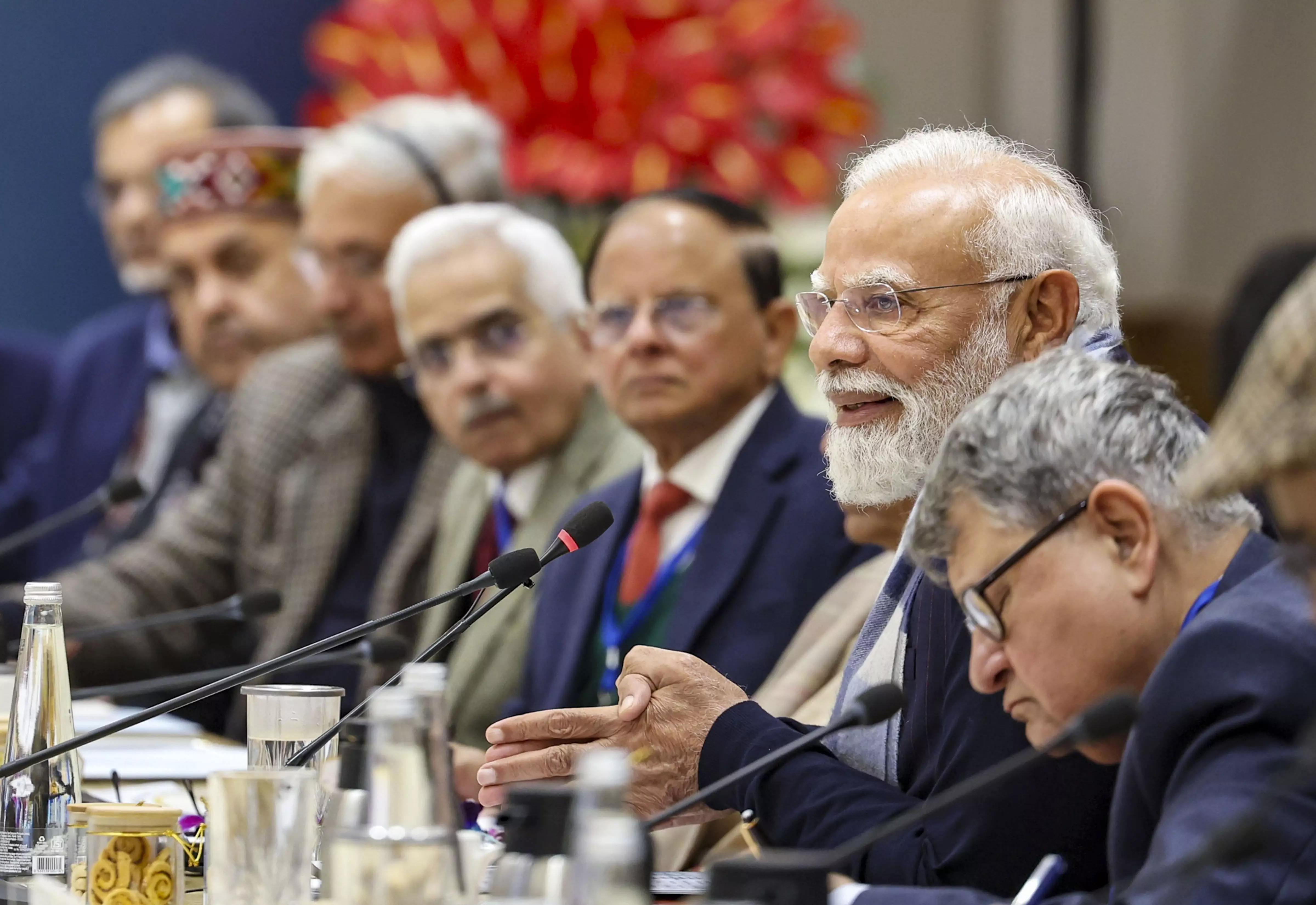
New Delhi: Prime Minister Narendra Modi on Tuesday said that India has boarded the ‘Reform Express’ as the country has emerged as the centre of global attention due to the innovative zeal of our people. Stressing the need for building global capability and attaining global integration, the prime minister called for mission-mode reforms across diverse sectors to sustain long-term growth. "India’s policymaking and budgeting must remain anchored with vision for 2047. There is a need to ensure that the nation remains a vital hub for the global workforce and international markets," he said.
Ahead of the budget, the Prime Minister also shared his thoughts in a meeting with eminent economists and sectoral experts to seek their views on the budget for 2026-27.
During the interaction, the economists shared strategic insights on enhancing productivity and competitiveness across the manufacturing and services sectors. The discussions focused on accelerating structural transformation through increased household savings, robust infrastructure development, and the adoption of cutting-edge technology. They also explored the role of artificial intelligence (AI) as an enabler of cross-sectoral productivity and also discussed the continued scaling of India’s Digital Public Infrastructure (DPI).
Modi further said that India is being appreciated by the world for the manner in which the pace of progress has been accelerated with next-generation reforms, which are cross-sectoral and amplify the nation's growth potential. "The year 2025 would be remembered as a year for India when it focused on reforms as a continuous national mission, building on the ground covered over the past 11 years. “We modernised institutions, simplified governance, and strengthened the foundations for long-term, inclusive growth,” he said in a social post.
“I have been telling many people that India has boarded the Reform Express. The primary engine of this Reform Express is India’s demography, our young generation and the indomitable spirit of our people. Today, the world sees India with hope and confidence. They appreciate the manner in which the pace of progress has been accelerated with next-generation reforms, which are cross-sectoral and amplify the nation’s growth potential,” Modi said.
The meeting is being held as part of the government’s ongoing consultations ahead of key economic decisions in the next Union Budget. Besides economists and sectoral experts, Union finance minister Nirmala Sitharaman, Niti Aayog vice chairman Suman Bery, Niti Aayog CEO BVR Subrahmanyam and other members also attended the meeting, according to officials.
Modi also said that the government moved ahead decisively with higher ambition, faster execution and deeper transformation. “We moved ahead decisively with higher ambition, faster execution and deeper transformation. The reforms have been about enabling citizens to live with dignity, entrepreneurs to innovate with confidence and institutions to function with clarity and trust,” he said.
The prime minister also cited a few examples of the reforms undertaken that include GST, permission of 100 per cent FDI in Indian insurance companies, labour laws and rural employment guarantee. “Clean the two-slab structure of 5 per cent and 18 per cent has been implemented in the GST and the burden has been eased on households, MSMEs, farmers and labour-intensive sectors,” he said, adding that the purpose is to ensure dispute reduction and better compliance and this reform has boosted consumer sentiment and demand.
He also said that unparalleled relief has been given to the middle class. In a first, individuals earning up to Rs 12 lakh a year faced no income tax at all. “The Obsolete Income-tax Act of 1961 has been replaced with the modern and simple Income Tax Act, 2025. Together, these reforms mark India's move towards a transparent, technology-driven tax administration,” he said.
On small and medium businesses, Modi also said that the definition of small companies has been expanded to include firms with turnovers up to Rs 100 crore. “Compliance burdens and associated costs for thousands of companies will get reduced. The government allowed 100 per cent FDI in Indian insurance companies. This will give a fillip to insurance penetration and security for the people. Apart from enhanced competition, it would offer better insurance choices and improved service delivery for the people,” he said.
The prime minister also said five landmark maritime legislations were passed in a single Parliament session (the Monsoon session): the Bills of Lading Act, 2025; the Carriage of Goods by Sea Bill, 2025; the Coastal Shipping Bill, 2025; the Merchant Shipping Bill, 2025; and the Indian Ports Bill, 2025. “These reforms simplify documentation, make dispute resolution easier and reduce logistics costs and outdated Acts dating back to 1908, 1925 and 1958 have also been replaced,” he said.
Among all, he said that historic labour reforms were initiated by merging 29 fragmented laws into four modern labour codes. “India has created a labour framework that secures the interests of workers while boosting the business ecosystem. The reforms focus on fair wages, timely payment of wages, smoother industrial relations, social security and safer workplaces. They ensure greater female participation in the workforce. Unorganised workers including contract workers are brought under the ESIC and EPFO expanding the coverage of the formal workforce,” he added.
Citing trade agreements with New Zealand, Oman and Britain, Modi said that these would add to investments, boost job creation and also encourage local entrepreneurs. “They reinforce India's position as a trusted and competitive partner in the global economy. The FTA with the European free trade association, comprising Switzerland, Norway, Iceland and Liechtenstein, has been operationalised. This marks India's first FTA with developed European economies,” he added.
