Mumbai: Police Deny Jarange Permission for Protest at Azad Maidan

Jarange, who has led multiple hunger strikes in the past, has demanded that all Marathas be officially recognized as Kunbis – an agrarian caste classified under the Other Backward Classes (OBC) category.
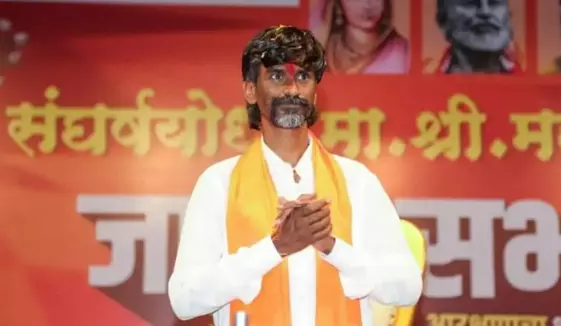
Mumbai: In a setback to Maratha quota activist Manoj Jarange, the Mumbai Police have denied permission to him to hold a hunger strike at Azad Maidan next week raising concerns over potential law and order problems.
The police also cited violations of conditions during the hunger strike undertaken by him in Mumbai last year.
Jarange had said he and his supporters would march to Mumbai on September 15 and hold an indefinite hunger strike at Azad Maidan on September 19.
He had assured to comply with all terms and conditions while seeking permission for the hunger strike.
However, the Azad Maidan Police Station informed that permission for the indefinite hunger strike has been denied because such a protest could disrupt normal life specifically in South Mumbai, affecting schools, hospitals, judiciary, public transport and healthcare services, thereby potentially creating a serious law-and-order situation.
Police further stated that large-scale Ganeshotsav celebrations, beginning from September 14, require extensive police deployment. Holding a protest amidst these crowds would raise public safety concerns, they added.
Police said while Azad Madian can accommodate only 5,000 protesters, last year around 40,000 protesters turned up, thereby infringing upon the rights of other protesters.
The police have also cited the likelihood of traffic congestion pointing out that Jarange had stated that “vehicles would number in the lakhs.” Last year, a ‘rasta roko’ was staged by parking approximately 5,000 vehicles illegally on the main roads of South Mumbai. As a similar situation is anticipated this year, there is a risk of disruption to the public transport system, police said.
The police have expressed concern that the protests would have an adverse impact on business in the city. South Mumbai houses the High Court, Sessions Court and Magistrate Courts. Last year, judges and lawyers faced obstacles in reaching the courts.
If key financial hubs such as Crawford Market, Zaveri Bazaar, the BSE, and the RBI were to shut down, it would have far-reaching consequences for the country's economy, they added.
Despite police’s denial, Jarange has clarified that he remains firm on his decision to stage the protest. “We abide by the Constitution. If the government tramples upon the law, the courts deliver justice.
We are not bound by the government’s rules, nor do we accept them,” he said.
Jarange alleged that police denied him permission out of malice. “The fact that permission is being refused even when the court has stated that every citizen has the right to protest reveals an underlying animosity.
The law cannot be applied merely for convenience. We do not accept dictatorship and hooliganism,” he said.
Jarange, who has led multiple hunger strikes in the past, has demanded that all Marathas be officially recognised as Kunbis – an agrarian caste classified under the Other Backward Classes (OBC) category. He has also pressed for reservations for the Maratha community in government employment and educational institutions.
