MP Played Key Role in Renaming India as Bharat, Says CM Yadav
CM Recalls Contributions of Govind Das and Hari Vishnu Kamath; Criticises Congress Over Constitutional Amendments
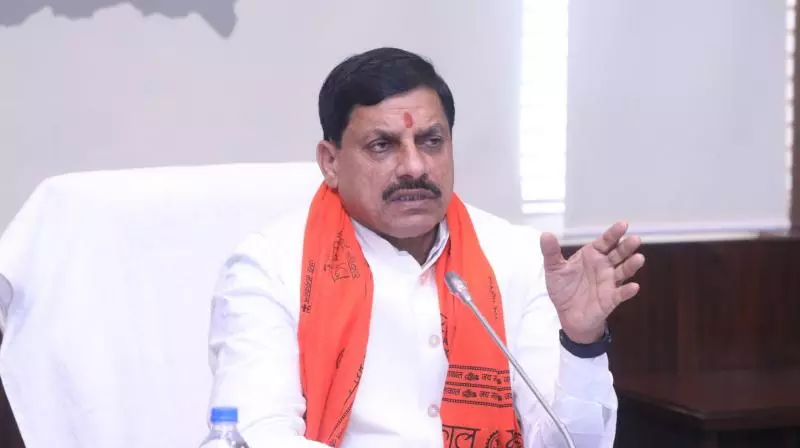
Madhya Pradesh chief minister Mohan Yadav on Thursday said that MP played a key role in renaming India as Bharat.
Addressing the Constitution Day Celebration at the Madhya Pradesh Legislative Assembly here, he said that the state made an important contribution to the decision to name the country ‘Bharat’, instead of ‘India’.
Seth Shri Govind Das and Shri Hari Vishnu Kamath, who represented the Madhya Bharat region, had strongly advocated the name Bharat in place of India, he recalled.
He said that the Constitution Day celebration 2026 reflects our glorious heritage and tradition.
Equality and fraternity are the soul of our constitution, and Madhya Pradesh played a significant role in its making, he said.
He recalled that Dr Harisingh Gour, hailing from Madhya Pradesh, had emphasized in 1921 the need to establish a supreme court within the country to ensure that the highest judicial decisions were delivered in India.
In 1928, Pandit Motilal Nehru also supported this view.
Former chief ministers of Madhya Pradesh, Pandit Ravishankar Shukla and Bhagwant Rao Mandoli, among others, raised issues concerning the contributions of the states and the Centre, as well as the distribution of taxes, he said.
In the present era, prime minister Narendra Modi has strengthened the system through the implementation of GST, introducing a simplified framework in coordination with the states.
The chief minister also highlighted Madhya Pradesh’s connection with the national emblem of India, the Ashok Pillar with its four lions.
He accused the Congress of amending the constitution multiple times, tampering with its spirit in the process.
The Indian constitution came into force in 1950, and the then prime minister introduced the First Constitutional Amendment in 1951, followed by the second Amendment in 1954.
Although the parliament has the constitutional authority to amend the constitution, amendments were also made without following the proper constitutional process, he said.
This reflected the approach of the then government towards the constitution, he said.
“The same attitude was evident in the imposition of the Emergency following the Allahabad High Court verdict and in the 39th and 42nd constitutional amendments, which altered several constitutional provisions”, he said and added that attempts were also made to curtail the powers of the judiciary.