Modi Urges India to Shed ‘Slave Mentality’ in Next Decade

Mr Modi said the country’s economic performance was linked to the faith of its people and an entire society was reduced to a synonym for poverty
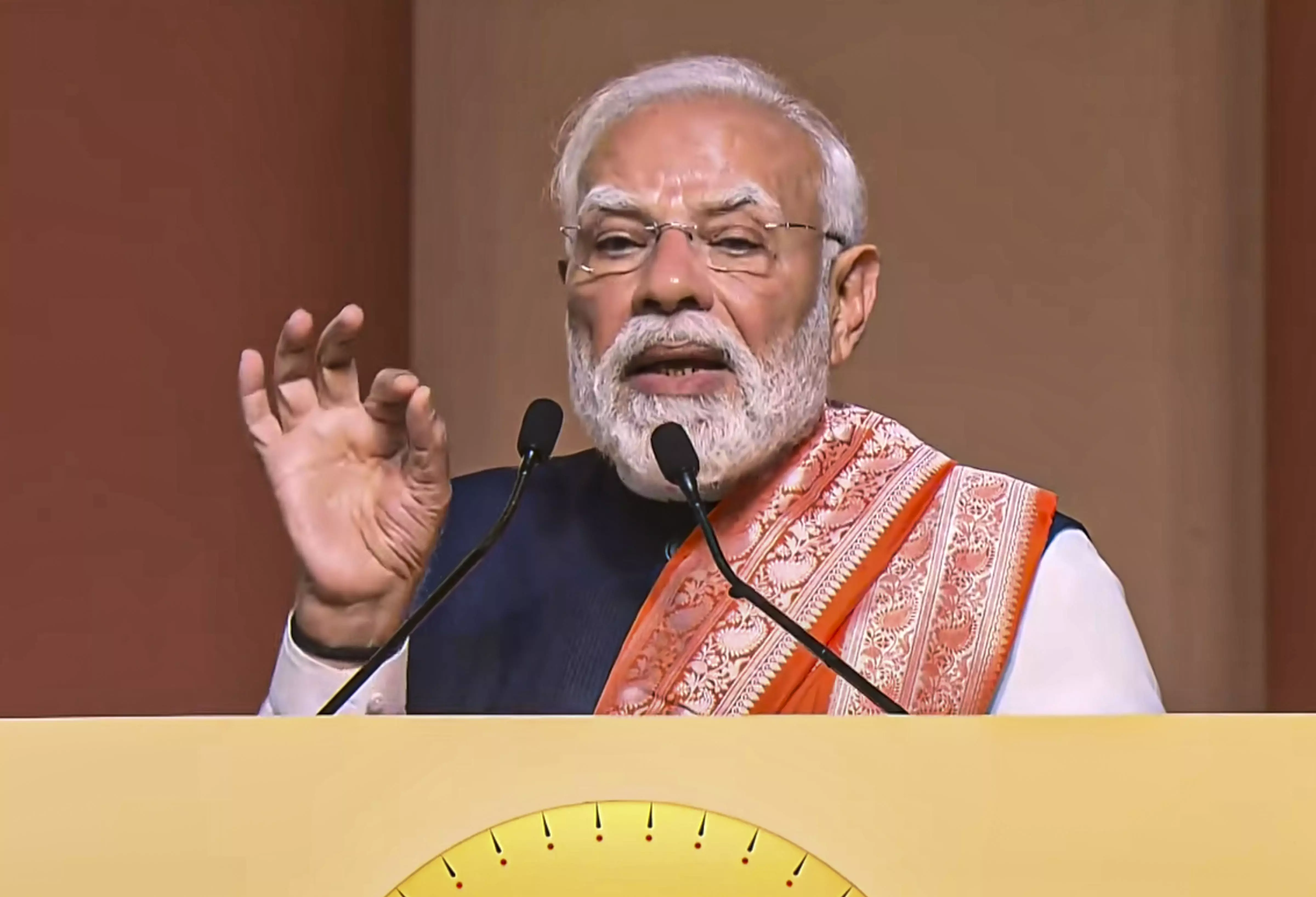
New Delhi: Prime Minister Narendra Modi on Saturday urged people to completely rid the country of the slave mentality in the next 10 years and hit out at “so-called intellectuals” for trying to malign an entire civilisation by terming years of sluggish economic growth as the Hindu rate of growth.
Addressing an event in the national capital, Mr Modi said India is brimming with confidence at a time when the world is full of uncertainties and is scripting the story of growth in the era of global slowdown. He asserted that no country can move forward without self-confidence and every sector today is shedding the colonial mindset and aiming for new achievements with pride.
“This colonial mentality has become a major barrier in achieving the goals of a developed Bharat. That is why today’s Bharat is working to free itself from this mindset,” Mr Modi said.
The Prime Minister said such was the impact of this colonial mentality that even today, when many around the world describe India as a global growth engine, very few speak proudly about this achievement.
“Has anyone ever referred to it as the Hindu rate of growth?” he asked and reminded the audience that the term was used at a time when India struggled even to reach a growth rate of 2 to 3 per cent.
Mr Modi said the country’s economic performance was linked to the faith of its people and an entire society was reduced to a synonym for poverty.
“The message being pushed was that India’s slow growth was somehow the consequence of Hindu civilisation itself. And those who now communalise every issue had no objection to this term then. This term became part of books and research papers,” the Prime Minister said.
“The policy of Macaulay, which sowed the seeds of mental slavery in India, will complete 200 years in 2035. This means there are 10 years left. Therefore, in these very 10 years, we all must come together to free our country from the slave mentality,” he said.
Asserting that India is a model of high growth and low inflation, he said the country’s 8.2 per cent growth in the second quarter of this fiscal shows that it is becoming the growth driver of the global economy.
Mr Modi said that at a time when the world is full of uncertainties, India is seen in a different league.
The changes happening in India are not just about possibilities but are a saga of changing thinking and direction, he said.
“We are standing at a juncture where one-fourth of the 21st century has passed. The world has seen many ups and downs: financial crises, global pandemics, technological disruptions, and the world falling apart. We are seeing wars these situations, in one way or another, are challenging the world,” Mr Modi said.
The world is full of uncertainties, but India is being seen in a different league altogether, Mr Modi said, adding, “India is full of self-confidence. When there is talk of slowdown, India writes the story of growth. When there is a trust deficit in the world, India is becoming a pillar of trust. When the world is moving towards fragmentation, India is becoming a bridge builder.”
Pointing out that the Q2 GDP figures are more than 8 per cent, the Prime Minister said it is the symbol of our pace. “This is not just a number but is a strong macroeconomic signal. It is a message that India is becoming the growth driver of the global economy,” Mr Modi said.
Global growth is around 3 per cent, while G-7 economies are growing at an average of about 1.5 per cent, he pointed out. “At such a time, India is a model of high growth and low inflation,” Mr Modi said.
There was a time when people, especially economists in our country, used to express concern over high inflation, but the same people now talk of inflation being low, he said in his address.
"India’s achievements are not ordinary. It is not about numbers but about
fundamental change brought about in the last decade, Mr Modi asserted.
Earlier in the day, speaking at the same conclave, external affairs minister S. Jaishankar said that the India-Russia partnership has been among the “steadiest big relationships” in the last 70-80 years. He said that the visit of Russian President Vladimir Putin was about "reimagining" the ties with a focus on economic engagement.
The foreign minister dismissed notions that the Russian president could complicate India's negotiations with the US on a bilateral trade agreement. He said no country in the world should have a veto on how India conducts its foreign policy.
