12 agreements signed; defence, AI, energy and supply chains in focus
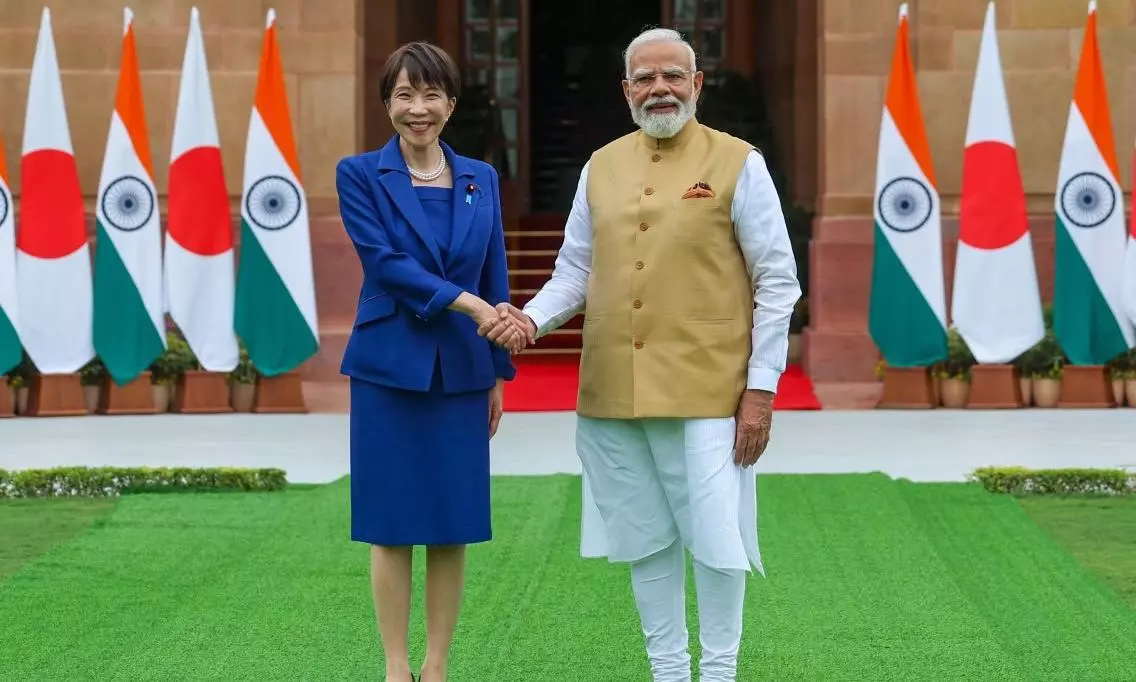
New Delhi: Declaring that “mutual trust is our greatest strategic asset”, Prime Minister Narendra Modi and Japanese Prime Minister Sanae Takaichi on Thursday co-chaired the 16th India-Japan Annual Summit in New Delhi and pledged to open a new chapter in the bilateral Special Strategic and Global Partnership.
The two leaders agreed to deepen cooperation in defence and security, economic security, energy resilience, technology, artificial intelligence (AI), innovation and people-to-people exchanges. They signed 12 agreements, including one to facilitate capital and investment flows between the financial regulatory authorities of the two countries, and issued four joint statements covering economic security, AI and energy resilience.
Both sides reaffirmed their goal of attracting 10 trillion yen in Japanese investment into India over the next 10 years. They also announced a Joint Roadmap for Economic Security aimed at strengthening supply chain resilience in strategic sectors such as semiconductors, quantum technologies, advanced materials, rare earths and critical minerals.
The summit reflected the warm personal rapport between the two leaders. In his media remarks, Modi referred to Takaichi as his "younger sister" and described her as a "visionary and popular leader". The two leaders agreed that India and Japan are "natural and indispensable partners" in advancing their respective national interests. Takaichi said they would work together "as brother and sister" and deepen strategic cooperation, particularly in maritime security. Modi later hosted a private dinner for the Japanese Prime Minister at his residence.
In a significant defence breakthrough, the two countries signed an agreement on their first co-development project, the Unified Complex Radio Antenna (UNICORN), a common radar mast for Indian Navy platforms. The agreement covers the remaining technical aspects of the project after an initial MoU was signed two years ago.
Foreign secretary Vikram Misri said both countries also agreed to jointly develop land, air, including unmanned aerial vehicles (UAVs), and naval systems. A joint statement said India and Japan would deepen maritime security cooperation through enhanced naval exercises, maritime domain awareness using satellite capabilities, maintenance, repair and overhaul (MRO) cooperation, and defence equipment development under the Make in India framework.
In an apparent reference to China, without naming it, the joint statement expressed serious concern over developments in the East and South China Seas. The two Prime Ministers reiterated their strong opposition to unilateral attempts to change the status quo by force or coercion and agreed to begin preparations for an inaugural India-Japan-Philippines Track 1.5 policy dialogue. They also reaffirmed their commitment to a free, open and rules-based Indo-Pacific.
The leaders also unequivocally condemned terrorism and violent extremism in all forms, including cross-border terrorism from Pakistan.
To strengthen energy security, India and Japan launched an Energy Resilience Initiative aimed at tackling disruptions such as oil shocks. Misri said the initiative includes cooperation on strategic petroleum reserves, joint investment in maritime energy transport, and collaboration in batteries, green hydrogen and nuclear energy.
Under the India-Japan Biogas Initiative, the two countries will establish 1,000 biogas and organic fertiliser plants across India to promote sustainability, rural livelihoods and clean energy. They also launched the India-Japan Next Generation Mobility Partnership Framework to expand cooperation beyond automobiles into shipbuilding, aviation and logistics.
The 12 agreements signed during the summit covered battery supply chains, pharmaceuticals and medical devices, geology and mineral exploration, biological research, informatics and financial cooperation.
Highlighting AI cooperation, Modi said technology would become the strongest pillar of the bilateral partnership. He noted that the two countries had issued a joint AI statement and that several Indian AI institutions had signed agreements with Japanese partners. Cooperation will include work on large language models and other advanced AI technologies.
Modi said more than 100 new business agreements had been signed over the past year, bringing over $10 billion in Japanese investment into India. He reiterated the target of attracting 10 trillion yen in investment over the next decade and doubling the number of Japanese companies operating in India.