Modi Proposes Maritime, Tech Initiatives to Deepen India-Asean Ties

Mr Modi reiterated that India’s commitment to Asean unity and centrality would remain unwavering.
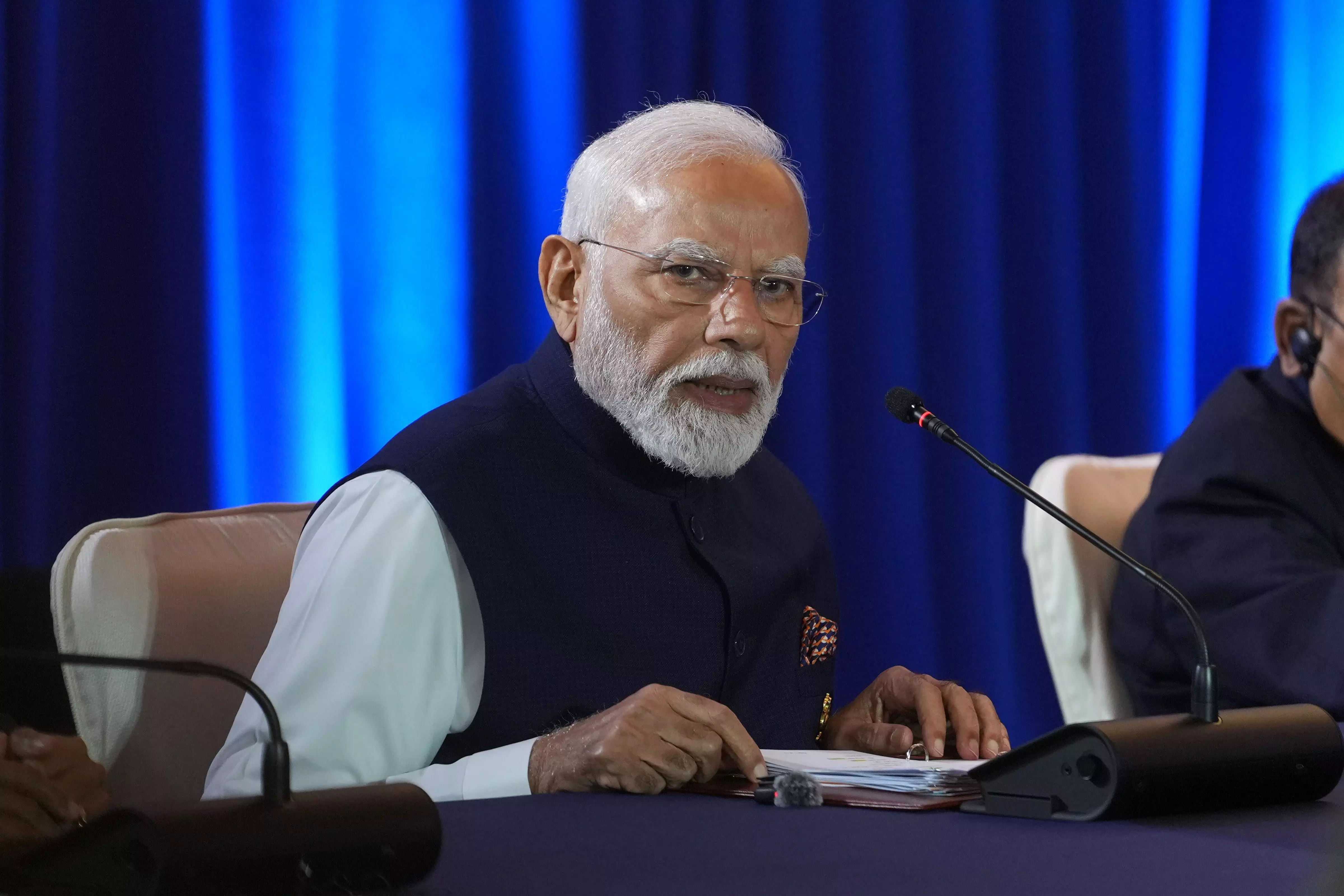
New Delhi:Amid China’s growing influence in the Indo-Pacific, Prime Minister Narendra Modi on Tuesday proposed a series of initiatives to deepen India’s engagement with Asean, including a long-term maritime cooperation plan covering connectivity, scientific research, disaster management, Coast Guard cooperation, maritime domain awareness and seafarers’ security.
At the 23rd India-Asean Summit in Manila, leaders also adopted a joint statement on cooperation in disaster management, pledging to strengthen preparedness through regular training exercises, simulation drills and exchanges of disaster response personnel, including joint exercises between India and Asean member states.
Addressing the summit, Mr Modi proposed a joint cyber forensics training programme to build regional capacity, technical exchanges on nuclear energy, an Asean-India Space Hackathon and cooperation in mining and critical minerals.
To strengthen people-to-people ties, he suggested free e-visas for tourists from Asean countries, an Asean-India Youth Connect initiative involving youth summits, exchanges among young parliamentarians and start-up hackathons. He also proposed expanding scholarships for Asean students at Nalanda University and setting up an Asean-India Creative Partnership Pavilion at Waves 2027, according to a statement issued by New Delhi.
India’s partnership with the Southeast Asian grouping had expanded beyond shared culture and heritage to include new areas such as digital technology, defence and space, the Prime Minister said in his opening remarks.
He said "today’s meeting will take our comprehensive strategic partnership to new heights and contribute to building a secure, inclusive, and prosperous Indo-Pacific". Over the past 12 years, India and Asean had given fresh momentum to their relationship, he said, adding that the two sides must now chart a new course for the region.
Mr Modi reiterated that India’s commitment to Asean unity and centrality would remain unwavering.
"Over the past few years, the world has faced one crisis after another. Today, what the world needs most is peace, stability, and predictability. In this context, this year’s theme, 'Navigating Our Future, Together', holds special significance,” the Prime Minister said. "Together, India and Asean represent nearly one-fourth of the world’s population. That is why it is essential to ensure that our future is shaped not by competition, but by cooperation. We have both the capabilities and the shared resolve to achieve this. Together, we can make this region a symbol of peace and stability," he added.
Congratulating Philippine President Ferdinand R. Marcos Jr. on the country’s successful Asean chairmanship, Mr Modi also thanked him for his contribution as India’s country coordinator. He said India’s Act East Policy, launched in 2014, had given fresh momentum and greater depth to relations with Asean.
Since 2014, India had undertaken more than 100 initiatives to strengthen people-to-people ties, launched nearly 250 Quick Impact Projects and provided over 10,000 skill-building scholarships, Mr Modi said. Direct flights between India and nine Asean countries, along with growing tourism, were further evidence of the close relationship, he added.
"This is my third visit to an Asean country this year, reflecting the special importance Asean holds for India. We firmly believe that India's growth and Asean's prosperity are deeply interconnected. In the coming years, both the Asean Community Vision 2045 and Viksit Bharat 2047 can help us turn our shared aspirations into reality," the Prime Minister said.
In a statement later, New Delhi said Mr Modi had "noted that 2027 will be a special year for India-Asean relationship, when the two sides will be celebrating 35 years of their ties and five years of their comprehensive strategic partnership".
The Joint statement on cooperation in disaster management noted "the shared exposure of Asean member states and India to hazards, including earthquakes, tsunamis, floods, cyclones, extreme heat and landslide and other climate-induced disasters, and their disproportionate impact on people in vulnerable situations".
The two sides agreed to "strengthen regular consultations between the Asean Committee on Disaster Management (ACDM), the AHA Centre and India's National Disaster Management Authority (NDMA) to promote complementarity between respective disaster management mechanisms".
It also resolved to "enhance cooperation on early warning systems for earthquakes, tsunamis, floods and cyclones and landslide, including through the sharing of satellite data, seismic monitoring information and meteorological forecasts, on a voluntary basis and in accordance with national laws and regulations". It was also decided to "support the use of space-based data and applications, building on ongoing Asean-India space cooperation, for disaster risk assessment, monitoring and forecasting".
