PM launches ‘charm offensive’ to woo younger generation
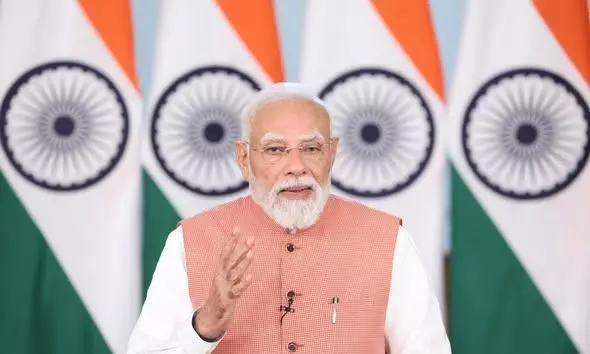
NEW DELHI: Prime Minister Narendra Modi on Thursday exhorted the youth to choose playgrounds over PlayStations, while calling for expanding India’s participation across Olympic disciplines.
Launching a “charm offensive” to woo the younger generation, Modi said sports centres were more important than screens and urged youngsters to tap the transformative potential of sports.
In a virtual address to hundreds of athletes, students and volunteers gathered at various locations for the “Khelo India Dialogue” ahead of National Sports Day on Saturday, the Prime Minister said his vision for sports was not merely about winning medals but making it an integral part of the nation-building process.
“Sports centres are more important than screens. Playgrounds are more important than PlayStations,” Modi said.
Reflecting on the sports vision he unveiled from the Red Fort on Independence Day, Modi said the value of sports extended far beyond winning medals. He described sports as a vital campaign to integrate the nation's athletic and youth power towards building a “Viksit Bharat”.
“I have always kept saying, those who play, will blossom,” he remarked.
Drawing attention to what he described as a major challenge, Modi said India had historically not participated in nearly half of all Olympic disciplines. Citing the 2012 Olympics, when India competed in only 13 sports, he said the country was missing out on a large share of potential medals by not competing in more than 20 other disciplines.
“To increase our medal tally, we will absolutely have to achieve mastery in these sports as well,” the Prime Minister said.
Flagging India's untapped potential, Modi pointed to the country's vast coastlines and mountainous regions, which were suited for surfing, sports climbing and winter sports, but said India remained largely invisible globally in these disciplines. He called for a targeted approach to identify districts where specialised sporting ecosystems could be developed.
Modi said every district had the potential to establish itself on the global sporting map. “Every district has the potential to make its mark on the global sports map. It is with an understanding of this immense potential, we have to take this Samvaad programme forward,” he said.
Stressing grassroots engagement, the Prime Minister said a true sporting culture could be built only when schools treated physical education as a core component of life rather than merely a co-curricular activity. Institutionalising sports, he said, would expand the national talent pool while helping young athletes secure family support.
Outlining a long-term strategy for the 2036 Olympics, Modi called for immediately identifying and preparing athletes capable of qualifying across a wide spectrum of sports.
He reiterated plans for a massive national “Talent Hunt” targeting children aged five to 15, saying selection should take into account both their interests and their physical suitability for particular disciplines.
“Whatever support is needed from the government for this, the government will walk shoulder to shoulder with you in it,” Modi said.
Reaffirming the administration's commitment to building a modern, 21st-century sports ecosystem, the Prime Minister detailed the establishment of specialised sports universities and advanced training centres. He said the government was also increasing international cooperation to share global best practices in sports science, training and coaching.
“A system is being built in the country where, from identifying talent to taking it to the world stage, support is received at every level,” Modi said.
He described the “Khelo India Samvaad” as more than a discussion and said it was a platform for shaping the country's sporting vision. He urged youngsters to connect their personal aspirations with national goals and said their ideas on talent development and governance could influence policy.
“These very new ideas of youth power will become the strength for the realization of a Viksit Bharat,” Modi said.
Highlighting the societal benefits of sports, Modi said sportsmanship helped foster a healthy society, strong families and a better work culture. “Sports do not only teach us to become champions, but sports also teach us to become better competitors,” he said.
Praising the incredible transformative power of sports, the Prime Minister singled out the nation's Para Athletes for their profound ability to alter societal perspectives on life and adversity. He noted that the success of a specially-abled athlete fundamentally revitalizes their entire family, elevating the courage and dreams of parents and siblings who supported their early struggles.
Modi celebrated the achievements of Para Athletes including archer Sheetal, double Paralympic medallist Avani Lekhara, Sumit Antil, Nitesh Kumar and Jhandu Kumar.
“When I meet Avani, I feel very proud; every such companion inspires us,” Modi said.