The Prime Minister asserted that India’s MANAV vision would become a crucial link for humanity’s welfare in the AI-driven world of the 21st century
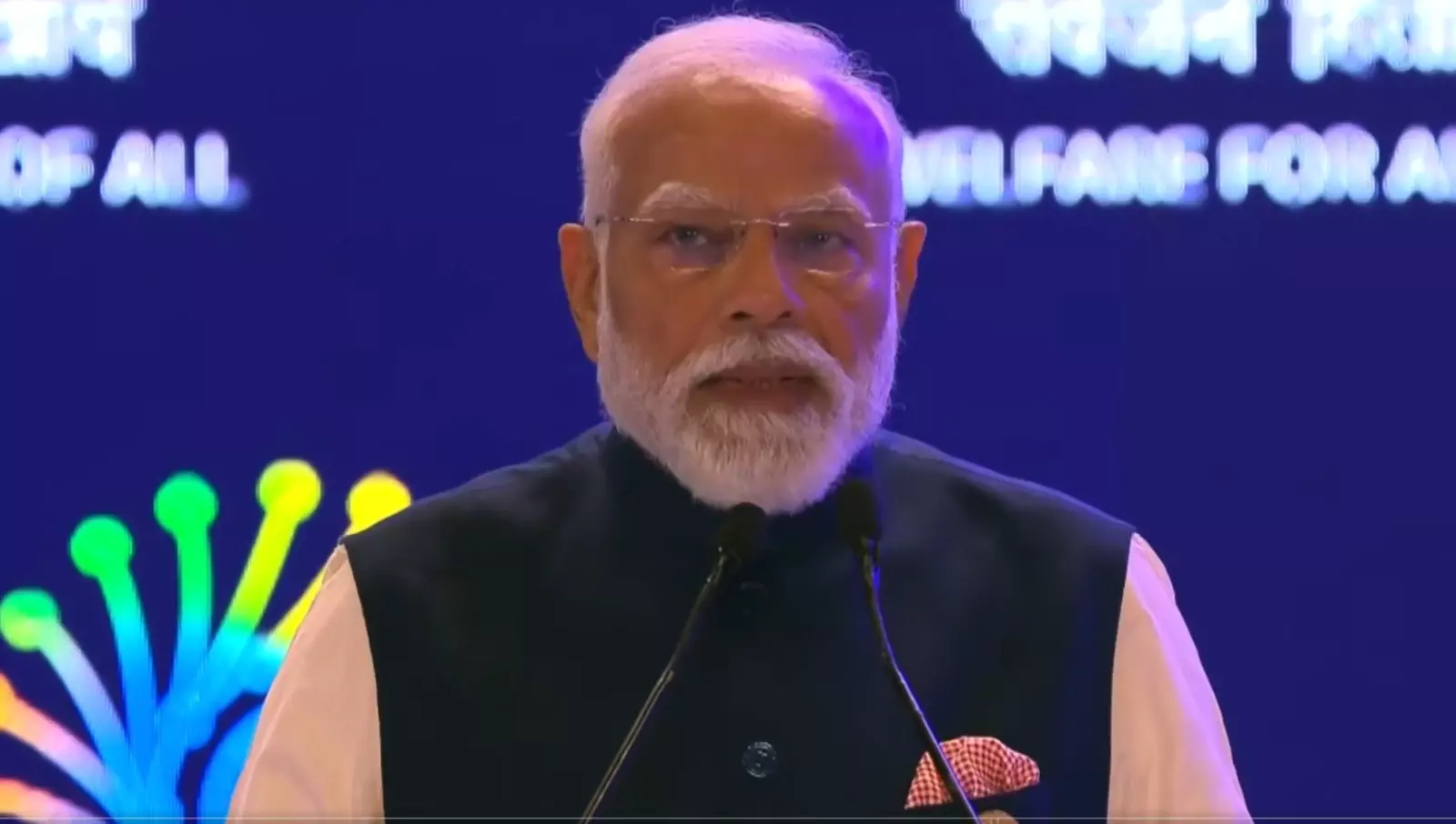
New Delhi: Outlining a “human-centric” vision for the future of Artificial Intelligence (AI), Prime Minister Narendra Modi on Thursday launched the country’s AI revolution, saying that India was not just a part of the AI revolution, but was leading and shaping it. He also called for the “democratisation” and “inclusiveness” of the rapidly emerging technology. “We must democratise AI. It must become a tool for inclusion and empowerment, particularly for the Global South,” Modi said, addressing global leaders and technology giants at the AI Impact Summit at Bharat Mandapam here.
Asserting that there was a need to “democratise” AI and make it an “inclusive” model, Modi also said that welfare and happiness for all was our benchmark. Humans should not become mere data points or raw material for AI. “The approach should be focused on how to make AI human-centric rather than AI-centric,” he said at the summit here, while presenting the “MANAV” framework for AI governance.
The Prime Minister asserted that India’s MANAV vision would become a crucial link for humanity’s welfare in the AI-driven world of the 21st century. Explaining MANAV, he said that M stands for moral and ethical systems (AI must be based on ethical guidelines), A for accountable governance (transparent rules and robust oversight), N for national sovereignty (data belongs to its rightful owner), A for accessible and inclusive (AI must not be a monopoly, but a multiplier) and V for valid and legitimate (AI must be lawful and verifiable).
While addressing the leaders’ plenary session at the summit, Modi also said AI’s global journey has a major role for aspirational India. India is the land of Lord Buddha who had said the right action comes from the right understanding and that is why it is very essential that everyone come together to create a roadmap that shows the right impact of AI. “The right impact comes only when we take the right decisions at the right time, with the right intention," he said.
Focusing on India to be the prime hub for artificial intelligence, the Prime Minister also pitched global tech leaders to develop and design their technology in India as well. “AI will also open higher-value, creative, and meaningful roles for more people, creating opportunities for innovation, entrepreneurship, and new industries. We should provide AI with an open scope to evolve, but the command must remain in our hands,” he said.
Highlighting the urgent need for global standards, the PM pointed out that “deepfakes” and fabricated content are destabilising open societies. Drawing a parallel with nutrition labels on food, he said that digital content too must carry authenticity labels so people can distinguish between real and AI-generated material. “There is a growing need for watermarking and clear source standards as AI increasingly generates text, images, and videos, stressing that trust must be built into technology from the start,” he said.
Emphasising the importance of child safety, Modi said that just as school syllabi are curated, the AI space must also be made child-safe and family-guided. “Today there are two kinds of people those who see fear in AI and those who see fortune. India sees fortune and future in AI, backed by talent, energy capacity, and policy clarity,” he said.
He also said that the scope for unethical behaviour is limitless in artificial intelligence, and put forward suggestions for ethical use of AI, which include respecting data sovereignty and making transparent safety rules. “The AI summit has brought together the who’s who from the AI world. There is representation from over 100 countries. There are distinguished participants from every corner of the globe. Our aim is the same leveraging the power of AI for the welfare of our planet,” he said in a separate post on X.

