Modi: Digital Manuscripts To Curb Intellectual Piracy

12 Sept 2025 11:15 PM IST12 Sept 2025 11:15 PM IST
Says Indian knowledge patented by others
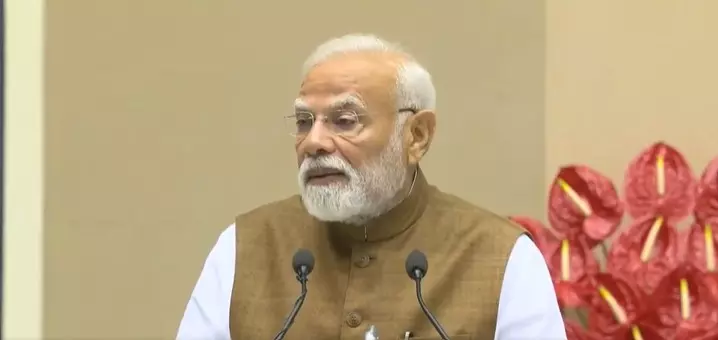
Prime Minister Narendra Modi (Image:DC)
NEW DELHI: Highlighting that many elements of India’s traditional knowledge systems, used for centuries, are often copied and patented by others, Prime Minister Narendra Modi on Friday said the digitisation of Indian manuscripts will help curb intellectual piracy.
Addressing the international conference on “Gyan Bharatam” under the theme “Reclaiming India’s Knowledge Legacy through Manuscript Heritage” in New Delhi, the Prime Minister said India’s manuscripts reflect the development journey of humanity.
Modi observed that viewing a manuscript feels like travelling back in time. He contrasted the painstaking efforts of ancient scribes with today’s ease of typing, editing, and mass printing. Urging the audience to imagine life centuries ago, he said that with limited material resources, India’s ancestors relied solely on intellectual strength to create scriptures and establish grand libraries that became global centres of knowledge.
The Prime Minister noted that India still possesses the world’s largest manuscript collection, with nearly one crore manuscripts. He lamented that millions were destroyed in the course of history, but the surviving ones remain as testimony to India’s dedication to knowledge, science, and learning.
He pointed to the fragility of scriptures written on bhojpatra and palm leaves, and the corrosion of words inscribed on copper plates, yet emphasised that Indians revered words as divine, preserving them for generations with the spirit of “Akshar Brahma Bhav.”
“India’s knowledge tradition remains rich because it rests on four foundational pillars: Preservation, Innovation, Addition, and Adaptation,” he said. Unlike modern notions of nationhood, India, he added, has always possessed its own cultural identity, consciousness, and soul.
Modi said India’s manuscripts, written in nearly 80 languages, embody unity in diversity and serve as civilisational declarations. While many countries preserve even a single manuscript as a national treasure, India possesses an immense wealth of manuscripts, which he called a source of national pride.
He emphasised that the return of hundreds of stolen idols to India in recent years reflects global trust in India as a custodian of heritage. “These returns are not due to sympathy but to confidence, confidence that India will safeguard and honour them with dignity,” he said.
The Prime Minister underlined that India has never measured knowledge in monetary terms, quoting ancient wisdom that “knowledge is the greatest donation.” He said the Gyan Bharatam Mission will also unify manuscripts housed abroad, strengthening humanity’s shared heritage.
Noting that elements of traditional knowledge are often copied and patented by others, Modi stressed the need to counter such misuse. He said digitisation would make authentic sources available globally, regulate intellectual piracy, and open new domains of research and innovation. He pointed out that the global cultural and creative industry is valued at $2.5 trillion, and digitised manuscripts can contribute meaningfully to its value chains.
( Source : Deccan Chronicle )

Next Story