Mirwaiz Umar Voices Alarm After Court Rejects Bail Plea of Shabir Shah

Mirwaiz urges release of Shah, citing health concerns and prolonged incarceration
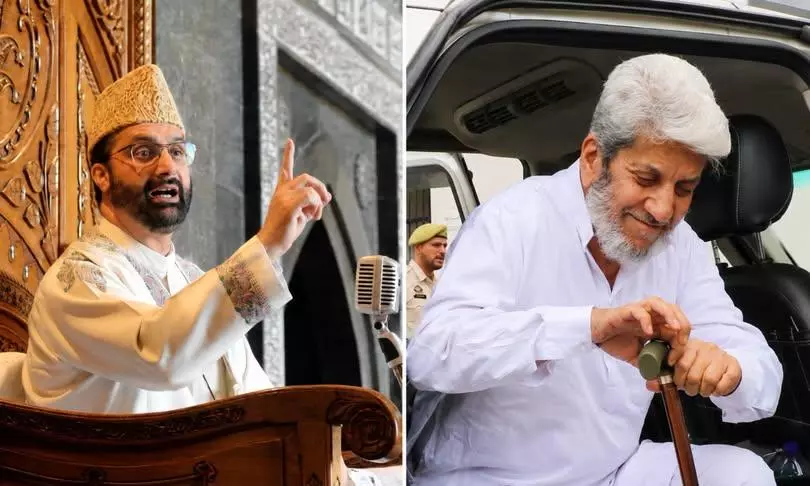
Srinagar: Kashmir’s chief Muslim cleric, Mirwaiz Mohammad Umar Farooq, has voiced strong concern over the NIA court’s rejection of Shabir Ahmad Shah’s bail plea, describing the decision as “deeply disappointing and unjust.” He said the continued incarceration of Shah—who has spent nearly four decades in various prisons without a conviction—stands in stark contradiction to the Supreme Court’s earlier decision granting him bail in March this year.
The Mirwaiz noted that Shah’s prolonged detention has severely affected his health, stressing that he urgently requires specialised medical care and the support of his family. He added that many other political prisoners face similar health crises due to extended incarceration and delayed trials. Appealing to the Government of India, opposition parties, civil society groups and all those who value human dignity, the Mirwaiz urged collective efforts to secure the release of these detainees.
He wrote on ‘X’, “I appeal to the Govt of India, opposition leaders, civil society and all those who believe in human dignity and the right to difference of opinion to ensure their release and return to families”.
The Special NIA Court in Jammu dismissed Shah’s bail application in a case linked to an alleged violent funeral procession in Srinagar in 1996. The case, registered at Police Station Shergarhi, pertains to the July 17 funeral of militant Hilal Ahmad Beigh, during which the procession reportedly turned violent near Naaz Crossing. According to the prosecution, Shah was among the principal leaders of the gathering, raising slogans and delivering speeches, while stone-pelting and firing by unidentified armed persons were also reported. The charges include multiple sections of the Ranbir Penal Code, Section 13 of the UAPA, and provisions of the Arms Act.
Shah’s counsel argued that the incident occurred nearly three decades ago, that Shah had always cooperated with investigative agencies, and that prolonged incarceration could not be justified on the basis of unproven allegations. They highlighted his age, deteriorating health, and the fact that other accused had already been granted bail. The defence also maintained that no material linked Shah to any direct act of violence.
The prosecution countered that Shah played a leading role in the procession and retained influence among sympathisers. It emphasised that protected witnesses had been examined and that further investigation was ongoing. Although Section 13 of the UAPA does not invoke the stringent bail bar under Section 43-D(5), the Special Judge Prem Sagar held that the possibility of influencing witnesses and prejudicing the trial justified rejecting bail at this stage.
Shah’s continued imprisonment also intersects with a long-standing legal principle-the Supreme Court has repeatedly held that handcuffing an accused cannot be done as a routine measure and is permissible only under exceptional circumstances with recorded reasons. This principle was reaffirmed in later judicial orders concerning Shah, where courts directed that he must not be unnecessarily handcuffed during transit due to his advanced age and multiple ailments.
In a separate development, the same Special NIA Court declared Nazir Hussain—a terror accused believed to be hiding in Pakistan—a proclaimed offender. Hussain is wanted in a grenade-smuggling conspiracy uncovered in Surankote in October 2024. Despite non-bailable warrants, public notices and gazette notifications, he failed to appear, leading the court to conclude that he had deliberately evaded arrest.
The investigation found that the grenade consignment had allegedly been sent from across the border by Hussain—who reportedly uses several aliases, including Ali Khan, Nasir, Naziru and Shaheen—for the purpose of carrying out blasts.
After hearing the NIA’s plea, the Special Judge declared Hussain a proclaimed offender under Section 84 of the Bharatiya Nagarik Suraksha Sanhita (BNSS). The court noted that non‑bailable warrants had previously been issued against Hussain, but could not be executed as he was not found at his residence and, according to the execution report submitted by the NIA, had absconded to Pakistan.
It further observed that despite multiple efforts by the prosecution—including publication of notices in newspapers and the official gazette of Jammu and Kashmir—the accused neither appeared nor surrendered, indicating that he had deliberately evaded arrest.
