MGNREGS Workdays Hit Decade Low of 43 in FY26: Govt

28 July 2026 10:16 PM IST28 July 2026 10:16 PM IST
The data showed that the average number of workdays has fluctuated between 38 and 52 days since 2008-09, well below the statutory guarantee of 100 days under MGNREGS.
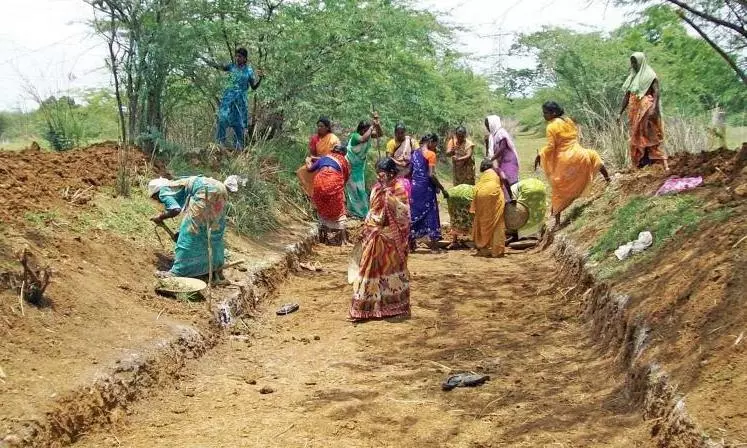
Representational Image
New Delhi: Rural households received an average of 43 days of employment under the Mahatma Gandhi National Rural Employment Guarantee Scheme (MGNREGS) in 2025-26, the lowest in a decade, according to data shared by the government in the Lok Sabha on Tuesday.
Replying to a starred question, Rural Development Minister Shivraj Singh Chouhan said the average number of workdays per household under the scheme declined from 50 days in 2024-25 to 43 days in 2025-26. Till June 2026, the average number of workdays was 24 in the current fiscal.
The data showed that the average number of workdays has fluctuated between 38 and 52 days since 2008-09, well below the statutory guarantee of 100 days under MGNREGS. The highest average of 52 days was recorded in 2020-21 and again in 2023-24, while the average stood at 50 days in 2024-25 before falling sharply in 2025-26. In 2008-09, the first year for which data was provided, households received an average of 38 days of employment.
Chouhan said MGNREGS has now been replaced by the Viksit Bharat-Guarantee for Rozgar and Aajeevika Mission (Gramin) (VB-G RAM G) under the VB-G RAM G Act, 2025.
"The VB-G RAM G Act, 2025 provides for a statutory guarantee of 125 days of wage employment in a financial year to every willing rural household demanding work, as against 100 days under the erstwhile MGNREGS," he said.
He said the scope of work under the new programme had been "significantly expanded" to focus on water security, core rural infrastructure, livelihood infrastructure and mitigation of extreme weather events, while promoting convergence with central and state government schemes.
The minister also said the Centre had allocated Rs 95,692.31 crore for the programme for the nine-month period from July 1, 2026 to March 31, 2027.
Including the states' share, the total outlay is expected to exceed Rs 1.51 lakh crore, he added.
On the financial implications of providing 125 days of employment, Chouhan said the annual budgetary requirement would depend on factors such as the actual demand for work, wage rates, the nature of work undertaken, material expenditure and administrative costs.
The Centre replaced MGNREGS with VB-G RAM G through a law enacted last year. The new programme increases the employment guarantee from 100 to 125 days and government says it is designed to strengthen rural employment and create durable assets. Opposition parties and several civil society organisations have criticised the move, saying it weakens the rights-based framework of MGNREGS.
( Source : PTI )

Next Story