Mehbooba Mufti Regrets Jantar Mantar Remarks, Says Comments Misunderstood

PDP chief apologises if her remarks hurt public sentiment, rejects claims that she called the viral video fake or AI-generated.
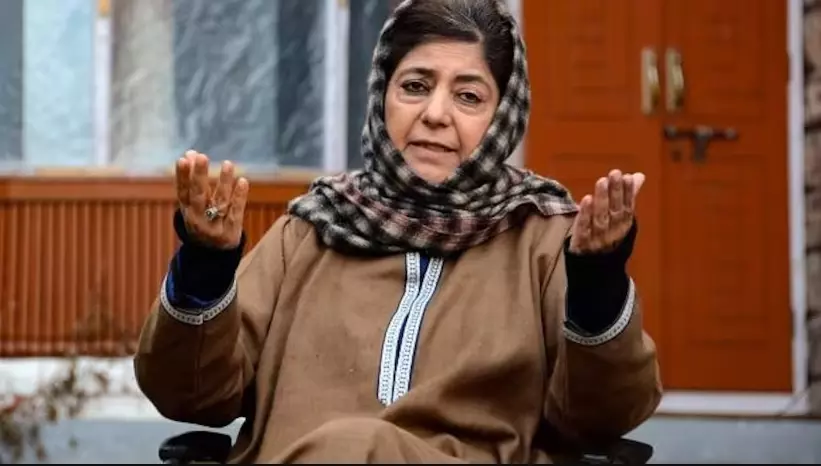
SRINAGAR: Peoples Democratic Party (PDP) president and former Jammu and Kashmir Chief Minister Mehbooba Mufti on Tuesday expressed regret over her controversial remarks on pellet guns made at New Delhi’s Jantar Mantar, saying a viral video of the interaction was genuine but that a single word had unintentionally slipped during a hurried exchange with journalists, leading to a misunderstanding.
Addressing a press conference here, Mufti clarified that she had never claimed the video was fake or AI-generated. She said her remarks had been misconstrued because of an incomplete expression made while responding to multiple media queries. Stressing her longstanding commitment to public service, Mufti said she has devoted nearly three decades to the people of J&K without seeking personal gain, adding that the trust and affection of the people remain her greatest political asset.
“If my words have hurt the sentiments of the people of Jammu and Kashmir, I sincerely apologise. The people here consider me their own, and if they have been pained because of my remarks, I express my regret,” she said.
The controversy erupted after Mufti, while showing solidarity with student protesters at Jantar Mantar, drew a comparison between police action in Delhi and security operations in Kashmir. Her remark that the use of pellet guns in Kashmir “makes some sense” in the context of militancy was widely criticised as a justification of force used during the 2016 unrest, when hundreds of Kashmiris were injured and many suffered permanent eye damage. She was the Chief Minister of the erstwhile state of J&K then. The comments triggered outrage across the political spectrum, with critics accusing her of reopening painful memories linked to one of the Valley’s most traumatic periods.
Rejecting the criticism, Mufti accused political opponents of deliberately taking her remarks out of context to damage her credibility and extract political mileage from the controversy. She maintained that, despite sustained political and personal pressures—including actions against members of her family after 2019—she had consistently spoken out on issues concerning the rights, dignity and welfare of the people of J&K. Reiterating her position, she said her political struggle has always centred on protecting the interests of the region and its people.
However, her expression of regret failed to quell the political storm. Chief Minister Omar Abdullah said that Mufti had not offered an unconditional apology for her controversial remarks, arguing that a statement of regret containing the word “if” cannot be considered a genuine apology.
Speaking to reporters here, Abdullah stressed that there is a clear distinction between expressing regret and seeking forgiveness. “When someone says ‘if anyone was hurt,’ that is not an apology. There is a difference between regret and forgiveness,” he said.
He also criticised PDP MLA Waheed ur Rehman Parra for claiming the controversial video was AI‑generated, pointing out that the PDP president herself has now acknowledged the video’s authenticity. “For five days people were told it was AI. Today their own party president admitted she made those remarks. Those who misled the people should answer for it,” Abdullah said.
The ruling National Conference (NC) also dismissed Mufti’s statement as inadequate, insisting it amounted to a justification rather than an apology. NC chief spokesperson and MLA Tanvir Sadiq accused Mufti of attempting to contain the controversy by distancing herself from claims made by Para, who had earlier suggested the viral video was digitally altered or AI-manipulated.
Sadiq argued that there could be no conditional regret for remarks that had deeply hurt Kashmiris, particularly victims of pellet injuries, and demanded an unconditional apology. In a separate statement, the NC reiterated that Mufti’s clarification did not constitute a genuine apology and also called on Para to apologise for alleging that the video had been manipulated.
Meanwhile, Mufti while addressing the PDP’s 27th foundation day function in Srinagar said the vision of PDP founder Mufti Mohammad Sayeed continues to guide the party and announced the adoption of a resolution reaffirming its commitment to resolving the Kashmir issue through dialogue, restoring J&K's identity and constitutional safeguards, and pursuing peaceful political engagement, reconciliation and confidence-building measures.
Calling for meaningful engagement as the path to lasting peace, Mufti advocated the reopening of traditional cross-Line of Control routes, including Muzaffarabad and Rawalakot, for travel and trade. She also urged the Government of India to facilitate the opening of the Sharda Peeth corridor for Kashmiri Pandits, sought the release of political prisoners and undertrials, and called for a review of security deployment in areas where militancy has significantly declined. Among her other demands were compensation or transfer of hydroelectric power projects to J&K, the creation of a separate administrative division for the Pir Panjal and Chenab regions, and measures for the dignified return and rehabilitation of Kashmiri Pandits.
Announcing the party’s future programme, Mufti said PDP leaders and workers would hold district-level protests across J&K on August 5 to mark their opposition to the abrogation of Article 370 and the constitutional changes introduced in 2019.
Responding to the PDP’s planned August 5 protest, Chief Minister Abdullah said the party must recognise its own role in shaping the current political situation. “If they had not brought the BJP to power in Jammu and Kashmir, we would not be in this position. If they now realise their mistake and want to correct it, that is their decision,” he added.
