Medical Education Reform Stays Stalled, says SC-appointed Oversight Secy

Just four states, three in South and Uttar Pradesh, command the largest pie in India’s medical education
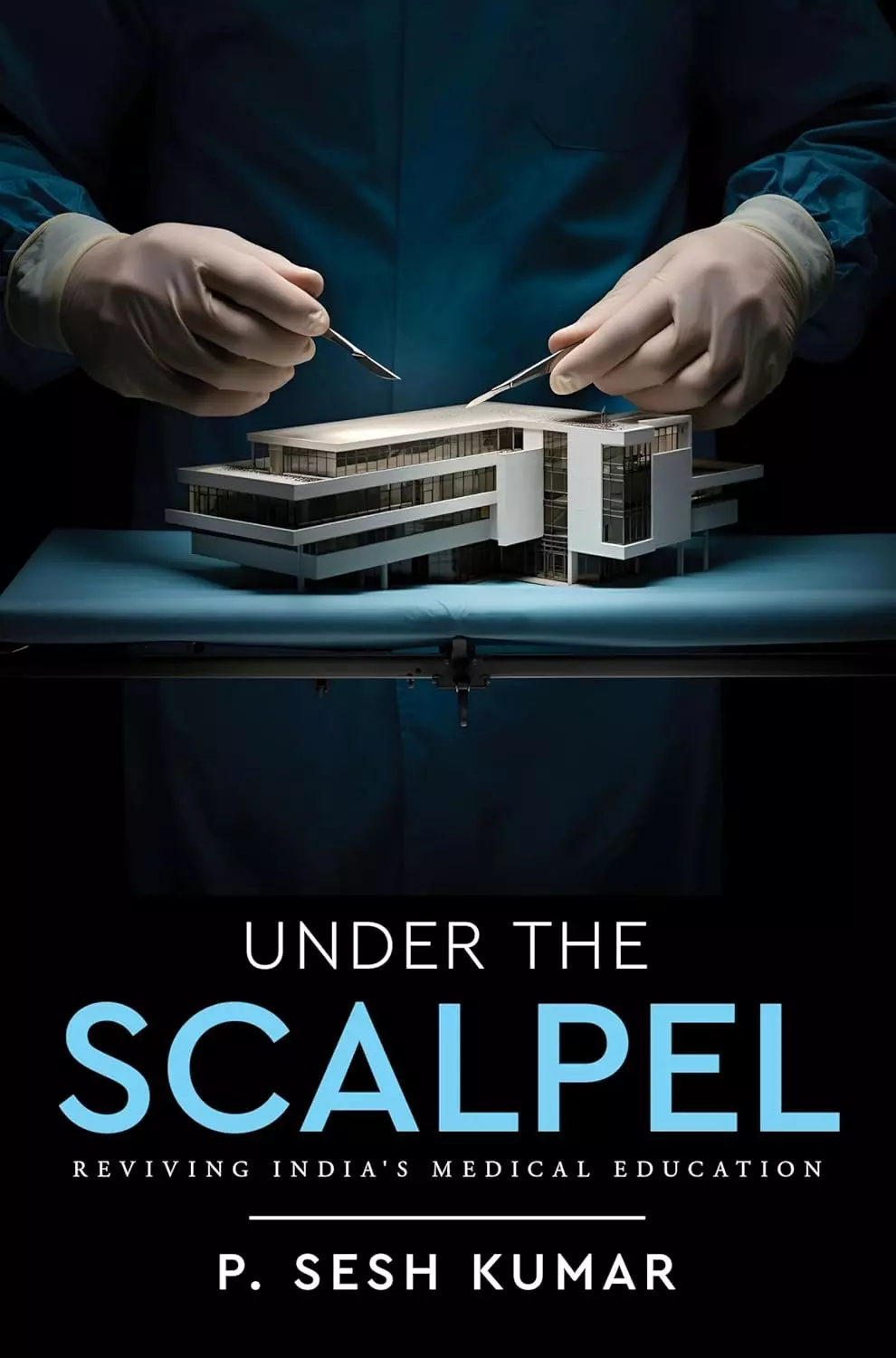
Guwahati: Even after a decade of medical education reforms in India, over a lakh students migrate to countries such as Iran and Bangladesh, while only a quarter of them clear the licensing examination in India. P. Sesh Kumar in his Under the Scalpel: Reviving India’s Medical Education indicts gridlock in medical education administration that allows situations where seats in medical colleges remain vacant while students pile up debts for foreign educations.
Kumar was secretary to an oversight committee appointed by the Supreme Court to overhaul and reform medical education in India. The Medical Council of India gave way for the National Medical Council with the advent of NEET for UG and PG. Yet seats are sold in grey markets, coaching industries mushroom to a staggering over ₹80,000 crore annual market. Kumar, as he gives inside details, laments that reform remains half-baked, and ills unresolved.
Probing the malaise by interviewing stakeholders, from administrators to students, Kumar distils cocktails that soured aims to reform medical education—ghost faculties, makeshift laboratories, paid patients, lopsided geographical spread of medical colleges, unintelligent examination and counselling, and strange seat blocking.
Just four states, three in South and Uttar Pradesh, command the largest pie in India’s medical education, with private institutions calling the shots. Rural India gets neglected, argues Kumar in the book, adding that the limited concentration of medical colleges leaves areas as vast as India’s Northeast uncovered.
Despite Prime Minister Narendra Modi’s clarion calls to reform medical education and quantitatively expand capacity of MBBS and Medical PG courses, Kumar brings the dark reality that more than one lakh aspirants go as far as Africa, Iran, Central Asia, China, the Philippines, and even Bangladesh to fulfil their dreams to treat patients in India.
The book offers a rare insider’s account of institutional breakdown, reform attempts, and the persistent political economy of medical education. Unlike many reformist narratives that foreground legislative change or judicial intervention in isolation, Kumar situates India’s medical education crisis within a wider system of regulatory capture, market distortion, and administrative weakness.
Kumar brings his surgical analytical knife to sift challenges bogging down entrance examinations, undergraduate and postgraduate mismatches, inspection regimes, federal tensions, and the transition from the MCI to the National Medical Commission (NMC). Throughout, the author’s central contention remains consistent: structural reform without regulatory integrity merely reproduces dysfunction under new statutory labels.
Kumar reconstructs how regulatory decisions are made, subverted, delayed, and judicialised—often through detailed descriptions of inspection practices, faculty verification procedures, and seat-allocation disputes. He reveals that medical education is treated not merely as a pedagogic enterprise but as a high-rent sector where real estate interests, speculative capital, and political patronage intersect with professional training. He probes the rapid numerical expansion of medical colleges on the one hand, and the persistent shortages of trained faculty, clinical exposure, and postgraduate seats on the other.
Exposing inherent lapses in the NEET (National Eligibility cum Entrance Test (NEET), Kumar evaluates NEET not simply as an admission mechanism but as a redistributive instrument whose socio-economic effects are uneven. While acknowledging that NEET curtailed several forms of overt admission corruption, he argues that it simultaneously entrenched a new stratification regime driven by coaching markets, urban educational infrastructure, and linguistic advantage.
Kumar gives a nuanced assessment in which meritocracy appears as a procedural ideal whose distributive consequences remain deeply unequal.
He brings a major structural insight in the persistent asymmetry between undergraduate MBBS production and postgraduate seat availability. Kumar demonstrates that successive governments prioritised politically visible undergraduate expansion without a commensurate increase in postgraduate capacity, teaching hospitals, or accredited faculty. The result has been the creation of a large pool of under-specialised medical graduates facing intense competition, professional insecurity, and informal labour absorption.
This mismatch is treated in the book as a systems failure rather than a capacity lag. His analysis links regulatory design, fiscal incentives, and institutional accreditation standards to show how the bottleneck is structurally reproduced despite repeated policy interventions.
Kumar’s assessment of the transition from the MCI to the NMC draws on his role during the period of judicially supervised regulatory restructuring. He argues that while procedural rationalisation has improved—through digital inspections, standardised norms, and expanded seat approvals—the deeper pathologies of regulatory capture and symbolic compliance persist.
The continuity of inspection manipulation, paper-only faculty appointments, and hospital infrastructure inflation is presented by him as evidence that statutory change alone cannot transform entrenched incentive structures.
The book situates medical education governance within India’s contested federal architecture. Kumar carefully traces centre-state disputes over fee control, seat allocation, language requirements, and admission criteria. The Tamil Nadu–NEET standoff is interpreted not as an episodic political conflict but as a manifestation of deeper tensions between national standardisation and regional social policy objectives. The book has been published by White Falcon Publishing.
