Ladakh Ramps Up Glacier-Water Drive; Spituk Farka Reservoirs Filled In Record Time

Together, the reservoirs store 2.4 crore litres, enough to irrigate nearly 1,000 acres of farmland.
SRINAGAR: Ladakh is witnessing an unprecedented water‑management and ecological restoration drive, with two major glacier‑water interventions—one completed in Leh and another launched in Changthang—marking a dramatic shift in how the cold desert harnesses its vast meltwater reserves.
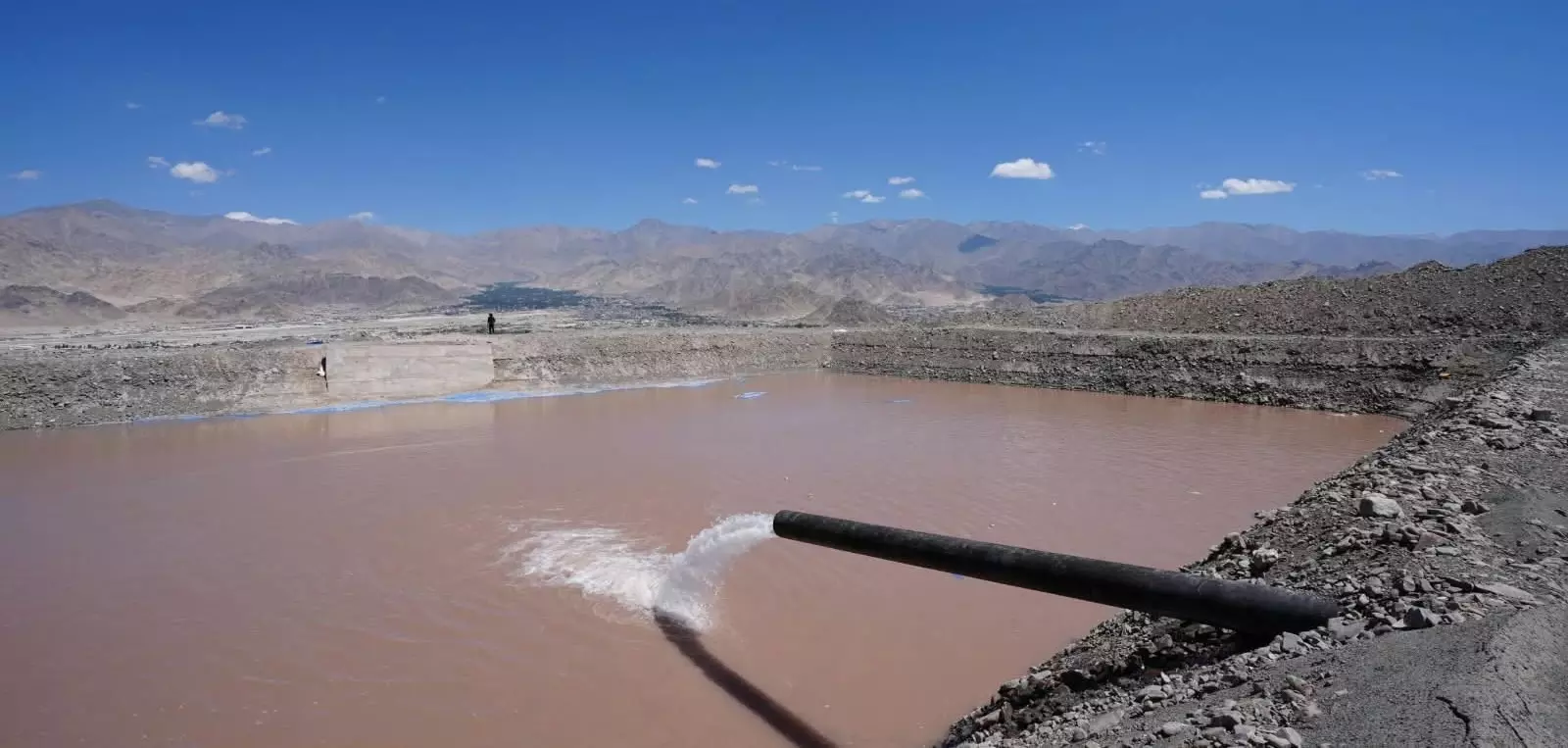
In Leh’s Spituk Farka, all four large ponds built under Project Him Sarovar have been filled with glacier meltwater in just five months, a milestone that officials say demonstrates the region’s new approach to low‑cost, gravity‑based water engineering. Construction began on April 10 and concluded on September 9, with each pond—measuring 60m × 40m × 2m—holding around 60 lakh litres of water. Together, the reservoirs store 2.4 crore litres, enough to irrigate nearly 1,000 acres of farmland. The ponds are fed by diverting seasonal flows from the Stok Glacier stream into the Igoo‑Phey Canal, conserving water that previously drained unused into the Indus and redirecting it toward irrigation, ecological restoration and long‑term water security.
Lieutenant Governor Vinai Kumar Saxena on Wednesday said in a social media post, “With immense delight and satisfaction, I share that all four large ponds, constructed under Project Him Sarovar at Spituk Farka in Leh, have now been filled with glacier meltwater, in a record time of just five months.” He added, “Together, the four ponds can store nearly 2.4 crore litres of water and are expected to create a new command area of nearly 1,000 acres.”
This achievement builds on Ladakh’s earlier breakthrough in August, when the administration successfully diverted 90 million litres of glacier water every day from the Stok Nallah into the Igoo‑Phey Canal—reviving a 43‑km irrigation system that had remained chronically water‑deficient for decades. The intervention rejuvenated 12 villages and expanded irrigation across more than 1,000 acres, proving that simple earthworks and gravity‑flow channels can unlock Ladakh’s enormous glacier‑fed potential.
Emboldened by these successes, Ladakh has now embarked on one of India’s most daring ecological restoration efforts: reviving the dying Tso Kar Lake in Changthang. Once spread across 11,000 acres, Tso Kar has shrunk by nearly 70 percent over the past decade, devastating local ecology and forcing Pashmina herders to migrate 50–75 km away as grazing grounds disappeared. During a visit on August 10, villagers told Lt. Governor Saxena that the lake’s collapse had erased livelihoods and driven away migratory birds, including the iconic Black‑Necked Crane.
The new project aims to reverse this decline by channelising 132 cusecs—about 320 million litres per day—of glacier meltwater from the remote Rupshu Kharnak stream, located 11 km away at 18,000 feet. Instead of concrete channels, engineers are relying on gravity flow and natural earthworks. Three natural depressions along the stream’s descent—spanning 270, 24 and 10 acres—are being transformed into cascading freshwater wetlands using check dams fitted with RCC pipes. These wetlands will store 1.23 billion litres of water, trap sediments and deliver clean meltwater to Tso Kar, while simultaneously creating new habitats visible from the Leh–Manali Highway.
Work began on September 2, racing against the onset of winter. By September 9, engineers had already diverted 20 cusecs into the first depression using earthen channels and a long‑defunct 1995 canal. Within four days, nearly 20 percent of the first wetland had filled—early proof that the low‑cost, landscape‑blending approach is working.
If successful, officials say Tso Kar could be restored to its original expanse within a year, marking India’s first high‑altitude lake revival of such magnitude. The cascading system promises dual benefits-- recharging the lake with clean water and creating new wetlands that could attract migratory birds, boost tourism and restore grasslands for herders.
Together, these initiatives signal a turning point in Ladakh’s environmental strategy—one that treats glacier meltwater not as a seasonal surplus but as a transformative resource capable of reshaping agriculture, ecology and climate resilience across the cold desert.
