Leh Clashes: 4 Killed, Prohibitory Orders Imposed

Violence erupts during LAB-led shutdown over statehood, Sixth Schedule; festival cancelled, police use force to restore order
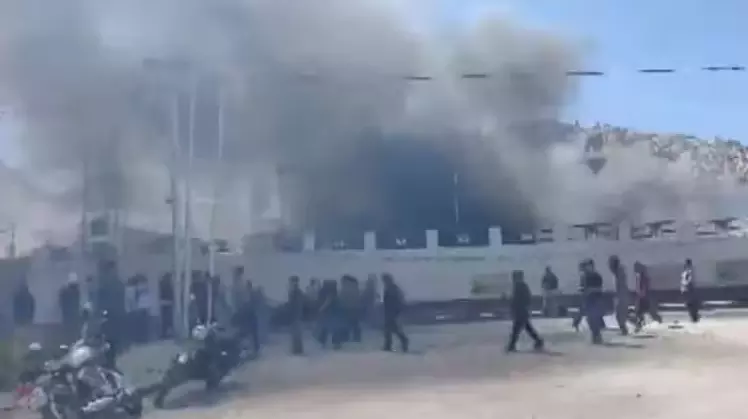
Srinagar: Leh, Ladakh’s principal town, was engulfed in turmoil as protests demanding statehood and inclusion under the Sixth Schedule of the Indian Constitution escalated into violence, claiming at least four civilian lives and injuring over 70 people, including 22 police personnel.
The Centre, on its part, alleged that the mob violence in Ladakh was guided by the "provocative statements" of activist Sonam Wangchuk, and certain "politically motivated" individuals were not happy with the progress made in the ongoing talks between the representatives of the government and Ladakhi groups.
Following violent clashes during statehood protests, Ladakh’s lieutenant-governor Kavinder Gupta confirmed that a curfew is being enforced across the Leh district. He warned of stringent action against those responsible for the unrest.
Addressing the public, Mr Gupta attributed the violence and loss of lives to vested interests. “The curfew is a precautionary step to curb further casualties. I extend my condolences to the families of those who lost their lives,” he said, emphasising that all measures would be taken to prevent additional violence. He directed the police and district administration to identify and take action against individuals disturbing peace and damaging public property.
Chering Dorjey, chairman of the Leh Apex Body (LAB), a leading advocacy group, confirmed the deaths, stating that security forces used heavy firing to control the unrest, resulting in numerous injuries.
Witnesses said that the violence saw hundreds of protesters, led by LAB’s youth wing, set fire to the local BJP office, torch multiple vehicles, including a security vehicle, and cause widespread disruption. Thick clouds of dark smoke billowed over Leh, visible from afar, as the capital observed a complete shutdown, marking one of the darkest days in the landlocked region’s recent history.
On August 5, 2019, Ladakh was separated from the erstwhile state of Jammu and Kashmir, which was stripped of its special status under Article 370 and reorganised into two Union territories: Jammu and Kashmir and Ladakh.
The latter was established as a Union territory without a Legislative Assembly, placed under direct Central governance. This restructuring sparked significant local aspirations for statehood and constitutional safeguards, such as inclusion under the Sixth Schedule, to protect Ladakh’s unique cultural identity, fragile ecology, and tribal population, fuelling the ongoing movement led by groups like the LAB and Kargil Democratic Alliance (KDA).
Wednesday’s unrest was sparked by the deteriorating health of two hunger strikers, Tsering Angchuk (72) and Tashi Dolma (60), part of a 35-day fast that began on September 10 to press for Ladakh’s demands. Their hospitalisation on Tuesday evening fuelled public anger, escalating a peaceful agitation into violent clashes. Mr Wangchuk, who had been on a 15-day hunger strike himself, ended his fast on Tuesday and addressed supporters in an emotional online press conference on Wednesday.
“This is the saddest day for Ladakh and for myself personally,” Mr Wangchuk said, lamenting the failure of five years of peaceful protests, including hunger strikes and a march from Leh to Delhi.
“I request the youth to stop arson and clashes. No hunger strike succeeds if lives are lost in violence,” Mr Wangchuk asserted, urging the administration to halt the use of teargas and appealing for calm, emphasising that the movement must remain non-violent.
Mr Wangchuk attributed the unrest to mounting frustration among Ladakh’s youth, who feel marginalised due to limited job opportunities and the unfulfilled promise of Sixth Schedule protections.
In response to the violence—the worst in Leh in recent memory—authorities imposed stringent curfew-like restrictions across the town and its surrounding areas. Leh District Magistrate Romil Singh Donk issued prohibitory orders under Section 163 of the Bharatiya Nagarik Suraksha Sanhita (BNSS), banning assemblies of five or more people, processions, rallies, and the use of loudspeakers without prior approval. “As notice cannot be served individually, this order is passed ex parte. Any violation shall invite punitive action under Section 223 of BNS,” Donk stated, citing risks to public peace, human life, and law and order.
Additional security forces, including police and paramilitary units, were deployed to sensitive areas to prevent further unrest. Hospitals in Leh reported receiving dozens of injured individuals, with several in critical condition, raising fears that the death toll could rise.
The violence disrupted the two-day annual Ladakh Festival, a celebration of the region’s culture, which was canceled midway due to “unavoidable circumstances.” The administration issued an apology to local artists, cultural troupes, and tourists affected by the abrupt cancellation.
The unrest also saw protesters target the BJP office and the Hill Council headquarters with stone-pelting and arson, setting fire to furniture, papers, and one of the buildings in the BJP complex. Police responded with teargas shells and baton charges to disperse the mobs, while Congress leader and councillor Phuntsog Stanzin Tsepag was booked for allegedly delivering a provocative speech at the hunger strike venue on Tuesday.
The LAB and the KDA, representing a broad coalition of political, religious, and social groups, have been advocating for a four-point agenda: statehood for Ladakh, inclusion under the Sixth Schedule, separate Lok Sabha seats for Leh and Kargil, and the establishment of a public service commission (PSC) to secure local employment opportunities.
The Sixth Schedule, currently applicable to tribal areas in Assam, Meghalaya, Tripura, and Mizoram under Articles 244(2) and 275(1) of the Constitution, provides autonomous governance, judicial mechanisms, and financial powers to protect tribal rights, a framework LAB and KDA seek to preserve Ladakh’s fragile ecology, unique cultural identity, and tribal population.
The movement has been largely peaceful over the past six years, with multiple hunger strikes and negotiations with the central government. However, stalled talks—most recently on May 27—have intensified public frustration. On September 20, the Centre invited LAB and KDA for a fresh round of discussions scheduled for October 6 in New Delhi, to be led by former MP and LAB leader Thupstan Chhewang, who recently resumed leadership after resigning earlier this year.
Protesters, however, are demanding an earlier meeting, citing prolonged hunger strikes and rising tensions. The Congress party recently distanced itself from LAB to maintain a non-political stance ahead of the Leh Hill Council elections next month.
J&K chief minister Omar Abdullah expressed solidarity with Ladakh’s cause in a post on X, stating, “Ladakh wasn’t even promised statehood, they celebrated UT status in 2019 & they feel betrayed & angry. Now try to imagine how betrayed & disappointed we in J&K feel when the promise of statehood to J&K remains unfulfilled even though we have gone about demanding it democratically, peacefully & responsibly.”
His remarks highlight the shared sense of disillusionment in the twin Union territories following the 2019 reorganisation.
Wednesday’s violence has cast a shadow over Ladakh, a region renowned for its serene landscapes and vast 173,266-sq-km expanse, making it India’s largest Lok Sabha constituency by area, yet sparsely populated.
In a statement issued late on Wednesday, the Union home ministry said barring a few unfortunate incidents that happened early on Wednesday, the situation was brought under control by 4 pm and asked everyone not to circulate old and provocative videos in the media and social media.
"The government stands committed to the aspiration of the people of Ladakh by providing adequate constitutional safeguards," the statement said.
The home ministry also said the process of dialogue through this mechanism has yielded phenomenal results. "However, certain politically motivated individuals were not happy with the progress made under HPC and have been trying to sabotage the dialogue process," the statement said.
Live Updates
- 24 Sept 2025 6:18 PM IST
“It saddens me deeply to see violence in Leh. The frustration of our youth, after peaceful protests brought no results, seems to have led to this tragic turn. The immediate trigger was the hospitalization of two fellow protesters.” — Sonam Wangchuk, Climate Activist


