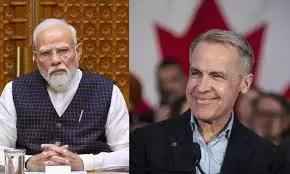
New Delhi: The “Khalistan” issue will be the elephant in the room during the forthcoming “law enforcement dialogue” on security concerns between India and Canada that will take place next week when Prime Minister Narendra Modi and Canadian PM Mark Carney meet on the sidelines of the G-7 summit in Alberta. India is set to ask Canada for a crackdown on the violent anti-India activities of pro-Khalistan elements in that country, while Canada is expected to rake up the Nijjar killing case. Ties between India and Canada had deteriorated sharply from September 2023, onwards during the tenure of Mr Carney’s predecessor, Justin Trudeau, who had, as Prime Minister, accused India of involvement in the killing of Canadian citizen and pro-Khalistan extremist Hardeep Singh Nijjar in June that year on Canadian soil. India had dismissed the Canadian allegations as absurd.
Pro-Khalistan extremist groups in Canada have already termed Mr Carney’s decision to invite Prime Minister Modi as a “betrayal”. The pro-Khalistan extremists wielded tremendous influence on the previous Canadian government led by Mr Trudeau, who was openly hostile to India. Nevertheless, New Delhi will be keenly watching developments after open threats issued by pro-Khalistan groups to “ambush” and stage protests against Mr Modi’s visit. It may be recalled that the violent and secessionist Khalistan movement -- that had aimed to break Punjab away from India in the 1980s and form a separate nation -- was finally crushed by the Punjab police three decades ago after a highly successful and sustained two-year campaign against militancy in 1992-94. However, in countries such as the United States, Britain, Canada and Australia, a section of the Sikh diaspora under the influence of radical groups has been attempting to revive the movement.
MEA spokesperson Randhir Jaiswal said in October last year that as many as 26 extradition requests were pending with the Canadian side even as he had named five alleged terrorists that India had asked Canada to extradite -- Gurjit Singh, Gurjinder Singh, Gurpreet Singh, Lakhbir Singh Landa and Arshdeep Singh Gill. “No action was taken by the Canadian side. This is a very serious issue. (These are) people whom we requested them to arrest, whom we asked to be deported (from Canada). Now the Royal Canadian Mounted Police (RCMP) is blaming the Indian side. This is a contradiction that we don’t understand,” Mr Jaiswal had said, at the height of diplomatic tensions between the two nations.
At that time, Canada expelled six Indian diplomats, including the Indian high commissioner, while New Delhi had swiftly retaliated by expelling the same number of Canadian diplomats including the Canadian acting high commissioner and deputy high commissioner. New Delhi had earlier said it first recalled its six diplomats, including its high commissioner and other “targeted” diplomats, soon after it received a communication from the Canadian government which “suggested that the high commissioner in Ottawa and other diplomats are ‘persons of interest’ in a matter related to an investigation in that country”, a reference to the matter of the probe into Nijjar’s killing.
Canada’s invitation to Prime Minister Modi to attend the G-7 summit indicates a probable reset and rebuilding of ties, while both sides may later agree to reinstate high commissioners. Last week, Mr Carney had stated: “I spoke with Prime Minister Narendra Modi today on the longstanding relationship between Canada and India, including deep people-to-people ties and significant commercial links. Importantly, we agreed to continue law enforcement dialogue and discussions addressing security concerns.” The security concerns from Canada’s side are being seen as a pointer to the Nijjar case while the security concerns from India’s viewpoint pertain to the political space and patronage provided to the pro-Khalistan extremists in Canada, particularly in the past few years.