Kashmir Agri Uni Produces India’s First Gene-edited Sheep

The gene editing was performed using CRISPR-Cas9 technology and adhered to international biosafety protocols. Importantly, the edited sheep contains no foreign DNA, distinguishing it from transgenic organisms and paving the way for regulatory approval under India’s evolving biotech policy framework.
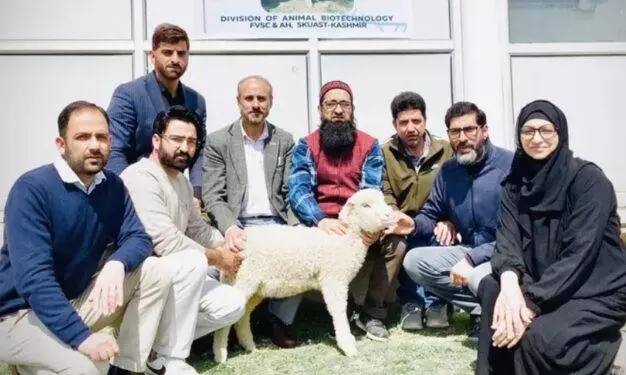
Srinagar: The scientists at Sher-e-Kashmir University of Agricultural Sciences and Technology of Kashmir (SKUAST-K) founded in 1982 have claimed to have successfully produced India’s first gene-edited sheep, by altering a gene that regulates muscle growth.
Prof. Nazir Ahmad Ganai, Vice Chancellor, SKUAST-K met Jammu and Kashmir Lieutenant Governor Manoj Sinha recently to brief him about the “breakthrough research”. The university, he informed Sinha, was endeavouring in the two most important technologies which are revolutionising the world: Artificial intelligence and the gene editing technologies and had earned its 77th patent.
Terming it a groundbreaking scientific achievement which marks “a historic milestone in the field of animal biotechnology”, Ganai said it placed India on the global map of advanced genome editing technologies and positioned SKUAST-K at the forefront of reproductive biotechnology research.
A statement issued by the University said that the gene-edited lamb has been modified for the myostatin gene, a regulator of muscle growth. “By disrupting this gene, muscle mass in the animal is enhanced by nearly 30 per cent, a trait naturally absent in Indian sheep breeds but known in select European breeds like the Texel,” it said.
The introduction of this mutation through gene editing – and not through traditional crossbreeding – represented a technological leap akin to the revolution artificial intelligence is driving in the 21st century.
This achievement comes on the heels of the recent release of India’s first gene-edited rice variety, endorsed by the Union minister for agriculture, and further cements India’s growing prowess in genomic science, it said.
The statement quoted Ganai as saying, “This is not just the birth of a lamb, but the birth of a new era in livestock genetics in India. With gene editing, we have the ability to bring precise, beneficial changes without introducing foreign DNA – making the process efficient, safe, and potentially acceptable to both regulators and consumers.”
He commended the researchers Dr Riyaz A. Shah and his team and highlighted the university’s commitment to excellence in research and innovation at both national and global levels. He asserted, “Biotechnology, in association with Artificial Intelligence and other next gen technologies, is emerging as a key driver towards achieving a sustainable bioeconomy for a developed India. Leading institutions like SKUAST-K can play a pivotal role in ensuring livelihood, food security, and sustainability for future generations.”
This achievement builds upon Prof. Riaz Shah’s pioneering legacy in cutting edge biotechnology, as his team had previously cloned India’s first Pashmina goat clone, “Noori,” in 2012 — a historic milestone that garnered global acclaim, the report said.
The gene editing was performed using CRISPR-Cas9 technology and adhered to international biosafety protocols. Importantly, the edited sheep contains no foreign DNA, distinguishing it from transgenic organisms and paving the way for regulatory approval under India’s evolving biotech policy framework.
CRISPR technology has emerged as a versatile tool with broad applications in medicine, agriculture, and biotechnology, particularly in addressing health issues such as cancers, HIV, sickle cell disease, cystic fibrosis, and muscular dystrophy. Though the current study was undertaken purely for research purposes only, SKUAST Kashmir is leading the way in implementing the latest biotechnologies to tackle challenges in the livestock sector, including reproductive cloning, gene editing, vaccine development, stem cell applications, and transgenic research.
