JUST SPAMMING|There Have Been Too Many Student Protests
But then, protests by students are not new to India or the world.
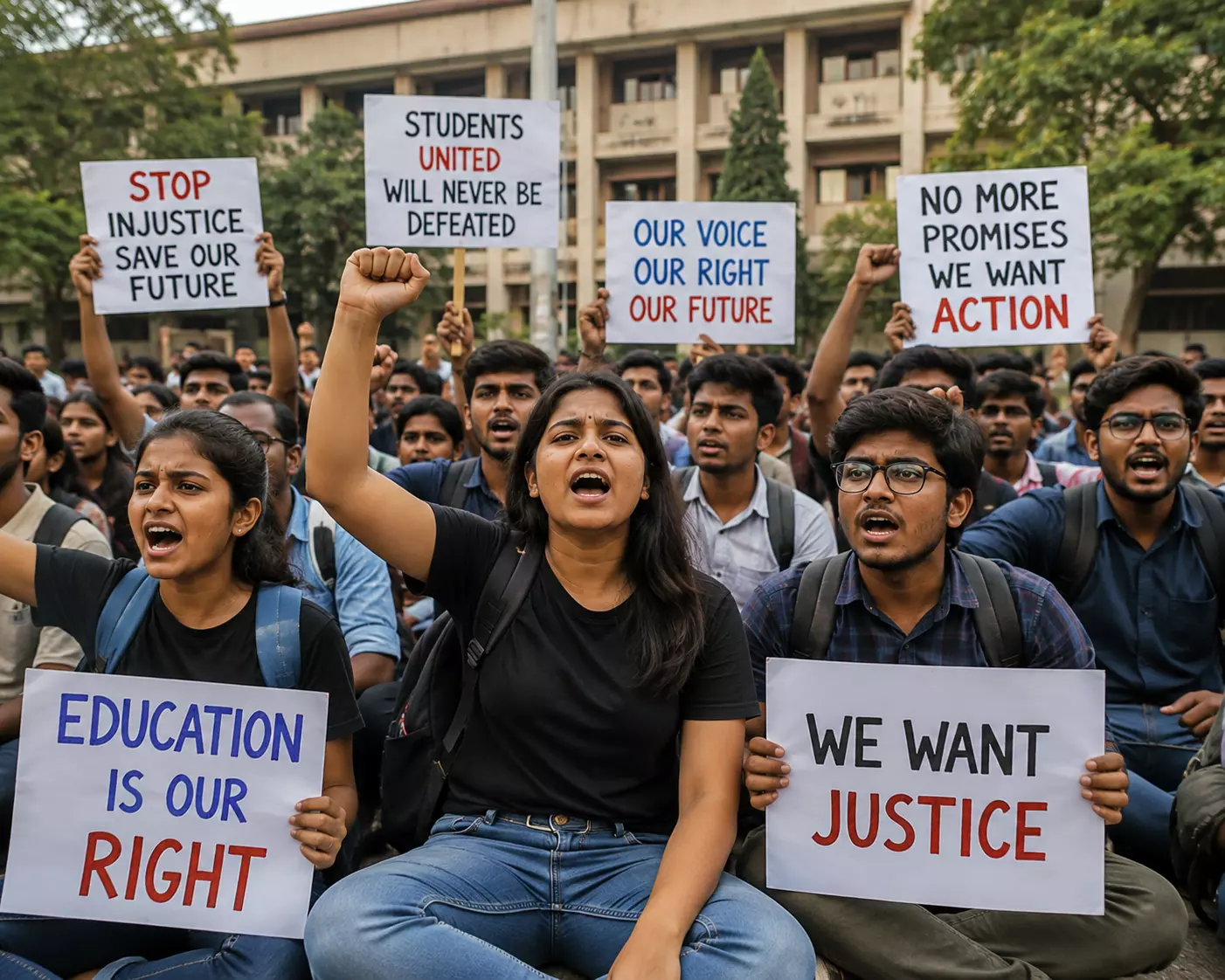
Student protests are the flavor of the season. A young woman stopping a bus transporting arrested protestors in Mumbai and another young woman shielding other protestors from an outstretched police lathi are two vignettes from the agitation sites in India that have caught the imagination of the people. The protests, demanding the resignation of Union Minister for Education Dharmendra Pradhan for the leaks of question papers for national competitive examinations, were seen with a sense of awe and incredulity by many since young people, particularly students, were hitting the streets at a time when the popular counsel to students is: Just study and keep off politics. But they proved the naysayers wrong as Pradhan had to go.
But then, protests by students are not new to India or the world. In 1968, the Paris student uprising, triggered by protests against educational reforms and university regulations at Paris Nanterre University subsequently exploded into a nationwide anti-authoritarian youth and labour revolt. Though the then French president Charles de Gaulle initially fled Paris secretly to secure military support, he returned to dissolve Parliament and call for snap polls, in which he won. However, the uprising led to the ushering in of labour reforms and shaped France’s politics. Though the strikes did not bring about a revolution it had profound consequences and de Gaulle resigned the next year and it marked a new era in French politics, which was dominated by new social movements
Back home, a students’ movement that metamorphosed into a political party that won an election to form the government happened way back in 1985 in the north-eastern State of Assam. It was spearheaded by the All Assam Students Union (AASU). From 1979 to 1985, the AASU waged a war with the government demanding deportation of ‘foreigners’ who entered the State before a cutoff date. The students’ protest enjoyed popular support, too. The six year agitation in Assam at that time was a subject of national debate for the students were unrelenting in achieving their demands. Once, when a delegation of the top leaders of AASU went to New Delhi for talks with the Union Government, a senior politician who had taken them there suggested that they paid homage to Mahatma Gandhi at Raj Ghat before starting the negotiations when one of young men snapped: We have not come here for a picnic.
That was the kind of steadfastness with which the AASU leaders conducted their protest and finally ascended the seat of power with their leader Prafulla Kumar Mahanta becoming the youngest Chief Minister of a full-fledged State at that time. Another protest by students that shaped politics, much ahead of Assam, was the anti-Hindi agitation of 1965 in the Madras State. It paved the way for the DMK, established in 1948, to capture power in 1967 and also rename the State as Tamil Nadu. In many other States, too, students joined popular uprisings launched by those like the Naxalites. The revolutionary fervor then had a romantic aura to it that even students from educated middle class backgrounds joined the Naxalite movement.
To name a couple of those students, Dilip Simeon, labour historian, and Rajiv Kumar, NITI Aayog vice chairman, were among those who left elite educational institutions like St Stephens College to join the movement. Similarly, the Jayaprakash Narayan (JP) movement, launched against the Emergency of 1975, drew students like Lalu Prasad Yadav, Nitish Kumar and Ram Vilas Paswan into politics. Later, students actively participated in the protests against CAA and NRC all over the country and also the agitation against the suicide of Rahit Vemula at the University of Hyderabad. Even the first stirring on the demand for the Telangana State was felt in the Osmania University campus in Hyderabad. So students’ protests have a long history in India.
Yet the protests launched by the Cockroach Janata Party (CJP) in 2016 made a mark as it put the biggest challenge to the BJP government since it came to power in 2014. Most of the political parties in the country have thrown their weight behind the CJP, which is not a regular political party or a social movement. It is just a loose mobilization of youth and students, who have gathered at the protest venues and are challenging the government. That many ordinary people are supporting the CJP is that they feel that the youth and students were doing something that they could not do but have wanted to. Overtly, the protestors were demanding the resignation of Pradhan but they were asking for more. They were questioning the conduct of national level admission tests and also the capability of the Union Government in holding such examinations.
That the name Cockroach Janata Party picked up traction among the youth itself says a lot about the resentment and disillusionment among the younger generation of Indian. For those who do not know what inspired that weird name for a people’s unconventional movement, let us have a quick recall. It was the Chief Justice of India Surya Kant who helped conjure up the name. Delivering a judgment in the Supreme Court, he said many youth were like cockroaches who later on become media persons or activists specializing in social media or RTI or other causes. So some youth picked the title ‘cockroach’ for them and have forced the world to take a look at their power, expressed through protests.
