Japanese Delegation Visits KIIT, KISS; Four MoUs Signed to Boost India-Japan Cooperation
A 35-member delegation from Japan's Tottori visited KIIT and KISS in Bhubaneswar, with four MoUs signed to strengthen academic, research and industry collaboration.
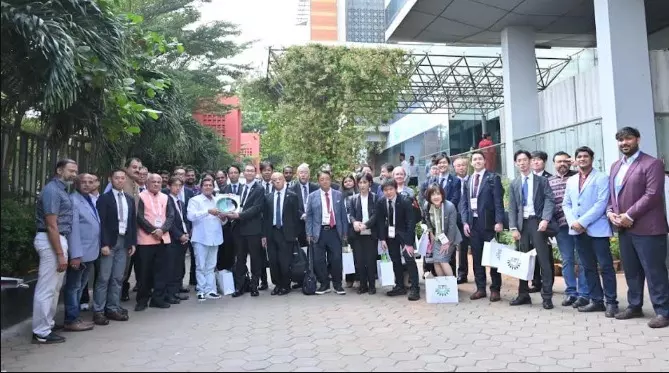
A 35-member delegation from Tottori, Japan, visited the KIIT and KISS universities’ campuses here on Wednesday, paving the way for enhanced academic, research and industrial collaboration between India and Japan. Four memoranda of understanding (MoUs) were signed during the visit to promote cooperation in higher education, joint research, skill development and industry-oriented training.
The agreements were signed between KIIT and Tottori University of Japan, Onestruction, TOA Software, and IEPMF and R Zero, with a focus on creating new avenues for academic exchange, technological innovation and industry-academia partnerships.
During their visit, the Japanese delegates toured various campuses of KIIT and KISS and interacted with faculty members, staff and students on issues relating to education, research and technological advancement. They also called on KIIT and KISS founder Dr Achyuta Samanta and appreciated his efforts in establishing and developing the two institutions.
The collaborations are expected to open up fresh opportunities for students in engineering, management and healthcare, particularly in internships, employment, research and specialised training. The proposed initiatives also envisage the establishment of Centres of Excellence to promote advanced learning and industry-oriented research.
The MoUs were signed in the presence of KIIT Deemed to be University Vice-Chancellor Prof. Saranjit Singh, Pro-Vice-Chancellor-cum-Registrar Prof. Jnyana Ranjan Mohanty and heads of various university departments.
The visit also provided an opportunity to explore joint initiatives in emerging and cutting-edge fields, including artificial intelligence, cybersecurity, blockchain technology, robotics and semiconductors. The proposed areas of cooperation are expected to strengthen institutional ties and facilitate the exchange of knowledge, expertise and technological capabilities between the two countries.
Expressing his appreciation for the partnerships, Dr Samanta said the collaborations would focus on introducing new academic programmes, promoting skill development, strengthening research and facilitating industry-oriented training and knowledge exchange.
