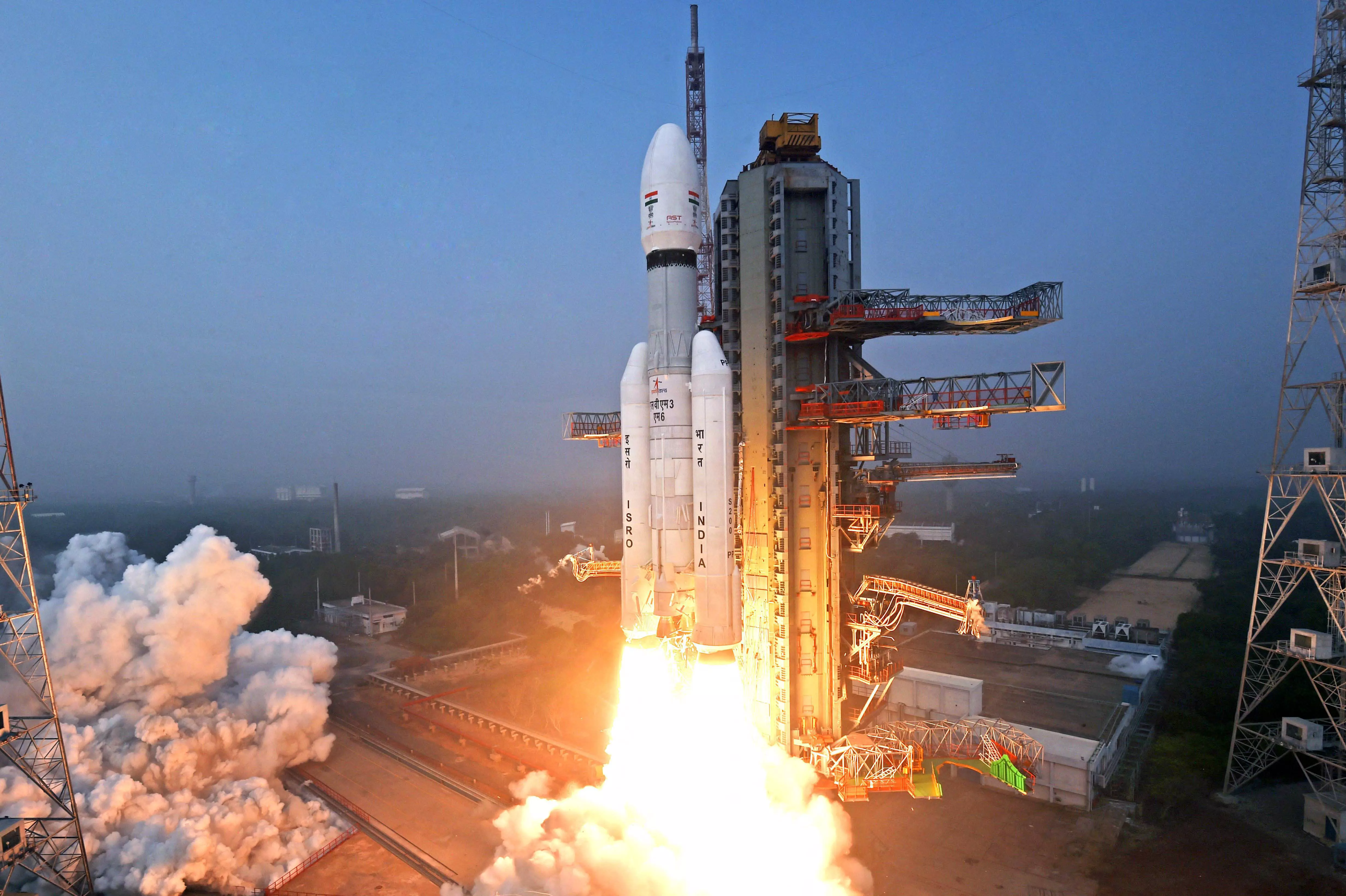
The LVM3-M6 rocket, also known as GSLV Mk-III, lifted off from the second launch pad at the Satish Dhawan Space Centre (SDSC-SHAR) at 8.55 am on Wednesday.
Sriharikota: The Indian Space Research Organisation (Isro) said it had achieved the best accuracy so far for a rocket launched from Indian soil, while placing its heaviest-ever satellite in space, on Wednesday. The nation got a unique peek into the operations with Isro releasing videos of step-by-step operations, from the ejection of different rocket stages to the release of the satellite.
It is a “New Year and Christmas gift to Bharat,” exulted Isro chief V. Narayanan, after the LVM3 ‘Bahubali’ rocket placed the 6,100-kg US-built BlueBird Block-2 satellite near-precisely in orbit.
About 15 and a half minutes after its launch from the spaceport at Sriharikota, ‘Bahubali’ released the satellite at 518.5 km above the Earth, marginally short of its intended orbit of 520 km. “Placing of the satellite precisely into the intended orbit is the best accuracy so far achieved ever on Indian soil,” Narayanan said.
Prime Minister Narendra Modi led the nation in congratulating Isro, saying, “A significant stride in India's space sector…. a proud milestone in India's space journey.”
The LVM3-M6 rocket, also known as GSLV Mk-III, lifted off from the second launch pad at the Satish Dhawan Space Centre (SDSC-SHAR) at 8.55 am on Wednesday. Owned by US-based AST SpaceMobile, it forms a constellation of satellite meant to support mobile phone communications.
Isro chairman Narayanan noted that the launch was executed just 52 days after the lift-off of LVM3-M5, reflecting exceptional coordination across Isro centres.
“Executing two back-to-back LVM3 missions within such a short timeframe is a remarkable achievement,” he said.
Isro has so far launched 434 satellites for 34 countries. Dr Narayanan noted that global customers are increasingly choosing isro due to its reliability and six decades of technological evolution.
Dr Narayanan announced that the government has approved Chandrayaan-4 and Chandrayaan-5, targeted for launch by 2028. Chandrayaan-4 will be India’s first lunar sample return mission, while Chandrayaan-5, a joint mission with the Japanese JAXA, will explore the Moon’s polar regions for water ice.
The LVM3, a human-rated launch vehicle identified for the Gaganyaan manned spaceflight programme, has now completed nine successive successful missions, significantly boosting confidence in its reliability.
“This consistency is mandatory for human spaceflight,” Dr Narayanan said.
With this mission, Isro surpassed its earlier record of launching the 4,400-kg CMS-03 (GSAT-7R) satellite in November. Designated LVM3-M6, the launch marked the sixth operational flight of LVM3 and its third dedicated commercial mission.
The three-stage rocket is powered by twin S200 solid rocket boosters, a liquid core stage, and a cryogenic upper stage. The boosters were developed by the Vikram Sarabhai Space Centre, while the cryogenic engine was built by the Liquid Propulsion Systems Centre.
The BlueBird Block-2 satellite is part of AST SpaceMobile’s next-generation LEO constellation aimed at providing direct-to-mobile 4G and 5G connectivity without specialised equipment. It features a 223-square-metre phased-array antenna, the largest of its kind in commercial communications satellites.
Mission director T. Victor Joseph said the compressed schedule required extensive synchronisation across centres, adding that technological upgrades demonstrated during the mission would strengthen future launches, including Gaganyaan.
Acting NSIL chairman P. Mohan said demand for LVM3 launches is rising globally, with customers seeking six to ten launches annually from 2026–27.

