ISRO Overcomes NVS-02 Setback, Puts NavIC Expansion Back on Track

Dr. Narayanan said GSLV-F18 achieved exceptionally high accuracy in injecting the 2,250-kg satellite into its designated Geosynchronous Transfer Orbit (GTO)
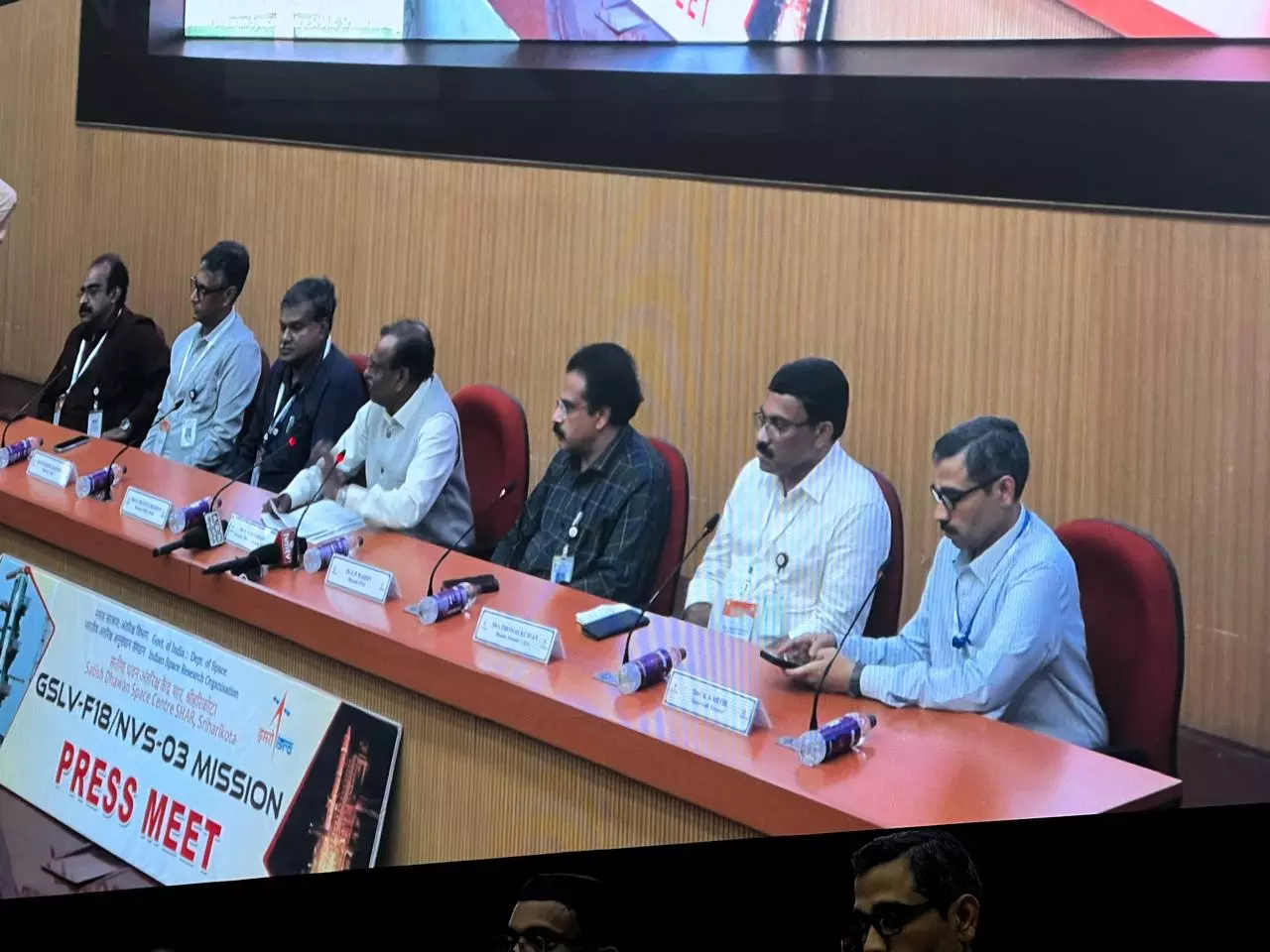
Sriharikota: The successful launch of navigation satellite NVS-03 has not only strengthened India's indigenous NavIC system but also demonstrated how ISRO turned a technical setback in its previous mission into an opportunity to improve the reliability of its future satellites.
Explaining the key technological measures adopted for the mission, ISRO Chairman Dr. V. Narayanan said the space agency had kept three pyro valves open in NVS-03 to avoid a recurrence of the problem encountered during the launch of its predecessor, NVS-02, in January 2025.
Addressing the media at the Satish Dhawan Space Centre, SHAR, in the early hours of Saturday after the successful launch of GSLV-F18, he said the decision was taken following an exhaustive technical assessment, including vibration and shock tests. A national-level committee headed by former ISRO Chairman A.S. Kiran Kumar.
The NVS-02 satellite could not be manoeuvred into its intended operational orbit after a failure in the electrical signal reaching a pyro valve in the oxidiser line of its propulsion system. The subsequent investigation identified a possible connector-contact issue in the electrical circuit. ISRO incorporated the necessary changes in NVS-03 to prevent a similar occurrence.
Dr. Narayanan said GSLV-F18 achieved exceptionally high accuracy in injecting the 2,250-kg satellite into its designated Geosynchronous Transfer Orbit (GTO). The planned perigee of 170.36 km was achieved at 170.31 km, while the planned apogee of 37,247 km was achieved at 38,080 km. He described the orbital injection accuracy as one of the best performances achieved by a launch vehicle.
The successful mission has also restored India's regional navigation satellite system, NavIC (Navigation with Indian Constellation), to its minimum operational configuration of four satellites. The system provides independent Position, Navigation and Timing (PNT) services across India and an area extending approximately 1,500 km beyond the mainland.
Highlighting the growing utility of NavIC, the ISRO Chairman said around 10,400 locomotives were being tracked in real time using the system, besides 64,000 fishing vessels. The agency aims to extend the tracking facility to one lakh fishing vessels within the next six months under the Pradhan Mantri Matsya Sampada Yojana. Around 15 lakh vehicles have also been fitted with tracking devices.
He said the introduction of the L1 civilian navigation signal in NVS-03, alongside the existing L5 and S-band signals, would widen the scope of NavIC applications. However, wider compatibility with civilian mobile phones would depend on strengthening the satellite constellation to its full seven-satellite configuration.
The Chairman announced that the next-generation navigation satellites NVS-04 and NVS-05 were planned for launch in approximately 10 months. Their deployment would further improve the continuity, accuracy and reliability of India's independent navigation services.
The mission also set new benchmarks in launch preparedness. The launch campaign was completed in just 47 days, while GSLV-F18 took off 56 days after the previous GSLV mission. The four L40 strap-on boosters were prepared in a record 37 days, reflecting ISRO's efforts to improve launch frequency and operational efficiency.
Dr. Narayanan said ISRO was preparing for five more launches before the end of the current financial year, including the first uncrewed Gaganyaan mission- G1, two PSLV missions and a small satellite mission apart from a private launch.
The press briefing was attended by senior ISRO officials, including GSLV-F18 Mission Director Thomas Kurian and Vikram Sarabhai Space Centre Director UP Rajeev.
