India’s Longest Tunnel at Zojila Nears Historic Breakthrough

Being constructed by Hyderabad -based MEIL, the tunnel will provide all-weather access to key strategic regions of Drass, Kargil, and Leh.
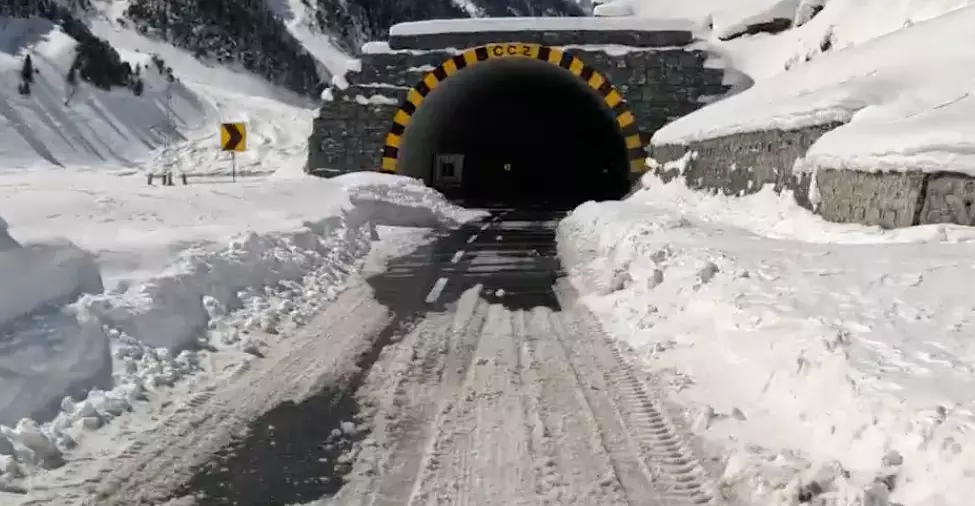
Srinagar: India’s longest road tunnel project at Zojila, a strategic infrastructure initiative valued at ₹6,500 crore, is on the cusp of achieving a landmark milestone.
On Tuesday, Union Minister for Road Transport and Highways Nitin Gadkari is scheduled to attend a ceremonial event marking the breakthrough of the main tunnel—an engineering achievement that underscores the scale and significance of this ambitious undertaking.
According to officials, Gadkari will travel to Sonamarg, a premium resort, to trigger the breakthrough blast, a symbolic and technical moment when excavation faces advancing from opposite ends of the tunnel finally meet. This milestone represents years of complex planning and relentless work in one of the most challenging terrains in the world.
Stretching 13.15 kilometres and situated at an altitude of 11,578 feet, the Zojila Tunnel is being constructed by Hyderabad-based Megha Engineering and Infrastructure Ltd (MEIL). With more than 13 kilometres of excavation already completed, the project has entered its final phase, with only a small stretch remaining before the two ends—driven from Baltal in Kashmir Valley and Minamarg in Ladakh—connect. This simultaneous excavation approach has been instrumental in accelerating progress despite the Himalayan region’s harsh climatic and geological conditions.
Strategically located about 24 kilometres from Sonamarg and 103 kilometres from capital Srinagar, the tunnel is expected to transform connectivity between Srinagar and Ladakh. Once operational, it will provide all-weather access to key strategic regions such as Drass, Kargil, and Leh, significantly enhancing civilian movement, supply chains, and military logistics. The project is widely regarded as a game-changer for the region, particularly given the frequent disruptions caused by heavy snowfall and avalanches at the Zojila Pass, which currently remains closed for several months each year.
In an official statement, the Ministry of Road Transport and Highways described the project as one of the most challenging tunnel constructions in the Himalayas. The ministry emphasised that the scheduled breakthrough blast on June 9, marks a “historic milestone” in India’s infrastructure development journey.
Harpal Singh, Joint Chief Operating Officer of MEIL, noted that excavation has reached its concluding stage, with only a few metres left before the tunnel faces meet. While speaking to local news agency KNO, he highlighted that the dual-end construction strategy—working simultaneously from both Kashmir and Ladakh sides—has been critical in maintaining momentum and meeting timelines in such a demanding environment.
Following the breakthrough, the project will transition into its next phase, focusing on internal works. These include concrete lining of the tunnel, installation of advanced ventilation systems, and the development of safety infrastructure. The tunnel will also feature a dedicated walkway to facilitate maintenance and emergency operations, ensuring both efficiency and safety once it becomes operational.
Awarded by the National Highways and Infrastructure Development Corporation Ltd (NHIDCL), the project has been under construction since October 2020. Engineers are employing the New Austrian Tunnelling Method (NATM), a globally recognised technique particularly suited for complex mountain terrains, allowing flexibility in design and execution based on ground conditions.
Beyond its engineering significance, the Zojila Tunnel is expected to deliver wide-ranging economic and social benefits. Improved connectivity is likely to boost tourism, stimulate trade, and provide year-round accessibility to remote areas that have long struggled with isolation during winter months. The project is also notable for its workforce composition, with over 1,200 personnel involved—nearly 80 per cent of whom are from the local region—reflecting its role in generating employment and supporting local communities.
Despite formidable challenges, including five avalanche incidents over the past five years, the project has maintained a strong safety record. A major avalanche in January 2023 required the rescue of 172 workers by the Army, highlighting the risks involved. Yet, the project has achieved an impressive milestone of 10 million safe man-hours, underscoring the commitment to safety and resilience on the ground.
As the Zojila Tunnel approaches its breakthrough moment, it stands not only as a feat of engineering but also as a symbol of connectivity, resilience, and progress in one of India’s most strategically vital regions. End it
