Narendra Modi said India will work to redefine Brics in a new form which will be “Building Resilience and Innovation for Cooperation and Sustainability”.
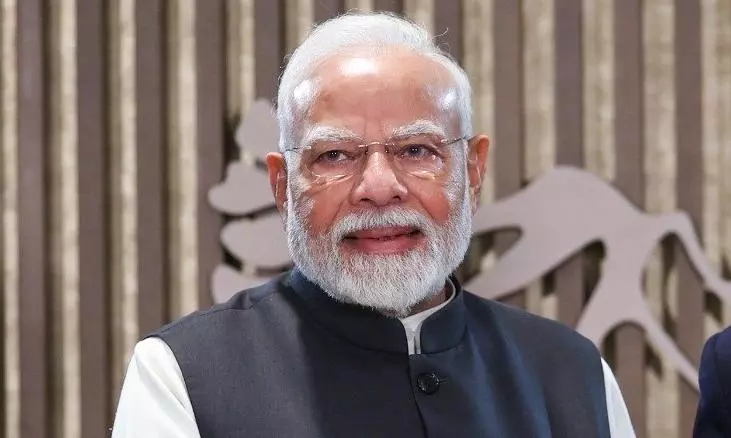
New Delhi/Rio de Janeiro: Addressing the session on “Environment, COP30 and Global Health” at the Brics summit in Rio de Janeiro, Prime Minister Narendra Modi on Monday said that despite being the world’s fastest-growing major economy, India was the first country to achieve its Paris commitments ahead of schedule. He added that India was steadily moving to achieve the “net zero” target by 2070. He highlighted that for India, “climate justice” was “not just an option but a moral duty”.
He said India believes that without technology transfer and affordable financing for countries in need, climate action will remain confined merely to climate talks. He added it was the duty of developed nations to reduce the gap between climate ambition and financing and these nations need to take together those countries that are struggling to cope with the food, fuel, fertiliser and financial crisis.
Mr Modi said that India’s Brics presidency next year will have a “humanity first” approach. He said India will work to redefine Brics in a new form which will be “Building Resilience and Innovation for Cooperation and Sustainability”. He added: “Just as, during our chairmanship, we gave breadth to G-20, gave priority to the issues of the Global South in the agenda, similarly, during our chairmanship of Brics, we will take this forum forward in the spirit of people-centricity and humanity first.”
“For us in India, climate change and environmental protection have always been subjects of the topmost priority. This has also been a part of our ancient culture. For us, climate change is not merely an issue of energy; it is about maintaining balance between life and nature. India is driven by the spirit of People, Planet and Progress. India has launched numerous initiatives like: Mission LiFE (Lifestyle for Environment), Ek Ped Maa Ke Naam (Tree for Mother), International Solar Alliance, Coalition for Disaster Resilient Infrastructure, Green Hydrogen Mission, Global Biofuels Alliance, International Big Cats Alliance,” Mr Modi said in his address.
He mentioned in the past 10 years India’s installed capacity of solar energy has increased by 400 per cent and through these efforts, India was setting up a strong foundation of a sustainable green future.
Mr Modi said he was grateful to Brazil for initiating a discussion on these topics at the Brics summit since these are important subjects for the future of humankind. “The health of our people and planet is inter-connected. The Covid-19 pandemic taught us that viruses do not arrive with visas, nor are solutions chosen based on passports! Hence, we have to strengthen our shared efforts to make our planet healthier,” Mr Modi said.
He gave out details of schemes rolled out in India for universal healthcare and using technology for the benefit of the people. “India is proud to have rolled out Ayushman Bharat, the largest health coverage scheme of its kind. We have leveraged the power of technology to make our health systems more effective. We also have vibrant traditional systems of medicine that further wellness,” Mr Modi said at the summit.
Earlier, in his address at a session on multilateralism, financial matters and artificial intelligence on Sunday, the PM had said that the Brics grouping needs to work together to make supply chains for critical minerals and technology secure and reliable and ensure that no country uses these resources for its own selfish gain or as a weapon against others. His remarks assume importance at a time when China has curbed the export of rare earth magnets to India to derail its automobile sector.
In his address, Mr Modi also called for the creation of global standards for the use of AI to maintain transparency and to prevent misuse. The PM announced that India will organise the “AI Impact Summit” next year.
On the sidelines of the summit, Mr Modi held bilateral talks with Malaysia’s PM Anwar Ibrahim, Vietnam’s PM Phạm Minh Chinh and President Miguel Díaz-Canel Bermúdez of Cuba. He also engaged with the leaders of some other Latin American countries, including President Yamandú Orsi of Uruguay and Bolivia’s President Luis Alberto Arce Catacora.
“Bolivia is a valued partner in Latin America and in recent years, our bilateral ties have become much stronger. We talked about the need for improving and diversifying trade linkages on a priority basis. We discussed how we can collaborate in sectors such as digital technology, critical minerals, healthcare, space and more. Also conveyed my best wishes on the historic occasion of Bolivia’s 200 years of independence,” the PM said. The two leaders discussed cooperation in critical minerals, trade and commerce, Digital Public Infrastructure and UPI, health and pharmaceuticals, traditional medicine, small and medium industries, training, and capacity building, the external affairs ministry said. The PM expressed solidarity with Bolivia’s people in the wake of the severe flooding in March-April 2025 in Laz Paz and several other parts of the country.
On Uruguay, Mr Modi said India was committed to doing everything possible to further deepen relations. The two sides discussed how to boost cooperation in trade, chemicals, pharmaceuticals, technology, defence and more. The rising popularity of yoga in Uruguay was wonderful for boosting people-to-people ties, the PM said. Mr Modi expressed gratitude to President Orsi for the strong condemnation of the recent barbaric terrorist attack in Pahalgam and appreciated Uruguay’s solidarity with India in the fight against terrorism.
With Cuba, Mr Modi said the economic relations between two nations have a lot of potential to grow in the future, particularly in sectors like technology, healthcare and energy.
Later, in a joint declaration on climate finance, the Brics leaders said they “condemn and reject unilateral, punitive and discriminatory protectionist measures” that are not in line with international law, under the pretext of environmental concerns, such as unilateral and discriminatory carbon border adjustment mechanisms (imposed by the European Union), due diligence requirements with detrimental impacts on global efforts to halt and reverse deforestation, taxes and other measures. The leaders reconfirmed support of the call in COP28 related to the avoidance of unilateral trade measures based on climate or environment.
“We also oppose unilateral protectionist measures which deliberately disrupt the global supply and production chains and distort competition. We express concern that such measures, as well as unilateral economic and financial sanctions, may undermine Brics countries’ capacities to invest in their own just transitions and development priorities and risk diverting away critical resources at a time when developing countries face a financial gap to pursue climate action and sustainable development. We emphasise the importance of non-discriminatory access to trade and to climate finance for all countries and the need to address existing barriers,” the declaration said.

