India Slams Pakistan at UN Over Minority Rights, Terrorists’ Burials

Indian diplomat Bhavika Mangalanandan challenges Pakistan’s record on minority rights, questioning its criticism of New Delhi over religious freedom and burial rights.
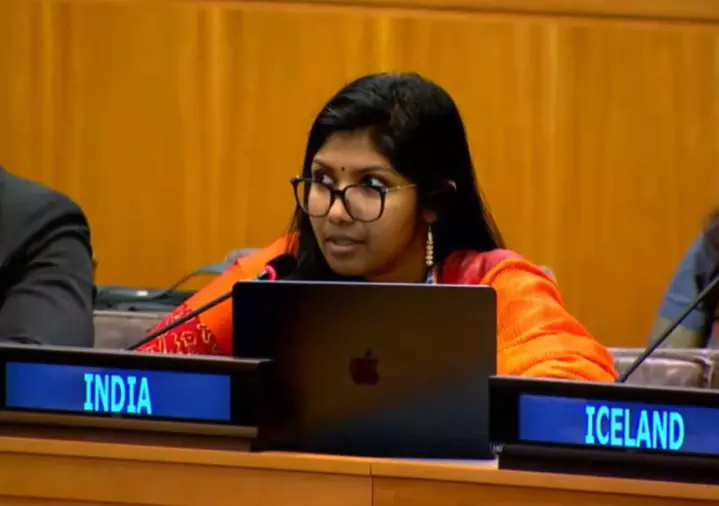
India has sharply criticised Pakistan at the United Nations, accusing Islamabad of failing to protect its religious minorities while questioning New Delhi’s record on religious freedom, burial rights and the treatment of people killed during security operations. India’s First Secretary at the Permanent Mission to the UN, Bhavika Mangalanandan, invoked the 1999 Kargil War to challenge Pakistan’s position, recalling that the Indian Army buried Pakistani soldiers with military honours and in accordance with Islamic rites after Pakistan did not acknowledge their involvement in the conflict.
Speaking on Thursday during an interactive dialogue with UN Special Rapporteur on Freedom of Religion or Belief Nazila Ghanea, Mangalanandan also questioned the interim report’s treatment of funeral rights in exceptional circumstances. She criticised what she described as selective scrutiny of religious discrimination, including during the COVID-19 pandemic, and argued that the rights of victims of terrorism should receive equal attention alongside discussions about the funeral rights of perpetrators.
The diplomatic exchange came after Ghanea’s report raised concerns over alleged restrictions on funeral rights in Jammu and Kashmir, including the denial of the return of bodies to families and remote or secret burials. The report said these practices disproportionately affected Muslims and raised concerns about consistency with their religious practices.
Responding to the report, India challenged Pakistan’s intervention on the issue, highlighting its own account of the treatment of Pakistani soldiers during the Kargil conflict and raising concerns over the protection of minorities in Pakistan.
India invokes Kargil War to question Pakistan’s position on burial rights
Mangalanandan directly challenged Pakistan’s comments on faith, religious freedom and burials, referring to the country’s response to the deaths of its soldiers during the 1999 Kargil conflict.
“It is deeply ironic that a State that did not even accept the bodies of its own soldiers who were killed in combat in 1999 in Kargil unabashedly speaks with fervour on faith, religious freedom, and burials,” the Indian diplomat said.
The Kargil War took place in 1999 after Pakistani soldiers and armed personnel crossed the Line of Control and occupied positions on the Indian side in the Kargil sector of Jammu and Kashmir. The Indian military launched operations to recapture the positions, resulting in intense fighting and significant casualties on both sides.
India has maintained that Pakistani military personnel were involved in the conflict, while Pakistan initially disputed the extent of the regular army’s role. Mangalanandan said the Indian Army had recovered the bodies of several Pakistani soldiers and buried them with military honours in accordance with Islamic rites.
“Let me remind them, it was the Indian Army that buried a number of Pakistani soldiers with military honours and in accordance with Islamic rites,” she said. Her remarks sought to contrast India’s account of its conduct during the conflict with Pakistan’s comments on funeral rights and religious freedom in the Indian Union Territory of Jammu and Kashmir.
The exchange took place during a discussion focused on funeral rights in exceptional circumstances, an issue that can involve competing considerations of religious practice, the rights of bereaved families, public security and the handling of people killed during military or counterterrorism operations.
Ghanea’s interim report said allegations of systemic denial of funeral rights in Jammu and Kashmir, including the withholding of bodies from families and secret burials, raised serious concerns. It also said the reported practices disproportionately affected Muslims and were potentially inconsistent with their religious customs. India challenged the report’s framing and questioned whether it applied its scrutiny consistently across regions and countries.
India raises concerns over minorities in Pakistan and alleged selective scrutiny by UN rapporteur
Turning to Pakistan’s record on minority protection, Mangalanandan said the country should address the situation of its own vulnerable communities before criticising India. “Pakistan's deep obsession with what is happening in the Indian Union Territory of Jammu and Kashmir should be actually directed at the developments that are underway in the parts of Jammu and Kashmir under its illegal occupation, such as Rawalakot,” she said.
She alleged that minorities in Pakistan were facing persistent rights violations and that their population share was shrinking. “A State that cannot ensure the safety of its own minorities has no standing to lecture India,” Mangalanandan said. Religious minorities in Pakistan include Hindus, Christians and Sikhs, among other communities. They account for approximately four per cent of the country’s population, according to estimates cited in the supplied report. Concerns over minority rights in Pakistan have included allegations of forced conversions and marriages, misuse of blasphemy laws, discrimination and inadequate protection against religiously motivated violence.
The Human Rights Commission of Pakistan (HRCP), in its seventh annual report, titled _Sanctuary Denied: Freedom of Religion or Belief in 2025/26_, released last week, said minorities continued to face violations of fundamental rights, forced marriages and conversions, discriminatory practices and misuse of blasphemy laws.
Separately, concerns have been raised in Pakistan’s Sindh province over the reported abduction of Hindu girls and allegations of forced religious conversions and marriages. At a recent interfaith dialogue in Hyderabad, Pakistan, participants called for stronger coordination to address religious extremism and improve protections for vulnerable communities. The event, organised by the Christian Study Circle, brought together political representatives, religious figures, lawyers and social activists.
Former Member of the National Assembly Neelam Kumari alleged that Hindu girls continued to face abductions and forced conversions. She also questioned the effectiveness of existing legal safeguards, citing shortcomings in implementation.
UN human rights experts have separately warned that coercion and inadequate legal protections can enable forced conversions through marriage, particularly affecting Hindu and Christian communities. They have stressed that religious conversion must be voluntary and that child marriage undermines the ability to give meaningful consent.
The experts have also highlighted the vulnerability of adolescent girls in Sindh, where poverty and marginalisation can increase exposure to abuse, psychological trauma and social stigma. Mangalanandan’s remarks placed these concerns at the centre of India’s response to Pakistan’s intervention at the UN, arguing that discussions on religious freedom should account for alleged violations across countries rather than focus disproportionately on India.
The diplomat also criticised the report’s treatment of discrimination during the COVID-19 pandemic, questioning why similar experiences in developed countries had not received comparable attention. “As per the report, all discrimination and wrong practices during COVID-19 supposedly took place only in the Global South,” she said.
“What benefit does the report derive by not mentioning similar tragic situations in the developed world?” she asked. Mangalanandan cautioned against using human suffering for political purposes, saying that UN special rapporteurs should approach allegations of discrimination and rights violations impartially.
“Deriving political mileage out of people's pain and loss should not be a topic that SRs (Special Rapporteurs) should base their relevance on,” she said. The Indian diplomat also challenged the report’s discussion of funeral rights for individuals killed in security operations, particularly when those individuals were accused of terrorism.
She argued that the report’s emphasis on the rights of perpetrators did not give comparable attention to the people killed in terrorist attacks and the lasting impact on their families and communities. “A terrorist not only kills innocent people but damages the psyche of a nation,” Mangalanandan said.
She added that the report’s advocacy for the rights of terrorists, who violate the right to life, did not similarly extend to the victims of terrorism. The debate highlights the difficult questions surrounding funeral rights in security-related cases, including the obligations of states towards bereaved families, religious practices and the legal restrictions that may apply in exceptional circumstances.
While the report raised concerns over alleged practices in Jammu and Kashmir, India argued that such assessments should take account of security considerations and be conducted consistently across regions. Mangalanandan also criticised the report for relying on references to India dating back several years while, in her view, failing to address more recent alleged violations in the region and the developed world.
The exchange underscores the continuing diplomatic tensions between India and Pakistan at the United Nations, where both countries frequently raise issues concerning Jammu and Kashmir, religious freedom, minority protection and terrorism.
India’s intervention sought to turn the discussion towards Pakistan’s record on minority rights and its conduct during the Kargil War while also challenging the methodology and geographical focus of the UN report. Pakistan’s position and any response to the Indian diplomat’s latest remarks were not included in the supplied material.
