India Saw Highest Launches In 2024 Since Beginning Of Space Age

ISRO's GSAT-20 had been launched by Falcon-9 Block 5 of SpaceX from Cape Canaveral. Likewise, TSAT-1A had been launched by Falcon-9.
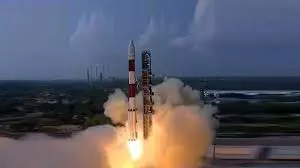
NELLORE: India during 2024 witnessed the highest number of launches since the beginning of space age, says the Indian Space Situational Assessment Report (ISSAR).
ISRO System for Safe and Sustainable Space Operations Management (IS4OM) compiled this report on April 22, 2025. ISRO chairman Dr. V. Narayanan released the ISSAR according to which there had been 261 launches attempts of which 254 had been successful, resulting in addition of 2,578 operational satellites in space.
Five lunar missions had been launched in 2024, indicating a renewed interest in lunar exploration. Further, there have been three major on-orbit break-up events in 2024. One major fragmentation of a Long March rocket stage (CZ-6A) reportedly added around 650 catalogued objects. Some of these fragments decayed within the same year, resulting in a net addition of 702 fragmented objects, taking the population of space debris by the end of 2024 to 3,665 objects.
A total of 2095 catalogued objects re-entered the atmosphere. This is also the highest number of re-entries.
In addition, the year witnessed intense solar activities as the peak of the 11-year solar cycle (Solar Cycle 25) approached. There had been 18 strong (G3 class), 20 severe (G4 class), and two extreme (G5 class) geomagnetic storms, which accelerated the orbital decay.
Although the number of satellites placed in orbit in 2024 is relatively less and a greater number of objects re-entered the atmosphere compared to the previous year, the total number of objects added to the space object population had been higher because of fragmentation events. Consequently, the growing trend in the space object population continued in 2024.
With regard to statistics of On-Orbit Indian Objects, a total of 136 Indian spacecraft, including those from private operators / academic institutions, have been launched in Earth-orbit till 31 December 2024. As per this date, the number of operational satellites owned by the Indian government is 22 in LEO (low Earth orbit) and 31 in GEO (geo-synchronous Earth orbit).
Further, two Indian deep space missions – Chandrayaan-2 Orbiter and Aditya-L1 at Sun-Earth Lagrange’s point are active. The propulsion module of Chandrayaan-3 spacecraft has continued to operate in a high Earth orbit (more than 1 lakh km away) after being relocated from its lunar orbit in November 2023.
There had been five launches from Sriharikota, namely PSLV-C58/XPoSat, PSLV-C59/PROBA-3, PSLV-C60/SPADEX, GSLV-F14/INSAT-3DS, and SSLV-D3/EOS-08 mission. All of them successfully injected the payloads into their nominally designated orbits.
ISRO's GSAT-20 had been launched by Falcon-9 Block 5 of SpaceX from Cape Canaveral. Likewise, TSAT-1A had been launched by Falcon-9. Consequently, total eight Indian satellites, one foreign satellite, and six rocket bodies (including POEM-3 and POEM-4) have been placed in their intended orbits.
